Cutting firewood separates the chainsaws that look good in a showroom from the ones that actually earn their keep. A pro arborist’s $1,400 climbing saw is overkill for a homeowner stacking three cords a year, and a $99 electric saw will burn out by Thanksgiving if you actually rely on it. The best chainsaw for firewood matches three things to your real-world use: engine displacement (or battery voltage), bar length, and how often you plan to run it. Get those right and a $400 saw cuts firewood for 15 years.
How Much Saw Do You Actually Need
Firewood cutting splits into three rough tiers, and the right saw size follows directly from how much wood you process:
- 1 to 3 cords a year — small landowner, occasional storm cleanup, weekend bucking. A 40cc to 50cc gas saw with a 16-inch bar, or a top-tier 40V to 60V battery saw
- 3 to 8 cords a year — primary heat source for a small home, or you sell a few cords. A 50cc to 60cc gas saw with an 18 to 20 inch bar
- 8 to 15 cords a year — your house runs on wood. A 60cc to 70cc pro-grade saw with a 20 to 24 inch bar, ideally a Stihl or Husqvarna pro line
Going bigger than you need is almost as bad as going smaller. A 70cc saw weighs 15 pounds bare and beats you up after three hours, while a 50cc saw at 11 pounds runs all day without fatigue.
Gas vs Battery: The Honest Comparison
Battery saws have closed the gap dramatically. For light-duty firewood work, a top-end 60V or 80V cordless from EGO, Stihl AP, Husqvarna T540iXP, or DeWalt FlexVolt cuts indistinguishably from a 40cc gas saw — until the battery dies after 30 to 60 minutes of moderate cutting. For most weekend warriors, that is plenty.
For serious firewood production where you spend a full Saturday bucking logs, gas still wins on cost-per-cut and run time. Two gallons of mixed fuel and a sharp chain produce a cord of bucked rounds in about three hours. Achieving the same with battery saws means owning four batteries minimum and a charger that runs off your truck.
Top Gas Picks for Firewood
These four saws cover the realistic homeowner range:
- Stihl MS 250 with 18-inch bar — the classic homeowner saw, $399, 45.4cc, light at 10.1 pounds, cuts cleanly through anything up to 16 inches
- Husqvarna 455 Rancher with 20-inch bar — $479, 55.5cc, the workhorse of small rural properties, 12.8 pounds
- Stihl MS 271 Farm Boss with 20-inch bar — $599, 50.2cc, anti-vibration system that pays for itself after the first long day
- Husqvarna 572 XP with 20-inch bar — $1,049, 70.7cc pro-grade, the saw to buy if firewood is half your annual heat budget
For most homeowners running 3 to 5 cords a year, the Husqvarna 455 Rancher remains the default recommendation. It has been in production for nearly two decades, parts are in every Tractor Supply, and it cuts above its price point.
Top Battery Picks for Firewood
If gas is not your thing or local restrictions push you toward electric, three battery saws stand out as the best chainsaw for firewood in their class:
- EGO Power+ CS1804 18-inch — $399 with 5Ah battery, cuts about half a cord per charge, brushless motor, surprisingly torquey
- Stihl MSA 220 C-B — $499 bare, $899 with AP 300 S battery and charger, pro-grade build quality, 30 minutes of bucking 12-inch rounds per battery
- Husqvarna 540i XP — pro arborist battery saw, $749 bare, expensive but the closest battery feel to a 50cc gas saw
Battery saws shine when you are working close to a structure (no exhaust, much quieter) and when you only run the saw for short bursts. They are not the right pick for someone cutting a full pickup load every Saturday from October to March.
Bar Length: Why Longer Is Not Better
A common firewood mistake is buying a 20-inch bar for trees that are mostly 10 to 14 inches in diameter. A bar 2 to 4 inches longer than the largest log you regularly cut is the sweet spot. Anything longer wastes power, hangs the tip into dirt during bucking, and adds weight to every cut.
For an Eastern hardwood mix (oak, ash, cherry, maple) up to about 18 inches in diameter, an 18-inch bar handles 95 percent of your work. For Western softwoods or larger hardwoods, step up to 20 inches. A 24 inch and longer bar belongs on a pro saw, not a homeowner machine.
Chain Choice Changes Everything
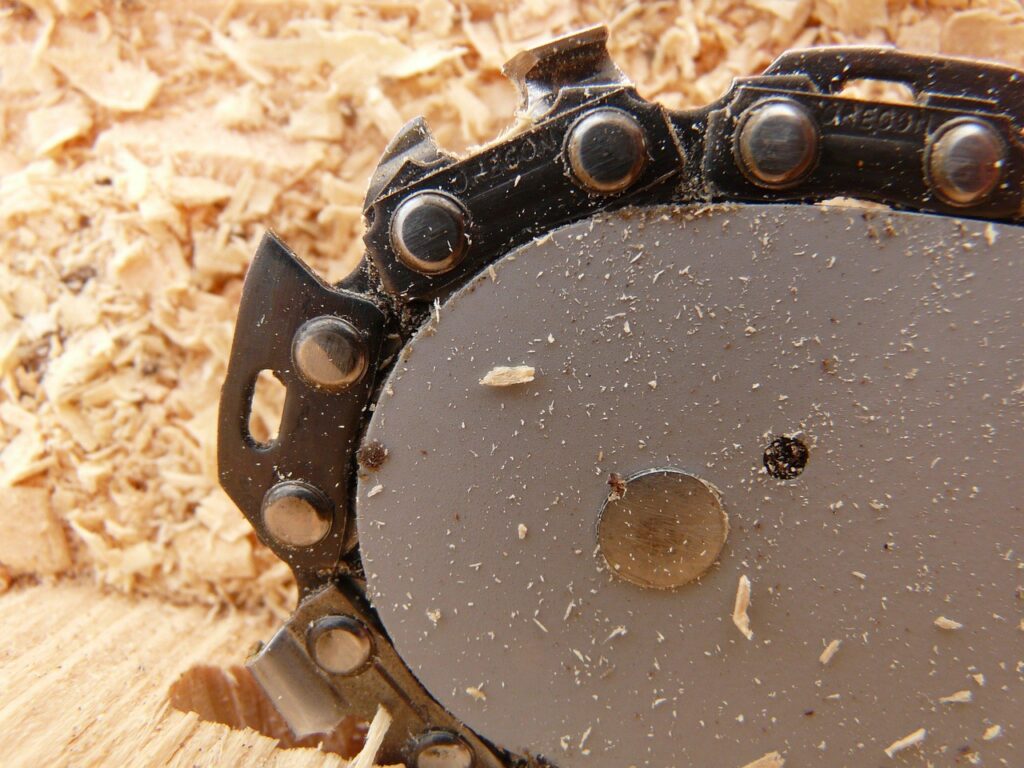
The chain matters as much as the saw. For firewood, choose a low-kickback full-chisel or semi-chisel chain in 3/8-inch pitch with .050 gauge — the most common combination on homeowner saws. Full-chisel cuts faster but dulls quickly in dirty wood. Semi-chisel holds its edge longer and is the right call for storm cleanup where bark carries grit.
Sharpen the chain every two to three tanks of fuel. A dull chain produces sawdust instead of chips and forces the saw to work twice as hard. A $40 file kit and 20 minutes per session keeps any saw cutting like new for years.
Essential Accessories
Budget for these on the same day you buy the saw:
- Kevlar chainsaw chaps — $80 to $120, non-negotiable safety gear
- Forestry helmet with face screen and ear muffs — $50 to $90
- Steel-toe boots, ideally with cut-resistant uppers
- 2.5-gallon gas can plus 1-quart bar oil bottle
- Felling wedges, a small hatchet, and a scrench (combo wrench/screwdriver)
- Extra chain or two and a sharpening file kit
Plan another $300 to $400 for safety gear and consumables on top of the saw itself. That is the real first-year cost of getting into firewood cutting, and it pays back in heating bills within one or two seasons for most rural homeowners.
Maintenance Habits That Double Lifespan
Empty the gas tank before storing any saw for more than two weeks — modern ethanol fuel turns to varnish and gums up the carburetor. Drain bar oil too if you store the saw on its side. Pop the air filter every five tanks and brush it clean with a soft toothbrush. Replace the spark plug annually. Check the bar oiler every time you refuel — running a bar dry kills the chain and the bar in a single tank.
Treat the saw well and the best chainsaw for firewood for your situation will outlast the truck you haul wood in. Treat it badly and even a $1,000 pro saw is junk in three years.