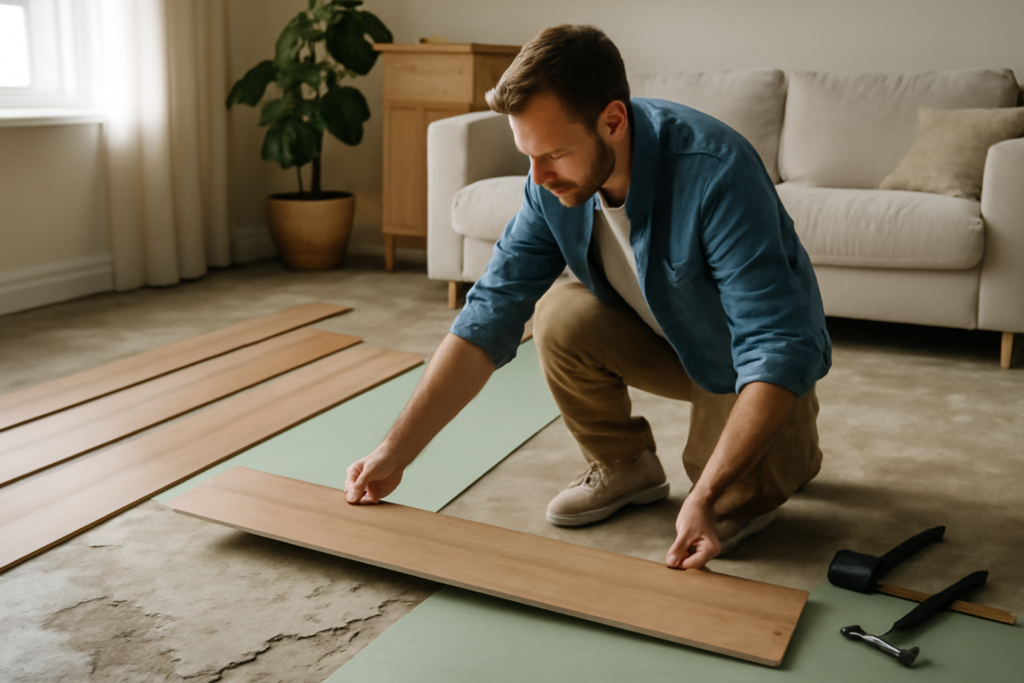
Most concrete slabs in homes built before 2000 are not flat enough for modern flooring. Industry tolerance for rigid-core LVP and engineered hardwood is 3/16 inch over 10 feet, and a typical 1985 basement slab can wave 1/2 inch or more across the same span. Picking the best flooring for uneven concrete means either accepting a product that handles imperfection or budgeting for self-leveler before any plank goes down. Both paths work; the wrong combination wastes money fast.
- Measure Before You Shop
- Top Pick: WPC Rigid-Core LVP
- Second Pick: Floating Engineered Hardwood
- Third Pick: Thick Floating Laminate
- Self-Leveling Compound: When You Need It
- What to Avoid on Uneven Concrete
- Spot Patching vs Full Leveling
- Subfloor Moisture First, Always
- Cost Comparison for a 500 sq ft Basement
- Climate and Seasonal Considerations
- Installation Tips That Save Floors
- Final Verdict
Measure Before You Shop
Pull a 10-foot straightedge across the slab in multiple directions. Note the maximum gap between the straightedge and the floor. Less than 3/16 inch over 10 feet: you can install almost anything. Up to 3/8 inch over 10 feet: stick to forgiving products or selective patching. Over 3/8 inch: full self-leveler is the smart move regardless of product.
A laser level set on the floor reveals slope direction. Most basement slabs slope toward a drain, which is fine if the slope is consistent. Random waves are the bigger problem because they can both peak and dip within the same 10-foot run.
Top Pick: WPC Rigid-Core LVP
Wood Plastic Composite (WPC) LVP, the slightly softer cousin of SPC, handles uneven concrete better than almost any other category. The thicker WPC core (typically 8-10mm) bridges minor dips that would telegraph through thinner SPC or laminate. The closed-cell foam structure also adds give underfoot, which masks slight subfloor irregularities.
Top WPC products: COREtec Plus Premium ($5.99-$7.49 per sq ft), Mannington Adura Max ($4.99-$6.49 per sq ft), Shaw Floorté Pro WPC lines ($4.79-$6.29 per sq ft). All carry pre-attached cork or IXPE underlayment and Uniclic 2G click systems. Tolerance is typically 3/16 inch over 10 feet, but the WPC core forgives a bit beyond that.
Second Pick: Floating Engineered Hardwood
Click-lock engineered hardwood floats over uneven concrete more forgivingly than glue-down. Products like Kährs Avanti, Mirage Floor’s Lock System, and Mohawk’s Engineered Click line use 9-15mm thick boards with reinforced click profiles that bridge minor variations.
The pre-attached underlayment varies by brand; some include 2-3mm IXPE foam, others require a separate underlay. For uneven concrete, a 5-6mm cork or rubber underlayment improves performance dramatically. Total install over uneven slab runs $7-$12 per sq ft material plus underlayment.
Third Pick: Thick Floating Laminate
12mm-14mm laminate planks, especially those with reinforced click systems, handle moderate slab irregularities better than thinner laminate. Pergo Outlast Plus 12mm, Mohawk RevWood Plus, and Quick-Step Premium 12mm are appropriate for slabs up to 1/4 inch wave per 10 feet.
Pair with a quality 3-5mm acoustic underlayment (Roberts Super Felt, QuietWalk Plus, or similar). Skip the cheap 2mm foam, which compresses under furniture and exposes every slab dip within a year.
Self-Leveling Compound: When You Need It
For slabs with more than 3/8 inch deviation per 10 feet, self-leveling compound (SLC) is the right answer. Modern SLCs like LATICRETE NXT Level Plus, Mapei Ultraplan 1 Plus, and ARDEX K 15 pour like pancake batter and self-flatten to within 1/32 inch tolerance.
Cost: $0.85-$1.40 per sq ft for material, plus $0.50-$1 per sq ft for primer and prep. DIY install is feasible for handy homeowners with one or two helpers because timing matters (most SLCs flow only 15-25 minutes after mixing). Pro install runs $2-$4 per sq ft total for product plus labor.
What to Avoid on Uneven Concrete
Glue-down LVT or sheet vinyl (without leveling): the adhesive amplifies every slab variation, and ridges telegraph through the wear layer within months. Glue-down only works on slabs prepped to 1/8 inch over 8 feet tolerance.
Ceramic or porcelain tile: tile is rigid and unforgiving. A slab dip causes uneven thinset bed, hollow spots, and eventual tile cracks at lippage points. Always self-level before tile, never tile over uneven slab.
Solid hardwood: nail-down or glue-down solid wood requires near-perfect substrate. The wood itself is too rigid to bridge dips, and uneven contact causes seasonal squeaks and movement. Skip solid for any slab outside tight tolerance.
Thin (4-5mm) SPC LVP: the dense rigid core transmits every irregularity. Only consider thin SPC after full self-leveling.
Spot Patching vs Full Leveling
For slabs with isolated dips (a single 1-by-2 foot low spot, a hairline crack, or a gouge), spot patching with a pourable repair compound works. Mapei Planiprep ET, Henry 547 UniPro, or DAP Patch & Repair handle small areas at $5-$15 per kit.
For widespread irregularity (waves across most of the room), spot patching is a waste of time. Full self-leveler costs more upfront but produces a flat substrate that supports any flooring choice. The cost difference is often $400-$800 for a 500 sq ft basement, which is small relative to total project cost.
Subfloor Moisture First, Always
Even the most forgiving flooring fails over a wet slab. Test moisture per ASTM F1869 (calcium chloride) or F2170 (RH probe) before any product goes down. Above 5 lbs per 1,000 sq ft per 24 hours: install a vapor barrier. Above 8 lbs: address foundation drainage or use sealed-perimeter systems.
Self-leveler does not waterproof. It bonds to the slab and reflects upward moisture into whatever flooring you install on top. Use a separate moisture mitigation primer (Mapei ECO Prim Grip or LATICRETE NXT Vapor Reduction Coating) if needed.
Cost Comparison for a 500 sq ft Basement
- WPC LVP no leveling: $3,000-$3,800 turnkey
- WPC LVP with full SLC: $4,200-$5,200 turnkey
- Floating engineered hardwood with SLC: $5,500-$7,500 turnkey
- 12mm laminate with SLC: $3,800-$4,800 turnkey
- Tile (always with SLC): $5,500-$8,500 turnkey
Climate and Seasonal Considerations
Self-leveler cure times vary with humidity. Install at 60-80°F and 40-60% RH for predictable cure. Cold dry conditions slow cure, hot humid conditions accelerate it. Plan SLC pours for shoulder seasons (spring or fall) when conditions stabilize.
Floating floors over uneven concrete also benefit from acclimation per manufacturer specs (48-72 hours) plus full HVAC operation during and after install. Climate transitions amplify substrate issues; running steady HVAC keeps the floor stable.
Installation Tips That Save Floors
Pull from 4-6 boxes simultaneously to randomize plank lengths and shade variation, which masks any subfloor irregularity by visually breaking up the field. Stagger end joints by at least 12 inches, ideally 16-24 inches.
Maintain 5/16 inch expansion gap at every wall and fixed object. On uneven slabs, the floor moves slightly more seasonally, and pinched edges fail faster than on flat slabs.
Use a tapping block and pull bar for clean click-engagement. Excessive hammer force chips the locking edge, which compromises long-term seam integrity.
Final Verdict
The best flooring for uneven concrete is WPC rigid-core LVP for tolerance up to 3/8 inch deviation, or any product over fully self-leveled slab beyond that. Skip glue-down vinyl, ceramic tile, and solid hardwood without leveling. Test slab moisture first, measure deviation second, then pick product or leveling strategy third. The total cost difference between cheap-and-failing vs done-right is usually $1,000-$2,000 on a typical basement, which beats the $4,000-$6,000 cost of redoing a failed install two years later.