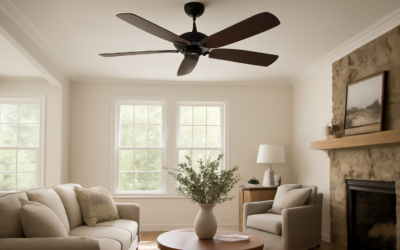
A ceiling fan can let you raise your thermostat by about 4 degrees with no drop in comfort, trimming your cooling bill while the room actually feels better. But picking from hundreds of models is harder than it should be. The best indoor ceiling fans match the right blade span and airflow to your room size, run quietly, and move enough air to make a real difference. After comparing dozens across living rooms, bedrooms, and kitchens, I’ve boiled the decision down to a few key specs and a short list of standout picks. This guide covers everything you need to choose well.
Why Ceiling Fans Still Matter
Fans don’t lower the air temperature; they create a wind-chill effect that makes your skin feel cooler. That lets you set the AC higher and save energy, while in winter, reversing the fan to spin clockwise pushes warm air down from the ceiling.
A modern DC-motor fan uses as little as 30 watts on high, a fraction of what air conditioning draws. Run it only in rooms you’re actually using, since fans cool people, not spaces, and turning one off in an empty room saves wasted energy.
Sizing the Fan to Your Room
Blade span is the single most important sizing factor, and getting it wrong leaves a room either under-cooled or overwhelmed. Match the diameter to your square footage.
- Up to 75 sq ft (bathrooms, breakfast nooks): 29 to 36-inch fans.
- 76 to 175 sq ft (bedrooms, kitchens): 42 to 48-inch fans.
- 176 to 350 sq ft (living rooms, large bedrooms): 52 to 56-inch fans.
- Over 350 sq ft (great rooms): 60-inch or larger, or two fans.
Also mind the ceiling height. For 8-foot ceilings, use a low-profile flush-mount (hugger) fan; for higher ceilings, add a downrod so the blades sit 8 to 9 feet off the floor for best airflow.
Airflow and CFM Explained
Cubic feet per minute (CFM) measures how much air a fan moves, and it’s the number to compare for real cooling power. A good fan moves 4,000 to 6,000 CFM, while high-performance models push past 7,000.
Don’t judge a fan by blade count alone; more blades look fuller but don’t automatically move more air. Motor quality and blade pitch (the angle of the blades, ideally 12 to 15 degrees) matter more. Check the efficiency rating too, expressed as CFM per watt, where higher means more air moved per unit of electricity.
DC vs. AC Motors
The motor type shapes performance, noise, and running cost. Traditional AC motors are cheaper upfront and perfectly reliable. Newer DC motors cost more but use up to 70 percent less energy, run noticeably quieter, and usually offer more speed settings plus a remote.
If the fan will run for hours every day, a DC motor pays for itself over time through lower energy use and delivers a smoother, quieter experience. For an occasional-use guest room, a solid AC motor is the economical choice.
Top Picks for 2026
These models balance airflow, noise, looks, and value across different needs and budgets.
- Hunter Dempsey 44-inch (around $150): A quiet, low-profile pick for bedrooms and mid-size rooms, with a clean look and integrated LED.
- Minka-Aire Light Wave 52-inch (around $300): A whisper-quiet DC-motor fan that moves strong airflow for living rooms.
- Big Ass Fans Haiku 52-inch (around $700): Premium DC motor, exceptionally quiet and efficient, with smart-home integration.
- Honeywell Carnegie 52-inch (around $130): A budget-friendly industrial-look fan with solid airflow for the price.
Features Worth Paying For
A few extras genuinely improve daily use. Integrated LED light kits save you from buying separate fixtures and deliver dimmable, efficient lighting. Remote controls and smart-home compatibility let you adjust speed and reverse direction without a wall switch.
Look for a reversible motor so you can run the fan clockwise in winter to recirculate warm air. Multiple speed settings (at least three, ideally six on DC models) give you finer control. A quiet motor with sealed bearings is worth seeking out, since a noisy fan in a bedroom defeats the purpose.
Installation and Safety Basics
Ceiling fans weigh more than light fixtures, so they must hang from a fan-rated electrical box, not a standard one. If you’re replacing a light with a fan, verify the box is braced and rated to support a fan’s weight and motion, or install a fan brace from the attic or through the ceiling.
Maintain at least 7 feet of clearance from the floor to the blades and 18 inches from the blade tips to the nearest wall. Turn off the breaker before wiring, and if you’re not comfortable with electrical work or the box isn’t fan-rated, hire an electrician; a fan that pulls loose is dangerous.
Matching Fan Style to Your Decor
A ceiling fan is hard to hide, so its look should suit the room. Modern spaces pair well with sleek, low-profile fans in matte black, brushed nickel, or white, often with two or three blades and integrated LED panels. Farmhouse and rustic rooms call for wood-tone blades and aged-bronze or galvanized finishes.
Traditional rooms suit classic five-blade fans with a light kit and a polished metal finish. In a kid’s room or a casual den, a fun caged or industrial design adds character. Whatever the style, make sure performance still leads the decision; a gorgeous fan that barely moves air is just expensive ceiling jewelry.
Maintenance and Longevity
Ceiling fans ask for almost nothing, but a little care keeps them quiet and efficient. Dust the blades every few weeks, since buildup unbalances them and reduces airflow; an old pillowcase slipped over each blade catches dust without scattering it. A wobbling fan usually just needs a blade-balancing kit, a cheap clip-and-weight set that solves the most common annoyance.
Tighten the mounting and blade screws once a year, because vibration slowly loosens them over time. Quality fans with sealed bearings run for 10 to 15 years or more with this minimal upkeep, making them one of the best long-term comfort investments in a home.
Making the Final Choice
Start by measuring your room and matching the blade span, then compare CFM among fans in that size range to find the strongest, most efficient airflow. Choose a DC motor for rooms you use daily and an AC motor to save money on occasional-use spaces. The best indoor ceiling fans aren’t necessarily the most expensive; they’re the ones correctly sized for your room, quiet enough not to notice, and efficient enough to actually lower your cooling bills all summer long.