
Burglary attempts drop sharply on well-lit properties. That is not marketing copy — it is decades of FBI Uniform Crime Reporting data. But the best outdoor security lighting setup is not about brightness alone. Lumens, beam angle, motion sensor placement, IP rating, and color temperature all matter, and getting any one of them wrong leaves you with floodlights that either blind your guests or never trigger when someone walks up the driveway. Here is the realistic breakdown a contractor would give a homeowner.
Part of our Windows & Doors guide — explore the full guide →
- Lumens, Beam Angle, and Color Temperature
- Motion-Activated Floodlights: The Workhorses
- Solar Security Lights: When They Make Sense
- Hardwired Camera Systems for Full Coverage
- Pathway and Step Lighting
- Installation, Wiring, and Code Considerations
- Smart Integration and Automation
- Budget Recommendations by Property Size
Lumens, Beam Angle, and Color Temperature
Before you pick a product, set targets. For driveway and yard floodlights, you want 2,500 to 3,500 lumens covering a 120-degree spread. For a porch or doorway, 700 to 1,200 lumens is plenty and avoids glare. For pathway lights, 50 to 100 lumens per fixture is the sweet spot — anything brighter washes out the landscape.
Color temperature is measured in Kelvin. Stick to 4000K to 5000K for security applications. The cooler white reveals detail on a camera and triggers a stronger psychological deterrent. Warm 2700K bulbs look pleasant but reduce surveillance footage quality and feel less alarming to a trespasser. Avoid anything above 5500K — the harsh blue cast violates dark sky ordinances in many municipalities and bothers neighbors.
Motion-Activated Floodlights: The Workhorses
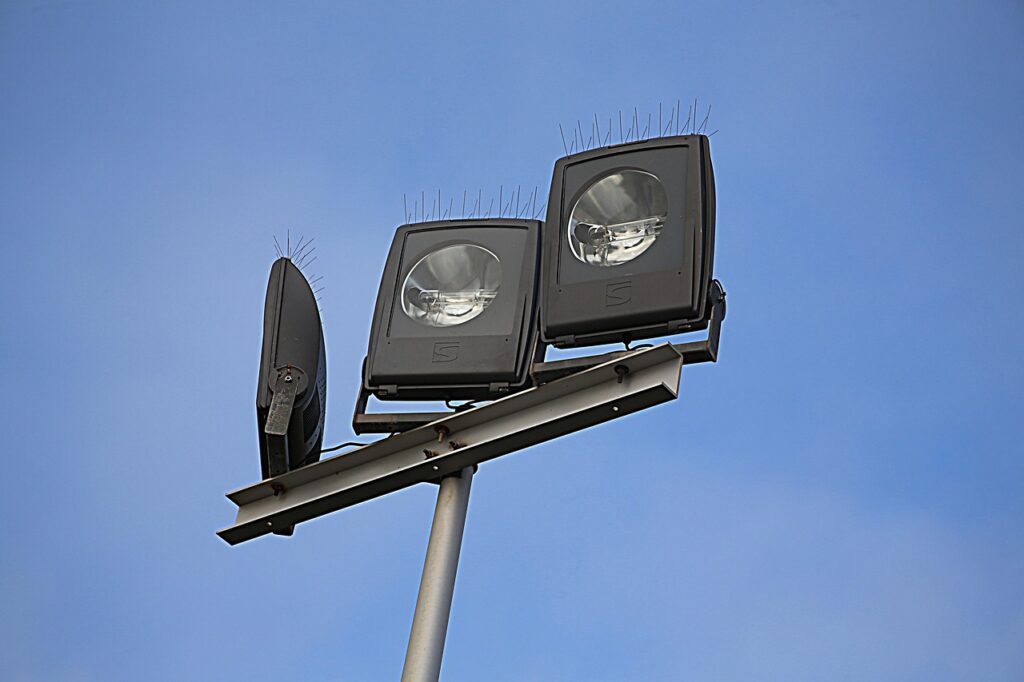
For perimeter coverage, motion-activated floodlights are the foundation of any system. The two units that consistently top contractor recommendations are the Ring Floodlight Cam Pro and the LEPRO Smart Floodlight.
The Ring Floodlight Cam Pro ($230) puts out 2,000 lumens across two LED heads, includes a 1080p camera, and integrates with Alexa or the Ring app. Motion detection is highly customizable — you can carve out zones to avoid triggering on a passing car. Hardwire installation only, on an existing outdoor junction box.
The LEPRO Dusk-to-Dawn Floodlight ($45) skips the camera and delivers 3,500 lumens of pure illumination at 5000K with PIR motion sensing up to 49 feet. Two-head design covers a 270-degree arc. For straight security without smart features, it is the better value per lumen.
Heath Zenith and Defiant (Home Depot’s house brand) make hardwired motion floodlights in the $30 to $80 range. They work but use 1990s-era PIR sensors with high false-trip rates. Spend the extra $20 for a digital PIR.
Solar Security Lights: When They Make Sense
Solar fixtures eliminate the wiring headache. They work well at the property perimeter, the side of a garage, or anywhere a 120V circuit is impractical. The Aootek 182 LED Solar Light ($35 for a 2-pack) puts out 800 lumens at full brightness, runs four hours on a single charge, and includes a 270-degree PIR sensor.
For higher-output solar, the Gama Sonic Solar Floodlight ($85) delivers 1,200 lumens with a separate solar panel that lets you mount the fixture in shade. Battery life claims of “two years” assume light usage in southern climates; northern installs in Michigan or Maine see degraded performance from October through March.
Solar fixtures struggle in three situations: shaded mounting locations, sub-freezing temperatures (lithium battery capacity drops 30 to 50% below 32°F), and ten or more consecutive cloudy days. For mission-critical security applications, hardwired beats solar every time.
Hardwired Camera Systems for Full Coverage
Standalone floodlights handle the easy zones. For driveway, side yard, and any blind spot, integrated camera floodlights pull double duty. The Reolink RLC-823A Floodlight ($230) provides 4K resolution, full-color night vision via dual spotlights, and works on PoE (Power over Ethernet) so a single Cat6 cable handles power and video.
The Eufy Floodlight Camera 2K Pro ($300) offers 3,000 lumens, AI person detection, and local storage — no monthly fee. Solar charge connection is optional. For larger properties, Lorex 4K wired systems with four to eight cameras run $700 to $1,500 and integrate with a network video recorder for 30 days of footage retention.
Wired beats wireless when reliability matters. Wireless cameras drop offline during router reboots, lose signal in heavy rain, and run on batteries that always seem to die at the worst time.
Pathway and Step Lighting
Path lights serve a different purpose — they guide guests and reveal anyone approaching the entry. Low-voltage 12V LED systems from Volt Lighting, Kichler, and Vista Pro run $25 to $60 per fixture with a 75 to 300 watt transformer handling the whole run. Plan for 50 to 75 watts of load capacity per 100 feet of low-voltage cable.
Solar path lights are widely available at Home Depot and Costco for $20 to $40 per six-pack, but you get what you pay for. Battery life drops dramatically after 18 months and the plastic stakes crack in cold climates. Hampton Bay solar path lights are the most common choice but typically last only two seasons.
Installation, Wiring, and Code Considerations
Outdoor wiring is governed by NEC Article 590 for temporary installs and Article 410 for permanent fixtures. Three rules drive most code violations:
- Every outdoor receptacle must be GFCI protected per NEC 210.8(A)(3).
- Junction boxes outdoors must be rated for wet locations and labeled with the “WP” designation.
- Cable runs in landscaping must be either direct-burial UF-B at 18 inches below grade, or THHN in PVC conduit at 18 inches.
For mounting height, install motion floodlights 8 to 10 feet above grade. Too low and intruders can reach up to unscrew the bulb. Too high and the PIR sensor cone shoots over their head. Aim the heads slightly downward (30 to 45 degrees) for the widest effective coverage area.
IP rating matters. Look for IP65 or IP66 on any fixture exposed to direct weather. IP65 means dust-tight and resistant to water jets from any direction. IP44 is fine under eaves but will fail within two years of direct rain exposure.
Smart Integration and Automation
Adding security lights to your smart home is straightforward with the right ecosystem choice. Ring lights tie into Alexa naturally and let you trigger groups of lights when any motion sensor activates. Philips Hue Outdoor (the Lily spotlight at $130 each, the Calla bollard at $200) integrates with Google Home, Alexa, and Apple HomeKit but assumes you already own a Hue Bridge.
Set up automations that turn all exterior lights on at full brightness when an outdoor camera detects a person between 10 PM and 6 AM. Pair the lighting trigger with a phone notification and an interior light strobe — a 60-decibel chime indoors is a stronger deterrent than the lights alone.
Budget Recommendations by Property Size
For a 1,200 to 1,800 sq ft suburban home, a working setup runs $300 to $600 total. Two LEPRO motion floodlights cover the front and back perimeters, two Ring Path Lights flag visitors on the driveway approach, and a single Ring Floodlight Cam Pro records the main entry.
For larger 2,500 to 4,000 sq ft properties with detached structures, plan on $800 to $2,000. Add a Reolink PoE camera at the garage, two motion floodlights at side yards, and a low-voltage Volt Lighting kit for the landscaping. For rural properties on 5 acres or more, hardwire is non-negotiable and the budget climbs to $2,500 or higher with proper trenching and conduit. Whatever the property, layered lighting with motion triggers beats a single high-output flood every time.


