Fiberglass batts fail in the gaps. Every wire, pipe, and outlet box they get stuffed around leaves a void, and studies of real-world installations routinely find batt walls performing 15 to 30 percent below their rated R-value. BIBS insulation — the Blow-In Blanket System — was developed to close those gaps for good. Instead of pre-cut batts, installers staple a tough fabric netting over open stud bays and blow specially graded fiberglass behind it under pressure, packing every cavity, corner, and gap around obstructions into one dense, seamless blanket. The result is R-15 in a 2×4 wall and R-23 in a 2×6 wall with essentially zero voids. Here’s how the system works and whether it’s worth the premium over batts.
How the Blow-In Blanket System Works
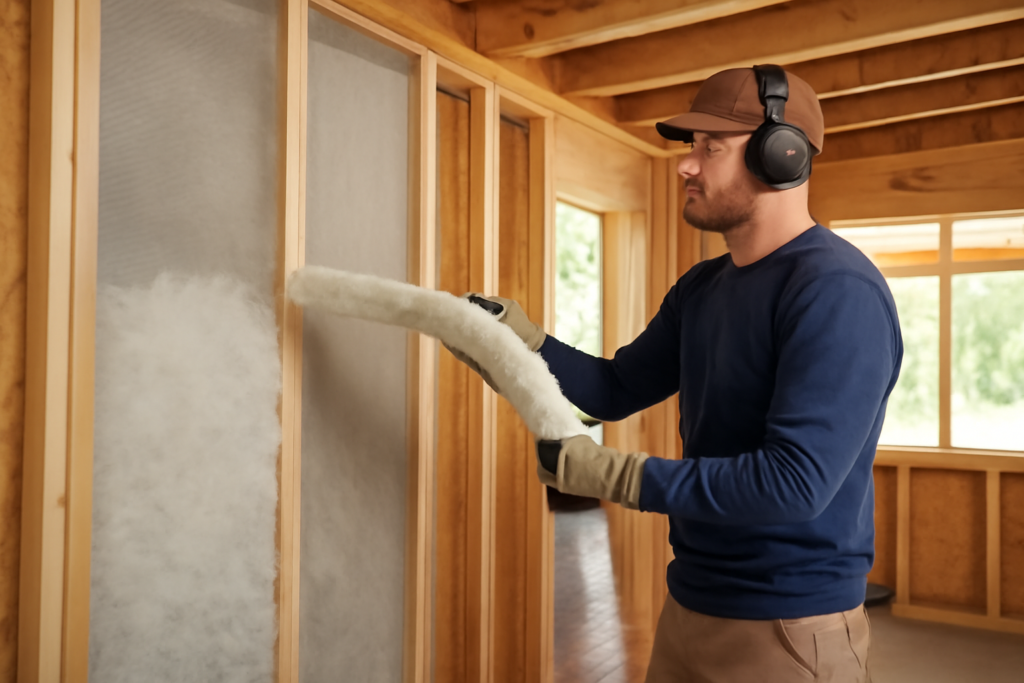
BIBS is a patented, certified system rather than a generic technique — contractors are trained and licensed, and the fiberglass used is a specific white virgin-glass blowing wool (Johns Manville Spider Plus and CertainTeed OPTIMA are the common approved fibers). Installation happens after rough-in inspections and before drywall, in four steps: installers staple a translucent polypropylene netting across the face of the studs, cut a small slit in each cavity, insert the blower hose, and fill the bay at a controlled density of about 1.8 to 2.2 pounds per cubic foot. A roller then flattens any pillowing so drywall lies flat.
Density is the magic word. At roughly twice the density of a standard batt, the packed fiber can’t settle, slump, or leave the top-of-wall gaps that plague loose-fill retrofits. And because the material flows as thousands of small tufts, it wraps completely around romex runs, plumbing, and electrical boxes — the exact places batts get butchered. Third-party testing on BIBS walls consistently shows the installed assembly hitting its rated R-value, which is precisely what batt walls struggle to do outside a laboratory.
R-Values and Performance Numbers
Blown fiberglass at BIBS density delivers about R-4.2 per inch, noticeably better than the R-3.1 to R-3.7 of low-density batts. In framing terms:
- 2×4 wall (3.5 in): R-15
- 2×6 wall (5.5 in): R-23
- 2×8 wall (7.25 in): R-30
- Cathedral/scissor truss cavities: filled to depth, commonly R-38+
Beyond raw R-value, the dense pack meaningfully cuts air movement within the cavity — not a true air barrier, but enough convection suppression to improve real-world performance in cold, windy weather where batts lose the most. Sound is the sleeper benefit: a dense-packed BIBS wall improves STC ratings several points over batts, which is why the system shows up in home theaters and bedroom party walls. The fiber is inorganic glass, so it doesn’t feed mold, doesn’t appeal to pests, and is naturally noncombustible — no added fire retardants or borates to off-gas or corrode.
What BIBS Insulation Costs
Expect to pay $1.00 to $2.00 per square foot of wall area installed for new-construction BIBS in 2026 — commonly quoted around $1.25 to $1.75 for 2×6 walls. Comparison points: fiberglass batts run $0.65 to $1.20 installed, damp-spray cellulose lands in similar territory to BIBS, open-cell spray foam runs $1.50 to $2.50, and closed-cell spray foam $2.50 to $4.50+. For a typical 2,400 square-foot house with about 2,800 square feet of exterior wall, that’s roughly $3,500 to $5,000 for BIBS versus $2,200 to $3,000 for batts — a $1,500 to $2,000 premium for a measurably better wall.
Because BIBS is a licensed system requiring a blowing machine and trained crew, this is not a DIY line item, and pricing varies with local installer competition. Get quotes from at least two certified BIBS contractors (the BIBS Council maintains installer listings) and ask specifically for the installed density and a certificate of the design R-value — reputable crews weigh bags against filled volume to verify they hit spec.
Where BIBS Makes the Most Sense
New construction and full gut-remodels are the system’s home turf, since it needs open cavities faced with netting. It particularly earns its premium in:
- Complex framing: gables, angled walls, arched openings, and heavily plumbed/wired bays where batts can’t be fitted cleanly
- Cold climates: zone 5 and up, where closing convective gaps pays back fastest
- Quality-focused builds: ENERGY STAR and performance-tested homes, because BIBS reliably achieves RESNET Grade I installation — the top installation grade, worth real points in HERS scoring
- Sound-sensitive rooms: theaters, offices, walls against garages
- Vaulted ceilings: netting lets installers fill deep sloped cavities that batts bridge poorly
For closed existing walls, standard BIBS doesn’t apply — that’s the territory of dense-pack cellulose or blown fiberglass injected through drilled holes, a related but different retrofit method. If a contractor quotes “BIBS” for closed walls, clarify what they actually intend to install.
BIBS vs Batts, Cellulose, and Spray Foam
Against batts, the case is straightforward: BIBS costs 40 to 70 percent more and delivers the R-value the batts only promise. Against dense-pack cellulose, it’s closer to a tie on performance and price; cellulose offers recycled content and slightly better sound damping, while BIBS fiberglass is lighter on framing, completely inorganic (no concerns about moisture-holding or settling if a leak wets the wall — glass dries without degrading), and dust-free once installed. Many builders simply use whichever system their best local crew installs.
Spray foam is the aspirational comparison. Closed-cell foam brings a class-leading R-6.5 to R-7 per inch plus genuine air sealing and vapor control, but at two to three times BIBS pricing, with combustion byproduct and trimming waste considerations. The pragmatic high-performance combo many builders now spec: a dedicated air-sealing pass (caulk, gaskets, taped sheathing) plus BIBS in the cavities. You get 90 percent of the foam wall’s real-world performance for roughly half the money — because once air leakage is handled separately, dense-packed fiberglass gives up very little to foam in a wall cavity.
Moisture, Fire, and Longevity
Durability questions deserve straight answers because walls are sealed for decades. On moisture: blown fiberglass neither absorbs water into the fiber nor wicks it the way cellulose can, so an incidental leak — a wind-driven rain event, a plumbing weep — drains and dries through the assembly without destroying the insulation. The netting is vapor-open, and the system pairs with whatever vapor retarder your climate zone calls for (kraft-faced strategy is replaced by smart membranes or painted drywall in most BIBS specs). On fire: the glass fiber is noncombustible and melts above 1,000°F, contributing nothing to flame spread — one reason insurers and code officials have no notes on the system after four decades of use.
Longevity data is reassuringly boring. BIBS installations from the late 1980s, when the system was patented, show no measurable settling on inspection because dense-packed fiber is held in compression by the cavity itself. There’s no food value for insects or rodents, no chemical off-gassing, and no maintenance schedule. Once the drywall goes on, the wall is simply done for the life of the building.
Questions to Ask Your Installer
Quality control is what you’re buying, so verify it. Ask whether the crew is BIBS-certified and which approved fiber they blow. Ask the target density and how they verify it (bag-count per cavity volume is the honest answer). Confirm the netting will be rolled flat and any pillowed bays corrected before drywall — drywallers hate fighting a bulged wall, and flattening after the fact is miserable. Confirm they’ll fill around all penetrations rather than skipping congested bays, and get the final R-value certificate for your records and any energy-program paperwork.
Schedule matters too: BIBS goes in after electrical, plumbing, and HVAC rough-ins pass inspection, and a typical house takes a two-person crew one to two days. If your builder plans insulation the day before drywall, make sure those trades are genuinely finished — blowing a wall and then opening it for a forgotten wire wastes everyone’s week.
The Verdict
BIBS insulation solves the oldest problem in wall insulation: the gap between rated and installed performance. For a premium of roughly a third over batts, you get a void-free, settle-proof, quieter wall that actually delivers its R-15 or R-23 — verified by the installation grade systems energy raters use. It isn’t the right tool for closed walls, and it isn’t an air barrier, but paired with basic air sealing it’s one of the best value plays in new-construction insulation. If you’re building or gutting in a heating climate and the batt quote and BIBS quote are on the table side by side, the blanket is usually the smarter check to write.