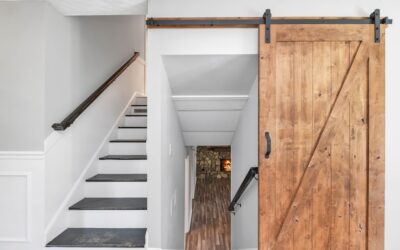
Standard sliding barn doors need a wall of open space beside the opening to park the door, and that is where most homeowners hit a wall, literally. A bifold barn door hardware kit solves the clearance problem by folding the door in half as it slides, so a wide closet or pantry gets barn-door style even in a cramped hallway. It combines the rustic look people love with the practicality of a folding door that tucks neatly out of the way.
Part of our Windows & Doors guide — explore the full guide →
How a Bifold Barn Door Works
Instead of one rigid slab, a bifold system uses two panels joined by a piano hinge. A top-mounted track carries a roller, while a guide pin at the leading edge follows a channel so the panels fold together as they open. The result is a door that needs only half its width in sideways travel, freeing up wall space for cabinets, switches, or artwork.
The hardware blends two proven systems: the rolling track of a traditional barn door and the folding action of a closet bifold. That hybrid is why these kits have surged in popularity for laundry rooms, closets, and pantries.
What Comes in a Kit
A complete kit saves you from sourcing mismatched parts. Most include the following.
- Track rail: Usually 6 to 8 feet of powder-coated steel.
- Rollers and hangers: Wheels that ride the track, rated by weight.
- Piano or continuous hinge: Joins the two panels.
- Floor or wall guide: Keeps the bottom of the door from swinging out.
- Mounting hardware: Lag bolts, spacers, and a backer board or brackets.
- Door stops and anti-jump discs: Prevent the door from rolling off the ends.
Doors are almost always sold separately. Confirm whether your kit includes the hinge, since some budget kits omit it.
Sizing and Weight Limits
Measure the opening width and buy a door assembly that overlaps the frame by 2 to 3 inches on each side for privacy and light blocking. The track should run at least double the folded door width so the panels can fully clear the opening.
Weight matters most. Typical residential kits carry 150 to 220 pounds, which handles solid pine or MDF panels. If you are hanging heavy hardwood or a glass-insert door, verify the roller rating before buying. Undersized rollers bind and wear out, causing the door to drag or jump the track.
Preparing the Wall
The track must anchor into solid framing, not drywall alone. Because studs sit 16 inches apart and the track needs continuous support, most installers mount a horizontal backer board first.
Backer Board Steps
- Cut a 1×6 board to span the opening plus the track overhang.
- Stain or paint it to match your trim.
- Locate studs and screw the board in with 3-inch structural screws at every stud.
- Mount the track to the board, which spreads the load evenly.
Installing the Door
With the track secured and leveled, the rest goes quickly. Attach the hinge to join the two panels, then bolt the rollers to the top edge of the leading panel. Lift the assembly onto the track and set the anti-jump discs so the rollers cannot lift off.
Install the floor guide last. Fold the door fully open, mark where the guide pin lands, and fasten the channel so the door stays flush to the wall. Test the swing several times, adjusting the guide until the panels fold smoothly without scraping.
Common Problems and Fixes
Most issues trace to leveling and hardware tension.
- Door drags on the floor: Raise the rollers or add spacers behind the track.
- Panels fold unevenly: Check that the hinge is straight and the guide channel is aligned.
- Rollers squeak: Apply a dry silicone lubricant, never oil, which attracts dust.
- Door swings out at the bottom: The floor guide is missing or set too loose.
Choosing the Right Door Material
The door you hang determines how the hardware performs. Lightweight hollow-core and MDF panels are the easiest on the rollers and the least expensive, making them a smart match for a standard 150-pound kit. Solid pine and reclaimed wood add character and heft, but their weight demands a kit rated well above the door’s actual mass so the rollers do not wear prematurely.
Glass-insert and mirrored panels bring light into a laundry or closet but push weight and cost up sharply. If you want glass, confirm the kit’s roller rating with a comfortable margin and consider a soft-close damper to keep the heavier door from slamming at the end of its travel.
Privacy, Sound, and Practical Limits
Barn-style doors, bifold or not, hang in front of the wall rather than sealing into a jamb, so they leave a small gap around the edges. That gap lets light and sound pass, which is fine for a pantry or laundry but a poor choice for a bathroom or bedroom where you want a tight seal.
You can narrow the gap by sizing the door to overlap the opening generously and adding a floor guide that holds the panels flush to the wall. For better sound control, choose a solid-core door over a hollow one. Keep in mind that a folding door still needs floor clearance to swing its panels, so remove any baseboard heaters or obstructions in the door’s fold path before installing.
Is a Bifold Barn Door Right for You?
If you love the barn door look but lack the wall space to park a full slab, a bifold barn door hardware kit is the smart answer. Expect to spend $80 to $200 on the kit plus the cost of the door, and budget an afternoon for a careful install. Done right, it delivers standout style and reclaims usable space in the exact rooms where clearance is tightest.