
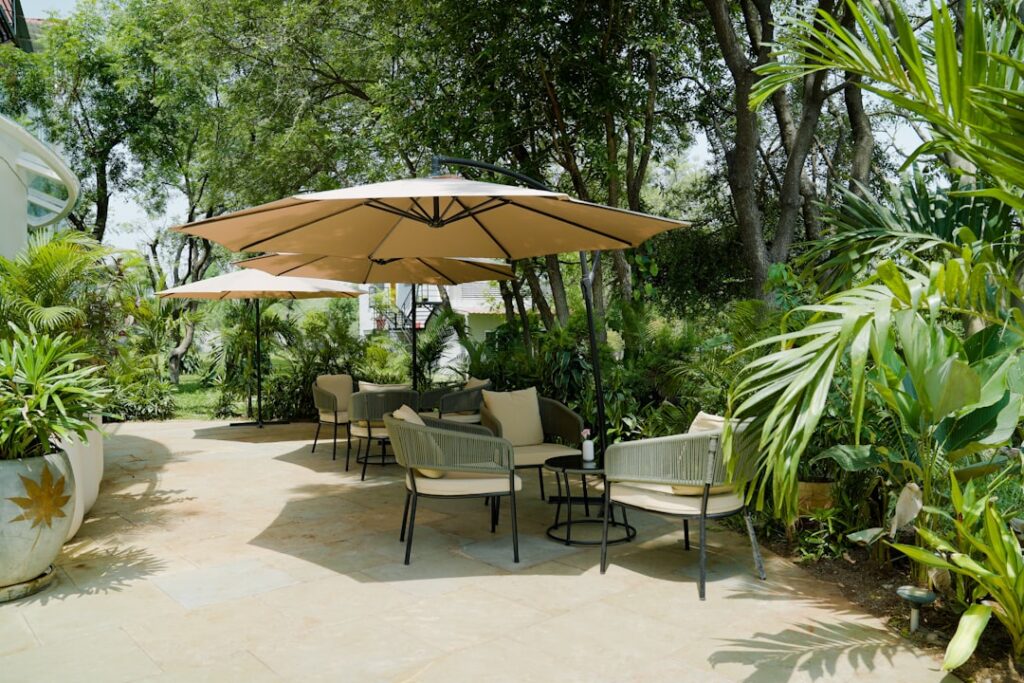
A standard 7-foot market umbrella covers a small bistro table and almost nothing else, which is why so many homeowners end up disappointed. If you want real, all-day shade, a big umbrella patio setup is the difference between sitting outside in July and retreating indoors by noon. The trick is matching the canopy size to your furniture, getting enough weight on the base, and picking fabric that does not fade after one season. Get those three things right and a large umbrella outperforms a pricey pergola at a fraction of the cost.
Part of our Decks & Outdoor guide — explore the full guide →
- What Counts as a Big Patio Umbrella
- Market vs. Cantilever: Which Big Umbrella Fits Your Space
- Anchoring: The Step Most People Get Wrong
- Fabric and Frame: What Actually Lasts
- Features Worth Paying For
- Sizing Chart for Common Patio Setups
- Care That Doubles the Lifespan
- Placement and Sun Tracking
- Common Buying Mistakes to Avoid
- The Bottom Line
What Counts as a Big Patio Umbrella
In the umbrella world, “big” generally starts around 9 feet in diameter and runs up to 13 feet for round canopies, with rectangular models reaching 8 by 11 feet. A 9-foot umbrella shades a four-seat dining set. An 11-foot model covers a six-seat table with room to spare. Cantilever (offset) umbrellas, which hang the canopy from a side arm, are often sold in 10- to 13-foot sizes because they need no center pole interrupting your table.
Think in terms of overhang. You want the canopy to extend at least 2 feet past the edge of your seating on all sides, because the sun moves and shade shifts through the afternoon. For a 48-inch round table, a 9-foot umbrella is the practical minimum.
Market vs. Cantilever: Which Big Umbrella Fits Your Space
Center-pole market umbrellas are the affordable workhorses. They run a center mast through a hole in the table and a heavy base, and they handle moderate wind well because the load sits low. Expect to pay $80 to $300 for a quality 9- to 11-foot model.
Cantilever umbrellas mount the pole off to one side and swing the canopy over open space, so you can shade a lounge area, a hot tub, or a table without a center hole. They are more flexible and more dramatic, but they cost more ($200 to $700) and need substantially more base weight, often 150 to 220 pounds, to stay upright.
- Market umbrella: best for dining tables with a center hole, lower cost, easier to anchor.
- Cantilever umbrella: best for open seating, sofas, or pools, tilts and rotates, needs a heavy weighted base.
Anchoring: The Step Most People Get Wrong
A big canopy acts like a sail. A 9-foot market umbrella needs a base of at least 50 pounds when used freestanding, or 30 to 40 pounds if the pole also passes through a table for added stability. Step up to 11 feet and you want 75 pounds or more. Cantilever models routinely require 4 fillable base plates loaded with sand or paver weights totaling 175-plus pounds.
For permanent installations, an in-ground or deck-mounted sleeve is the most secure option. Bolt a flange to the deck or set a sleeve in concrete, and the umbrella will shrug off gusts that would tip a freestanding base. Always close and lower the umbrella before storms or sustained winds above 25 mph.
Fabric and Frame: What Actually Lasts
Canopy fabric is where cheap umbrellas reveal themselves. Solution-dyed acrylic, with Sunbrella being the best-known name, resists fading for years and is the standard for quality. Polyester fabrics cost less and start fading within a season or two under strong sun. Look for a UV rating and a canopy weight of at least 200 grams per square meter.
For the frame, aluminum is the sweet spot: rustproof, lighter than steel, and strong enough for big canopies. Powder-coated steel is heavier and can rust at scratches. Avoid bargain umbrellas with thin fiberglass ribs unless you live somewhere genuinely windless. Wood frames look beautiful but need annual sealing.
Features Worth Paying For
- Push-button or crank tilt: lets you angle the canopy as the sun drops, extending usable shade by an hour or more.
- Vented canopy: a double-tier top lets wind pass through, cutting the chance of a flip-over.
- 360-degree rotation (cantilever): follow the sun without moving furniture.
- Integrated LED lights: nice for evening dining, though battery models are dimmer than they look online.
Sizing Chart for Common Patio Setups
Use this as a fast reference when matching an umbrella to your furniture:
- Bistro or 2-seat: 7 to 7.5 feet
- 4-seat 48-inch table: 9 feet
- 6-seat rectangular table: 10 to 11 feet, or an 8-by-10-foot rectangular canopy
- Lounge or conversation set: 11 to 13-foot cantilever
- Pool or hot tub: 11-foot tilting cantilever for clearance over water
Care That Doubles the Lifespan
Close the umbrella when it is not in use, because constant sun and wind exposure ages even premium fabric. Hose off pollen and bird droppings before they stain, and spot-clean acrylic with mild soap and lukewarm water rather than a pressure washer. In winter, store the canopy indoors or use a fitted cover rated for your climate. A little maintenance pushes a good umbrella from three seasons to eight or nine.
Placement and Sun Tracking
Where you set the umbrella matters as much as how big it is. The sun travels east to west and sits lower in the sky in late afternoon, which is exactly when most people want to relax outside. If you anchor a center-pole umbrella squarely over a table, the shade will drift off the seating by 4 or 5 p.m. A tilting model buys you back that lost hour, and a rotating cantilever lets you chase the sun without dragging furniture across the patio.
For a fixed location, observe your patio at the times you actually use it before committing to a base position. South- and west-facing patios bake the longest and benefit most from the largest canopy you can anchor safely. If afternoon glare is your main complaint, position the umbrella slightly to the west of the seating so the canopy intercepts the low sun rather than sitting directly overhead.
Common Buying Mistakes to Avoid
The most frequent regret is buying too small, because online photos make 9-foot umbrellas look enormous when they barely cover a four-seat table in real life. The second is underbuying on the base, then watching the umbrella tip in the first stiff breeze. People also overpay for battery LED lights that look bright in product shots but disappoint in person, and they skip the vented canopy that dramatically lowers the risk of a flip. Finally, many shoppers fixate on price and choose polyester fabric, only to see it fade and fray within two summers. Spend where it counts: size, base weight, frame metal, and acrylic fabric.
The Bottom Line
A well-chosen big umbrella patio arrangement delivers shade, comfort, and curb appeal without the permits or expense of a roof structure. Buy a canopy at least 2 feet wider than your seating on every side, load the base heavier than the box says, and spend the extra money on solution-dyed acrylic fabric and an aluminum frame. Those choices separate an umbrella that lasts most of a decade from one you replace every other summer.


