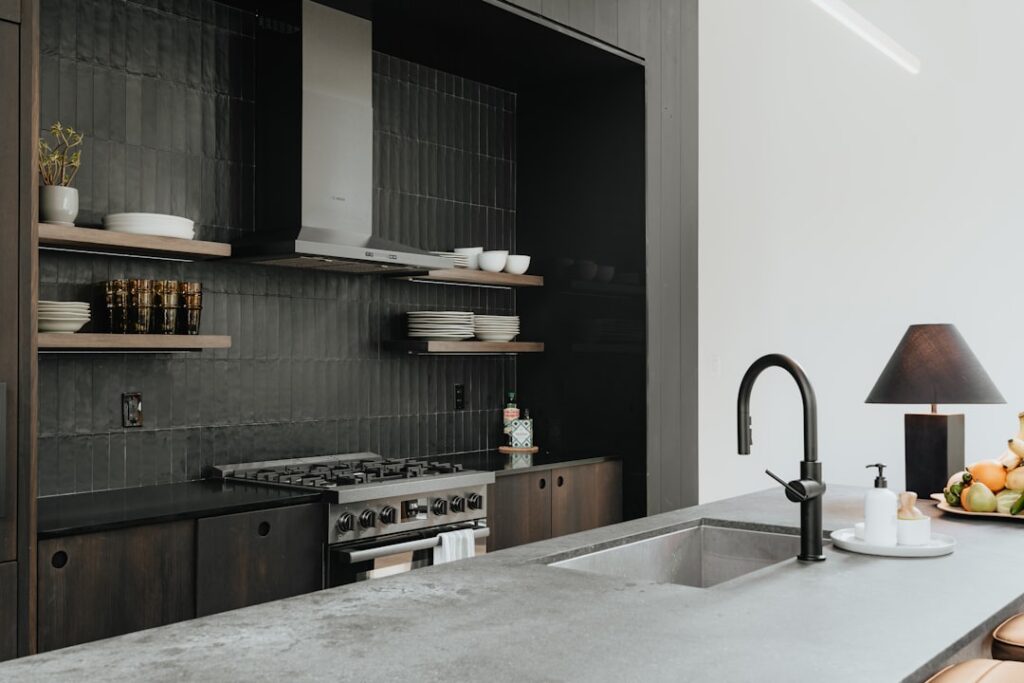
Matte black went from risky designer move to the second-best-selling faucet finish in America in under a decade, and it is not slowing down. A black kitchen faucet does something chrome cannot: it reads as an intentional design decision, anchoring the sink zone the way a black window frame anchors a wall. But black finishes are not created equal — some are bonded coatings that laugh at scratches, others are spray paint with a warranty card. This guide covers how the finishes differ, which models earn their price, and how to build a kitchen around one without the look going flat.
Part of our Kitchen Remodeling guide — explore the full guide →
Why Black Works (and Where It Struggles)
Black is the great neutral of kitchen design: it pairs with white shaker cabinets (the modern farmhouse formula), walnut and oak tones (organic modern), concrete and stainless (industrial), and colored cabinetry that would clash with warm brass. It hides better than it shows — coffee splashes and fingerprints disappear against matte black in a way they never do on polished chrome. Its weakness is mineral scale: in hard-water regions, dried droplets leave white ghosting that shows against the dark surface, so black demands either a quick daily wipe-down or soft water. If your water is very hard and your habits are casual, a brushed nickel faucet will forgive you more.
Not All Black Finishes Are Equal
Three manufacturing methods produce a “black” faucet, and durability tracks the method, not the marketing photo:
- Powder coat — electrostatically applied and baked. The most common method on quality fixtures; thick, even, and resistant to chips when done well. Delta and Moen matte black lines use durable baked finishes covered by lifetime finish warranties.
- PVD (physical vapor deposition) — metal vapor molecularly bonded in a vacuum chamber. The toughest option, essentially scratch-proof; found on premium models and often described as “matte black stainless.”
- Wet paint / e-coating on budget imports — thin, chip-prone, and unrepairable. If a no-name black faucet costs $45, this is why. One chip at the spray-head collar and the brass shows through forever.
Sheen matters too. True matte reads soft and modern; semi-gloss “onyx” finishes lean traditional; and some brands offer textured black that hides scratches best of all. Check the actual product in person when possible — “matte black” spans a surprising range between brands, which is also why mixing black components from two manufacturers rarely matches.
Top Picks by Budget
These are the models that combine proven internals with finishes that hold up:
- Best overall: Delta Trinsic Pull-Down in Matte Black (~$380 to $450). The minimalist cylinder that made black faucets famous, with Diamond Seal valve internals and MagnaTite magnetic docking. The Touch2O version adds tap-to-run for about $120 more.
- Best value: Kraus Oletto (~$180 to $250). A commercial-inspired silhouette with surprisingly good finish quality for the price and a dual-function spray head. The single best-reviewed budget black faucet on the market.
- Best modern design: Moen Align Matte Black (~$300 to $400). Crisp 90-degree geometry, Power Clean spray, and Moen’s easily serviced cartridge platform; the spring-coil pre-rinse version is a showpiece.
- Best premium: Kohler Crue in Matte Black (~$450 to $550). Sculptural arc, three-function spray head, and Kohler’s ceramic disc valve.
- Best two-tone: Delta Essa or Kraus Bolden in Black/Champagne Bronze or Black/Gold (~$250 to $400). The black-body, metallic-accent look that lets you bridge black fixtures with brass cabinet hardware.
Whatever the brand, insist on two things: a lifetime finish warranty in writing, and a magnetic or self-retracting dock — a sagging spray head undermines the whole tailored look.
Styling: Making Black Look Deliberate
A lone black faucet in an otherwise chrome-and-stainless kitchen looks like a replacement part. Repeat the color at least twice more in the room: cabinet pulls, pendant lights, window hardware, or the range hood trim. With stainless appliances, black plays perfectly fine — treat stainless as a neutral, not a competing metal. Sink pairing drives the vibe: black faucet over a white farmhouse sink is high-contrast classic; over a stainless bowl it goes industrial; over a black granite composite sink (Blanco Silgranit and similar) it becomes a seamless monolith, one of the strongest looks in current kitchen design. Mixing metals intentionally works too — black plus unlacquered brass or champagne bronze is the current designer default — but keep it to two metals and give each at least two appearances.
For the surrounding surfaces, black fixtures give you freedom that trendier metallics do not: they sit equally well against marble-look quartz, butcher block, zellige tile, and painted backsplash treatments.
Living With Black: Care and Cleaning
Care is simple but non-negotiable. Daily: wipe with a damp microfiber cloth and dry — 15 seconds that prevents 95 percent of problems. Weekly: mild dish soap and water. For mineral spots: a 50/50 white vinegar and water solution applied briefly with a soft cloth, rinsed promptly; do not let vinegar sit on the finish. Never use abrasive pads, powdered cleansers, bleach, or window cleaners with ammonia — every one of those will dull or strip a matte coating over time, and finish damage from harsh chemicals is excluded from every brand’s warranty. A chip or scratch on a powder-coated fixture cannot be invisibly repaired, which is the honest downside of the finish; that is what the lifetime warranty and the brand’s replacement policy are for.
Completing the Set: Drains, Dispensers, and Small Parts
The details sell the look, and they are the parts people forget to order. A black faucet over a stainless basket strainer reads unfinished; matching black sink strainers and disposal flanges cost $15 to $40 and close the loop. Add the coordinating soap dispenser and sink-hole covers from the same manufacturer’s finish line, plus a black air-gap cap or dishwasher button if your setup uses one. Filtration and instant-hot taps now come in matte black from most major brands, so the secondary faucet no longer has to break the scheme. One caution on mixing sources: order all black metal parts from as few brands as possible and inspect them side by side before installation — a warm-black faucet next to a blue-black strainer is subtle in daylight and glaring under warm evening light. Return windows exist for exactly this comparison.
Hard Water Strategies for Dark Fixtures
If your water is hard (above roughly 7 grains per gallon — most of the Midwest, Texas, and the Southwest), commit to a strategy before choosing black. Cheapest: keep a microfiber cloth on a hook by the sink and make the ten-second post-dishes wipe a habit; spots only bond when droplets dry in place. Middle path: a small squeegee and a monthly diluted-vinegar wipe keep film from accumulating. Structural fix: a whole-house softener ($1,500 to $3,000 installed) eliminates the problem at the source and protects every valve, cartridge, and water heater in the house — black fixtures are simply the finish that makes the payoff visible daily. What does not work is abrasive scrubbing after the spots have built up; that trades mineral haze for permanent dull patches. If none of those regimes sounds livable, that is a legitimate signal to choose a spot-forgiving finish instead.
The Verdict
Buy black if your kitchen has (or will have) at least two other black elements, your water is soft to moderate, and you are willing to spend $180-plus for a real bonded finish rather than painted brass. The Kraus Oletto is the value entry, the Delta Trinsic is the safe designer default, and the Moen Align rewards modern kitchens with the easiest long-term serviceability. Skip the $50 marketplace specials entirely — with black more than any other finish, the coating is the product, and cheap coatings tell on themselves within a year. And if you are torn between two models, let the docking mechanism and the finish warranty break the tie; those two lines on the spec sheet predict how the faucet looks in year five better than anything in the gallery photos.