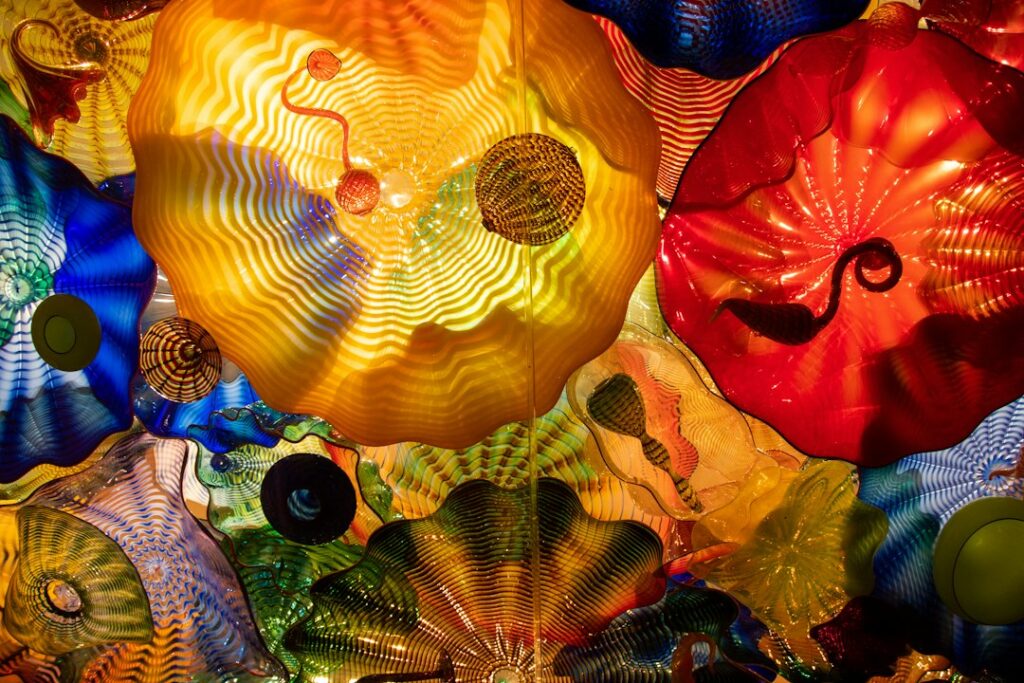
A blown glass chandelier is one of the few light fixtures that reads as sculpture even when it is switched off. Each piece of glass is shaped by hand from a molten gather, so no two bubbles, petals, or tendrils come out exactly alike, and that small irregularity is what separates art glass from factory-pressed shades. Most homeowners who fall for these fixtures make the same mistake: they choose by photo alone and only later discover that the fixture weighs 40 pounds, needs a reinforced ceiling box, and throws colored light across the whole room.
The short answer for anyone shopping: pick the glass color and form based on the room’s existing palette and ceiling height, confirm the total weight before you buy, and plan the mounting before the fixture arrives. Clear and smoke glass suit most spaces, saturated colors work best as a single bold statement, and organic cluster designs need more vertical room than you might expect. Getting the style, sizing, support, installation, and care right means the fixture you fall for actually works in your home.
- Choosing a Blown Glass Chandelier for Your Space
- Colored vs Clear Art Glass
- Bubble, Cluster, and Organic Forms
- Sizing and Hanging Height
- Weight and Ceiling Support
- Installation Steps and Safety
- Bulbs, Dimming, and Heat
- Cleaning, Care, and Troubleshooting
- Budget Ranges and When to Hire a Pro
- Frequently Asked Questions
Choosing a Blown Glass Chandelier for Your Space
Start with the room, not the catalog. A blown glass chandelier over a dining table plays a different role than one hanging in a two-story foyer or above a soaking tub. Over a table, the fixture sits at eye level for seated guests, so the detail of individual pieces matters and glare control matters even more. In a foyer, you see it from below and from a balcony above, which means the underside and top both need to look finished.
Think about how the fixture will be lit. Many art glass designs place small bulbs or integrated LEDs inside or behind each glass element, so the glass glows from within. Others hang glass pieces around a central light source, which creates more sparkle and shadow play on the walls. Glowing designs feel soft and ambient. Surround designs feel dramatic and can cast patterns that some people love and others find busy.
Finally, consider who lives there. Homes with tall teenagers, ceiling fans nearby, or pets that climb furniture need fixtures hung well out of reach, and fragile tendril forms are a poor match for a low hallway where someone might bump a stray piece while carrying a box.
Colored vs Clear Art Glass
Clear glass is the safest choice for resale and for rooms with strong existing color. It shows off the bubbles, ribbing, and seed inclusions that the glassblower worked into each piece, and it disappears visually during the day while still sparkling at night. Seeded clear glass, with tiny trapped air pockets, adds texture without adding color.
Colored glass changes the light itself. Amber and honey tones warm the room and flatter skin, which is why they are popular over dining tables. Cobalt, teal, and aqua feel cool and coastal but can make food and faces look slightly gray if they are the only light source. Multicolor fixtures with a dozen or more hues read as playful and are easiest to live with in neutral rooms with white or pale walls.
- Clear or seeded: flexible, timeless, brightest light output.
- Smoke or gray: modern and moody, reduces glare, lowers brightness noticeably.
- Amber or honey: warm, flattering, pairs with wood floors and brass hardware.
- Cool blues and greens: coastal or spa feel, best combined with other lighting.
- Multicolor: a single focal point; keep surrounding decor quiet.
A useful rule: if the fixture will be the main light in the room, lean clear or lightly tinted. If you have recessed or wall lighting doing the practical work, a saturated color can be the decorative layer.
Bubble, Cluster, and Organic Forms
A glass bubble chandelier uses dozens of round or slightly irregular globes hung at staggered heights. It reads as light and airy, works in both modern and transitional rooms, and is one of the easier art glass styles to scale up or down because you can add or remove pendants. If you are searching for a bubble chandelier light, look closely at how each globe is attached: individual cords allow you to adjust the cascade shape on site, while a fixed frame keeps the design exactly as the maker intended.
Organic cluster forms, built from twisting tendrils, petals, or leaf shapes attached to a central armature, are the most sculptural. They tend to be heavier per foot of width and harder to clean, but they deliver the strongest wow factor in a stairwell or great room. A hand blown glass chandelier in this style often requires the installer to hang each piece individually after the frame is up.
Linear designs stretch glass pieces along a long canopy and suit rectangular dining tables and kitchen islands. Ring or halo designs suspend glass around a circular frame and look tidy in square rooms.
Sizing and Hanging Height
Two simple formulas get you close. For overall room scale, add the room’s length and width in feet; the total, read as inches, is a reasonable fixture diameter. A 12 by 14 foot dining room suggests a fixture about 26 inches wide. Over a table, aim for a fixture roughly half to two-thirds the table width so diners do not hit their heads standing up.
- Over a dining table: bottom of the fixture 30 to 36 inches above the tabletop with 8 foot ceilings; add about 3 inches for each additional foot of ceiling height.
- Open walkways and foyers: keep at least 7 feet of clearance below the lowest glass piece.
- Two-story spaces: center the fixture near the second-floor window line so it reads from outside and from the landing.
- Bathrooms: check local code and the fixture’s rating for damp locations, and keep clearances from the tub rim.
Organic and cascading designs need extra vertical allowance. A cluster that measures 30 inches wide may hang 40 inches tall, which can crowd an 8 foot ceiling fast. Tape a cardboard outline to the ceiling or hang a balloon at the planned bottom height to visualize it before you commit.
Weight and Ceiling Support
Glass is heavy. A modest bubble fixture may weigh 15 to 25 pounds, while large sculptural pieces can reach 60 to 100 pounds or more. Standard plastic ceiling boxes are not built for that load, and many metal pancake boxes are rated only for light fixtures up to 50 pounds. Look for a box specifically marked for fixture support at or above the chandelier’s listed weight.
Secure the box to framing, not just drywall. Options include screwing a rated box directly to a ceiling joist, installing an adjustable heavy-duty brace bar between joists, or adding solid wood blocking between joists from the attic side. For fixtures over 50 pounds, many manufacturers call for independent support from the building structure, such as a threaded rod or a rated hook into a joist, so the electrical box is not carrying the load alone. In a finished ceiling with no attic access, this is often a reason to bring in a contractor.
Check the chain, cable, or rod as well. Every link and loop should be rated for the full weight with a safety margin, and adjustable aircraft cable systems should use the stop hardware supplied with the fixture.
Installation Steps and Safety
If you are comfortable replacing an existing fixture on a working circuit and the box is properly supported, a straightforward swap is a reasonable DIY job. Anything involving a new circuit, a new box location, or a switched outlet that does not already exist belongs with a licensed electrician.
Tools and Materials
- Non-contact voltage tester
- Stable step ladder or platform ladder rated for your weight plus tools
- Wire strippers, screwdrivers, and wire connectors
- Fixture-rated ceiling box and brace if upgrading
- Cut-resistant gloves and safety glasses
- A padded table or blanket-covered floor area for unpacking glass
Steps
- Turn off the breaker for the circuit, not just the wall switch, and confirm power is off at the fixture wires with a non-contact voltage tester. Tape a note on the panel so nobody flips it back on.
- Remove the old fixture and inspect the box. Confirm it is marked for the new fixture’s weight and fastened to framing. Upgrade it now if it is not.
- Mount the crossbar or mounting plate supplied with the chandelier, then hang the frame and canopy without any glass attached. Most manufacturers want the frame up first so you are not lifting glass overhead.
- Connect the fixture wires to the house wires per the instructions: ground to ground, neutral to neutral, hot to hot. Tuck the connections neatly into the box and secure the canopy.
- Set the hanging height, then attach glass pieces one at a time, working from the center outward to keep the fixture balanced.
- Restore power at the breaker and test the fixture. If you have a dimmer, confirm it is compatible with the bulbs or LED driver.
Handle every piece with gloves and eye protection, carry large elements with two people, and never flex or strike the glass edges. Unpack over a soft surface so a slipped piece does not shatter. Ladder safety matters too: keep three points of contact, never stand on the top two steps, and have a helper steady the ladder and pass up parts. For ceilings above about 12 feet or any two-story foyer, hire a pro with scaffolding or a fixture lift instead of working off an extension ladder.
Bulbs, Dimming, and Heat
LED bulbs are the right choice for nearly every art glass fixture. They run much cooler than incandescent bulbs, which protects the glass from heat stress and makes the pieces safe to touch during cleaning. Choose a color temperature of 2700K to 3000K for dining and living spaces, and pair it with a compatible dimmer so you can shift from task brightness to evening glow.
Check that bulbs do not exceed the fixture’s wattage label, and keep bulb tips from touching glass. Integrated LED fixtures use a driver, often hidden in the canopy; use the dimmer type the manufacturer specifies to avoid flicker or buzzing.
Cleaning, Care, and Troubleshooting
Dust builds up quickly on textured glass. Every few months, turn the fixture off and let it cool, then wipe pieces with a soft microfiber cloth. For a deeper clean once or twice a year, remove the glass pieces, wash them by hand in lukewarm water with a drop of mild dish soap, rinse, and air dry on a towel. Avoid the dishwasher, ammonia cleaners, and sudden temperature changes, which can crack hand-formed glass.
- Fixture hangs crooked: rebalance glass from the center out, or adjust individual cable lengths.
- Flickering when dimmed: swap to a dimmer listed as compatible with your LED bulbs or driver.
- Canopy pulling away from the ceiling: turn off power and inspect the box and support immediately; this signals an overloaded mount.
- A cracked or chipped piece: remove it, as edges can be sharp. Many art glass makers sell replacement pieces matched by color.
Budget Ranges and When to Hire a Pro
Prices vary widely. Mass-produced bubble fixtures with machine-assisted glass often fall in the few-hundred-dollar range. A genuine hand blown glass chandelier from a studio artisan typically runs from the low thousands into five figures for large custom commissions. Professional installation for a simple swap usually costs a few hundred dollars, and heavy fixtures that need new framing, a new box location, or scaffolding can push labor higher.
Call a licensed electrician for any new wiring, new circuits, or added switches, and when the existing box is not rated for the load. Bring in a contractor or carpenter when framing needs reinforcement through a finished ceiling, and hire an installer with lift equipment for anything above comfortable ladder height. Many studios offer white-glove installation for large custom pieces, which is worth the cost when one tendril can take a glassblower hours to replace.
Frequently Asked Questions
How heavy is a typical blown glass chandelier?
Small bubble fixtures often weigh 15 to 25 pounds, while large sculptural designs can reach 60 to 100 pounds or more. Always check the listed weight before you buy so you can plan the ceiling box and structural support.
Can I install an art glass chandelier on a regular ceiling box?
Only if the box is marked for fixture support at or above the chandelier’s weight and is fastened to framing. Heavy fixtures often need a brace bar, blocking, or independent support from a joist.
Do colored glass chandeliers give off enough light?
Colored glass absorbs some light, so saturated tones are dimmer than clear glass. Use them alongside recessed or wall lighting, or choose clear and lightly tinted glass if the chandelier is the main light source.
Is a glass bubble chandelier hard to clean?
Bubble designs are among the easier styles to maintain because smooth globes wipe clean with a microfiber cloth. Remove and hand-wash the globes in mild soapy water once or twice a year.
What bulbs work best in hand blown glass fixtures?
LED bulbs in 2700K to 3000K are ideal. They run cool, reducing heat stress on the glass, and they dim smoothly when paired with a compatible dimmer.