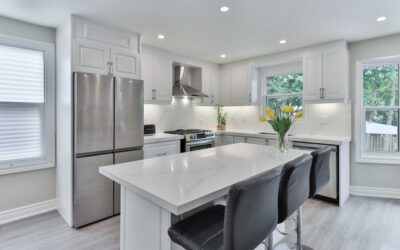
Most kitchens play it safe with white, gray, or beige, which is exactly why a blue kitchen countertop feels so striking the moment you walk in. Blue reads as calm and confident at the same time, and it works whether your home leans coastal, farmhouse, or crisp modern. The trick is choosing the right shade and material so the color feels intentional rather than trendy. Done well, a blue surface becomes the quiet anchor the whole room is built around.
Part of our Countertops guide — explore the full guide →
- Why Choose a Blue Kitchen Countertop
- Best Materials for a Blue Kitchen Countertop
- Choosing the Right Shade of Blue
- Pairing Cabinets with a Blue Countertop
- Backsplash and Hardware That Complete the Look
- Flooring and Wall Colors That Support Blue
- Care and Long-Term Considerations
- Making a Blue Kitchen Countertop Work in Your Home
Why Choose a Blue Kitchen Countertop
Blue is one of the few bold countertop colors that still reads as neutral. Deep navy behaves almost like a dark charcoal, grounding a space without the harshness of pure black. Softer slate and gray-blue tones bounce light around and make a small kitchen feel larger. Because blue sits opposite warm woods and brass on the color wheel, it flatters natural oak, walnut, and unlacquered hardware in a way gray never quite manages.
There is a practical upside too. Mid-to-dark blue hides everyday coffee rings, light scratches, and water spots better than a stark white slab, so the surface looks clean longer between deep cleanings. If you cook daily and want drama without constant upkeep, blue is a smart middle ground. It also photographs beautifully, which matters if you ever list your home or share the kitchen online.
Best Materials for a Blue Kitchen Countertop
Not every material comes in a convincing blue, so your color choice and your material choice are linked. Here is how the main options stack up.
Engineered Quartz
Quartz is the easiest way to get a consistent, saturated blue because the color is manufactured rather than mined. Brands offer everything from pale sky tones to inky navy with subtle veining, and the slab you see in the showroom is the slab you get. Expect to pay roughly $60 to $120 per square foot installed. Quartz is nonporous, never needs sealing, and shrugs off wine and lemon juice, which makes it the low-maintenance favorite for busy families.
Natural Stone
True blue in natural stone is rare and therefore expensive. Blue granites like Blue Pearl and Volga Blue carry shimmering feldspar crystals that flash silver and blue under light, while blue-gray soapstone offers a soft matte look that darkens beautifully over time. Blue quartzite, such as Azul Macaubas, is a showpiece that can run $100 to $200 per square foot or more. These stones are stunning but require periodic sealing to stay protected.
Laminate and Solid Surface
For a budget refresh, laminate now comes in convincing navy and cobalt patterns for as little as $15 to $40 per square foot installed. Solid surface materials like Corian offer seamless blue slabs with integrated sinks and sit around $45 to $75 per square foot. Neither matches stone’s longevity, but both let you experiment with color at a fraction of the cost, which is ideal for a rental, a laundry room, or a first test of the look.
Choosing the Right Shade of Blue
The exact blue you pick changes the entire mood of the kitchen. Navy and indigo feel formal and timeless, pairing naturally with brass and traditional cabinetry. Slate and steel blue lean transitional, bridging modern and classic without committing to either. Bright cobalt or teal makes a playful, retro statement that suits a backsplash-forward, personality-driven space.
A reliable rule: the smaller the kitchen, the lighter you should go. In a compact galley, a pale gray-blue keeps things open, while a large island can carry a deep navy that would overwhelm a full run of perimeter counters. If you love dark blue but worry about it feeling heavy, use it only on the island and keep the perimeter light. This two-tone approach is one of the most popular ways to introduce blue without committing the entire kitchen to it.
Pairing Cabinets with a Blue Countertop
Cabinet color decides whether your blue counter feels crisp, cozy, or dramatic. White cabinets are the foolproof choice; they let a blue counter pop while keeping the room bright and airy. Natural or medium-stained wood cabinets create a warm, organic contrast that suits coastal and Scandinavian styles. For a bold, moody kitchen, pair a lighter blue counter with deep gray or charcoal cabinets and let metallic accents do the talking.
One pairing to approach carefully is blue-on-blue. Blue cabinets with a blue countertop can look sophisticated, but only if the two tones are clearly different in value, such as pale counters over navy cabinets. Match them too closely and the eye loses definition, leaving the room feeling flat instead of layered.
Backsplash and Hardware That Complete the Look
A blue counter gives you room to have fun overhead. White subway tile is the safe, timeless partner and keeps the counter as the star. For more depth, a marble-look backsplash with faint gray veining ties into blue’s cooler undertones. If your blue leans warm and dusty, a natural stone or terracotta accent adds welcome contrast.
Hardware is where you set the temperature of the room. Brass and gold warm up a cool blue and read as elevated and current. Matte black hardware sharpens navy into something graphic and modern. Polished chrome or nickel keeps things clean and understated. Pick one metal and repeat it on faucets, pulls, and lighting so the look feels cohesive rather than accidental.
Flooring and Wall Colors That Support Blue
Do not forget the surfaces you are not replacing. Warm-toned wood or wood-look floors keep a blue kitchen from feeling cold, while light oak in particular gives coastal blues a relaxed, sun-washed feel. Gray or greige floors reinforce a modern scheme. On the walls, soft whites, warm creams, and pale greiges all let blue lead; if you want more energy, a muted sage or a warm clay accent wall plays beautifully against navy. Test paint chips against your chosen slab before committing, since undertones that clash are far more obvious once both are in place.
Care and Long-Term Considerations
Maintenance depends entirely on the material you chose. Quartz and solid surface need nothing more than mild soap and water, and they resist the etching that acidic foods cause on stone. Natural blue granite and quartzite should be sealed on installation and roughly once a year afterward; test by dripping water on the surface and watching whether it beads or soaks in. Soapstone wants periodic mineral oil to even out its patina.
Think about resale before you commit. A saturated cobalt island reads as personal taste, which some buyers love and others do not. A muted slate or navy tends to age more gracefully and appeals to a wider audience, so it is the safer bet if you expect to sell within a few years.
Making a Blue Kitchen Countertop Work in Your Home
Start with a full-size sample, not a two-inch chip, and live with it in your actual kitchen for several days. Blue shifts dramatically between morning daylight, warm evening bulbs, and cool LED fixtures, and a shade that looks perfect in the showroom can turn gray or purple at home. Set the sample against your cabinet doors, flooring, and wall paint before you order.
A blue kitchen countertop rewards a little planning with a room that feels custom and collected rather than copied from a catalog. Choose a material that fits how hard you actually use the space, dial in a shade suited to the room’s size and light, and let cabinets, backsplash, and hardware support the color instead of competing with it. Get those pieces right and blue stops being a risk and starts being the reason your kitchen stands out.