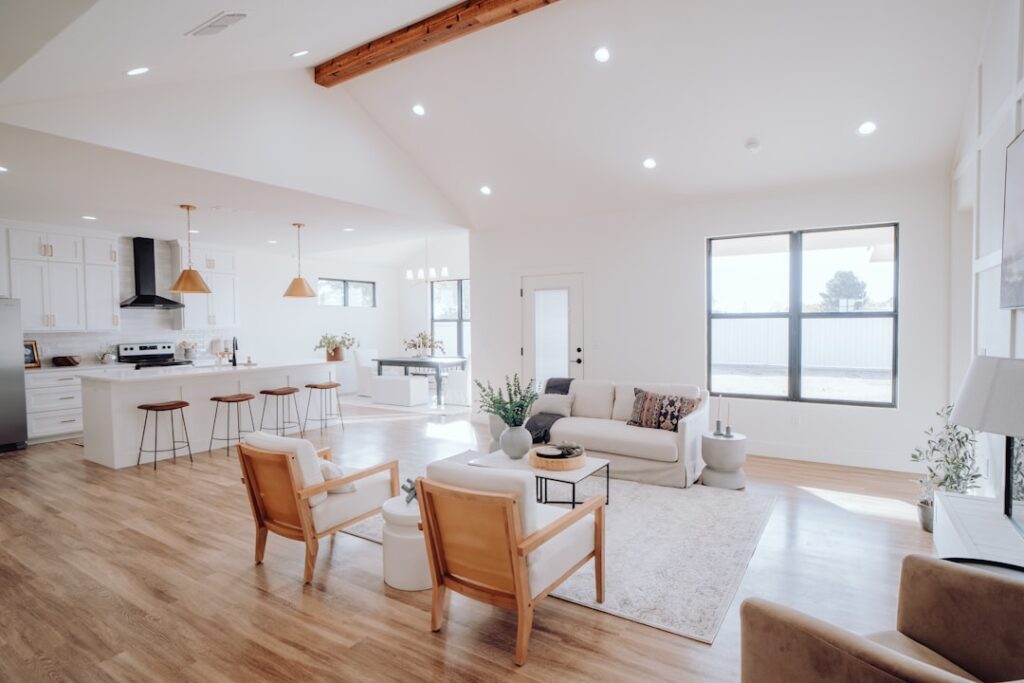
The flooring you walk on at a friend’s new construction usually came from a wholesaler the homeowner never saw. Builders pay 30 to 50 percent below retail because they buy in container quantities, hold trade accounts, and never browse a showroom. Builders wholesale flooring is increasingly accessible to homeowners willing to do their own coordination, but the rules of engagement differ enough from big-box shopping that mistakes can cost more than they save.
This guide explains how the wholesale tier actually works, which products show up there, and the steps a homeowner takes to buy at builder pricing without a contractor’s license.
- What Wholesale Actually Means in Flooring
- How to Access Wholesale Pricing as a Homeowner
- Pros That Justify the Hassle
- Cons That Catch Retail Buyers Off Guard
- How to Vet a Wholesale Distributor
- Best Use Cases for Wholesale Buying
- What Wholesale Won’t Solve
- Specific Wholesale Distributors Worth Knowing
- Final Recommendation
What Wholesale Actually Means in Flooring
Wholesale flooring distributors sit between mills (Shaw, Mohawk, Mannington, Armstrong) and the retail tier (Home Depot, Lowe’s, Floor & Decor, independent showrooms). Their core customers are builders, multi-family developers, property managers, and large-volume contractors. Wholesale pricing requires a resale certificate or contractor account in most states, though many distributors now sell to retail customers at modestly higher rates.
Common wholesale brands and their typical contractor pricing per square foot:
- Shaw Floorte vinyl plank: $1.79 to $3.49
- Mohawk RevWood laminate: $1.49 to $2.89
- Mannington Adura LVP: $2.49 to $4.49
- Bruce engineered hardwood: $2.99 to $5.49
- Daltile and Florida Tile porcelain: $1.49 to $4.99
Add 20 to 35 percent for retail-walk-in pricing at these same wholesale houses.
How to Access Wholesale Pricing as a Homeowner
Three realistic paths exist:
- Trade account through a contractor — your installer orders the material on their account and passes through cost plus a small markup
- Resale certificate — if your state issues them to homeowners with rental properties, you qualify on your own
- Cash-and-carry retail counter — most wholesalers have a side counter where walk-ins pay retail-ish pricing that still beats big-box by 10 to 20 percent
Of these, working through your contractor is by far the smoothest. Reputable installers buy at true wholesale and charge cost plus 10 to 15 percent, which still saves the homeowner 15 to 30 percent versus going to Home Depot directly.
Pros That Justify the Hassle
- Pricing on container-direct LVP and laminate runs 25 to 45 percent below big-box on identical SKUs
- Deeper inventory of 20 mil and 22 mil wear-layer commercial-grade vinyl that big-box stores rarely stock
- Access to mill-direct hardwood like Mannington, Bruce, and Mullican without retail markup
- Pallet-level pricing makes large-project economics work — full pallets often beat by-the-carton rates by another 5 to 10 percent
- Counter staff are usually former installers and answer real technical questions about subfloor prep and adhesives
Cons That Catch Retail Buyers Off Guard
Wholesale houses are not set up for handholding. There are no Saturday-morning sample chains, no design consultations, and no return policies as generous as Home Depot’s. Most wholesalers charge 25 percent restocking on opened cartons and refuse returns on closeout or discontinued items entirely.
Delivery is your problem. Wholesalers will load your truck or trailer; they rarely offer doorstep delivery for retail customers. Renting a U-Haul pickup for $20 to $35 plus mileage is the standard play for a 500 to 1,000 square foot job.
Quality control falls on the buyer. Every carton needs visual inspection before it leaves the warehouse. Damaged cartons get rejected at the counter, not returned three days later.
How to Vet a Wholesale Distributor
Before placing a deposit at any builders wholesale flooring operation:
- Confirm they carry the specific SKU you want, not a “comparable” substitute
- Get the manufacturer warranty document (not a generic distributor flyer)
- Verify wear-layer thickness, AC rating, Janka hardness, or DCOF rating in writing on the quote
- Ask about lot-matching policy — wholesale lots can vary slightly between runs
- Confirm payment terms (most require cash, check, or ACH; many do not take credit cards on contractor pricing)
Best Use Cases for Wholesale Buying
Wholesale economics hit hardest on projects above 1,000 square feet. Below that, the time you spend on logistics outweighs the per-square-foot savings. A 2,000 square foot LVP install at $3.99 retail versus $2.79 wholesale represents $2,400 in material savings — enough to justify renting a trailer and spending a Saturday morning at the distributor.
Wholesale is also the right call for landlords furnishing multiple rental units with the same product. Buying a full pallet of mid-tier LVP at $2.19 per square foot to floor three units in matching style locks in pricing and ensures lot consistency.
What Wholesale Won’t Solve
Wholesale pricing does not include installation, and most distributors do not maintain installer referral lists for retail buyers. You still need to source and vet a contractor independently. Wholesale also does not solve the warranty question — claims go to the manufacturer, and the distributor’s role ends at delivery.
For homeowners hoping wholesale will give them access to exclusive products, the reality is more mundane. Wholesalers stock the same Shaw, Mohawk, and Mannington SKUs found at Lumber Liquidators and Floor & Decor. The difference is price, not product mix.
Specific Wholesale Distributors Worth Knowing
The major flooring wholesale distributors operating in the US include:
- Galleher — West Coast distributor of Shaw, Mohawk, and engineered hardwood
- BPI Flooring — large Midwest and Southeast network
- NRF Distributors — Northeast specialist in commercial-grade products
- All Tile — national tile and stone distributor with LVP lines
- The L.J. Smith Company — hardwood and stair-parts specialist
Many of these operate cash-and-carry counters open to homeowners, even without trade accounts.
Final Recommendation
If your project exceeds 1,000 square feet and you have a trusted installer willing to order on their trade account, wholesale routing saves real money. For smaller jobs, the time and logistics overhead rarely pencil out. Either way, the savings are biggest on 20 mil LVP, AC5 laminate, and engineered hardwood from name-brand mills — the products where retail markup runs heaviest. Smaller items like trim, transitions, and underlayment often cost about the same at any tier.
Prefer to explore on your own?
See how new flooring looks in your actual room in seconds — free, no signup.
Try the free Floor Studio →