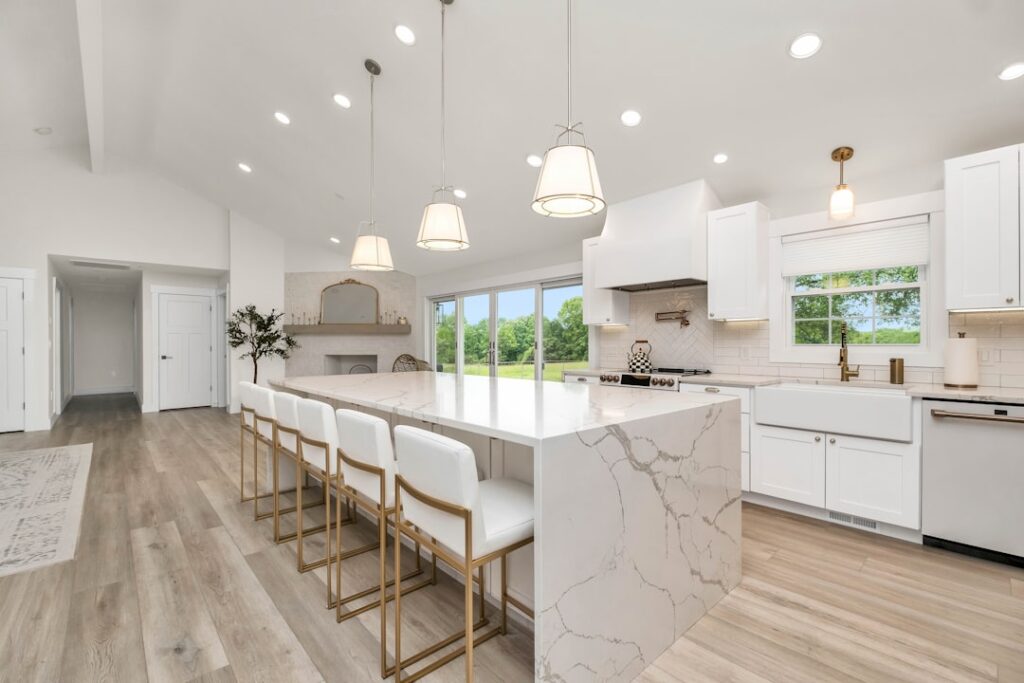
The dream kitchen in every renovation magazine has a white countertop laced with dramatic gray veining, and for decades that meant expensive, high-maintenance Calacatta marble. Calacatta Delios quartz is one of the engineered-stone answers to that dream — a manufactured quartz surface designed to capture the bright white background and bold, flowing veins of luxury marble while delivering the toughness and low maintenance that only quartz can offer. If you love the marble look but not the etching, staining, and constant sealing, this style of quartz deserves a serious look.
Part of our Countertops guide — explore the full guide →
- What Calacatta Delios Quartz Looks Like
- Quartz vs. Real Calacatta Marble
- Pros and Cons
- What Calacatta Delios Quartz Costs
- Edge Profiles and Design Details
- Design Pairings That Flatter It
- Care and Maintenance
- Is It Right for Your Kitchen?
- Where to Use It in the Home
- How to Buy It Wisely
- Final Verdict
What Calacatta Delios Quartz Looks Like
Calacatta-style quartz patterns are defined by a crisp white or warm-white base with pronounced gray veining that runs in bold, sweeping lines, often with finer secondary veins branching off. Delios and similar Calacatta patterns aim for that high-contrast, elegant look that reads as genuine natural marble from across the room. Unlike the subtle, feathery veins of Carrara, Calacatta patterns are dramatic and eye-catching. Because it is engineered, the veining is printed and dispersed consistently through the slab, so you get a predictable, repeatable look rather than the lottery of natural stone.
Quartz vs. Real Calacatta Marble
Understanding the difference clarifies why so many homeowners choose engineered quartz:
- Durability: Quartz is roughly 90 to 94 percent ground natural quartz bound with resin, making it harder and more scratch-resistant than marble.
- Stain resistance: Quartz is non-porous and never needs sealing; marble is porous and stains readily.
- Etching: Acidic foods etch and dull marble; quartz resists everyday acids like lemon and wine.
- Consistency: Quartz patterns repeat predictably; marble is one-of-a-kind.
The trade-off is that real marble has genuine depth and a coolness quartz cannot perfectly replicate, and marble tolerates heat better. But for daily kitchen use, quartz wins on practicality.
Pros and Cons
Every material has trade-offs, and being clear-eyed helps you decide. The strengths of Calacatta Delios-style quartz are compelling: it is non-porous and highly stain-resistant, extremely durable against scratches and chips, never needs sealing, and delivers the coveted marble look with consistent quality. On the downside, quartz is not heatproof — a hot pan straight from the burner can scorch or discolor the resin, so trivets are a must. It also can fade or discolor under prolonged direct sunlight, making it less ideal for sun-drenched outdoor kitchens. And a very high-end Calacatta pattern can cost as much as some natural stone.
What Calacatta Delios Quartz Costs
Dramatic Calacatta-style quartz patterns sit at the upper end of the quartz price range because the bold veining is more complex to manufacture. Expect material costs of roughly $60 to $100 per square foot, with premium designer patterns higher. Installed, including fabrication, edging, and the sink cutout, most kitchens land between $75 and $120 per square foot. For a typical kitchen with 40 to 50 square feet of countertop, that translates to roughly $3,000 to $6,000 installed. Waterfall edges, mitered thick edges, and full-height backsplashes add to that total.
Edge Profiles and Design Details
The edge you choose shapes the whole look. A straight, squared eased edge reads modern and clean, letting the veining be the star. An oversized mitered edge — where the slab wraps to create a thick 2- to 3-inch look — is a current favorite for a substantial, luxurious profile. A waterfall edge, where the countertop cascades down the side of an island to the floor, showcases the dramatic veining vertically and creates a stunning focal point. For a bold Calacatta pattern, simpler edges usually look best; ornate ogee profiles compete with the busy veining.
Design Pairings That Flatter It
Because the surface is bold, the rest of the palette should support rather than compete. It pairs beautifully with:
- White or cream cabinets: A timeless, bright, all-white-and-gray kitchen.
- Navy or deep green cabinets: The white quartz makes a bold cabinet color pop.
- Warm wood tones: Oak or walnut adds warmth against the cool white and gray.
- Brass or matte black hardware: Both provide crisp, current contrast.
Carry the veining into a full-height backsplash for a dramatic, high-end effect, or keep the backsplash simple to let the counter breathe.
Care and Maintenance
This is where quartz earns its keep. Daily care is as simple as wiping with mild soap and water or a gentle pH-neutral cleaner. There is no sealing, ever. Avoid abrasive scrubbers and harsh chemicals like bleach or oven cleaner, which can dull the finish over time. Never set a hot pot directly on the surface — always use a trivet, since heat is quartz’s real vulnerability. Wipe up spills when convenient rather than urgently, because the non-porous surface will not stain. Compared with the wipe-immediately, reseal-often routine of real marble, quartz is nearly effortless.
Is It Right for Your Kitchen?
Choose Calacatta Delios-style quartz if you want the dramatic, luxurious look of white marble with bold gray veining but need a hardworking surface that resists stains, etching, and daily abuse without maintenance. It is ideal for busy family kitchens where real marble would be a constant worry. If you crave the absolute authenticity, coolness, and heat tolerance of genuine stone and are willing to baby it, real Calacatta marble is the alternative. Always view a full slab in person before buying — photos never capture the true scale and flow of the veining, and a full slab lets you plan how the pattern falls across your island and counters.
Where to Use It in the Home
The pattern is versatile enough for nearly any surface, but a few applications stand out. On a kitchen island, a dramatic Calacatta-style slab becomes the room’s centerpiece, especially with a waterfall edge that shows the veining cascading to the floor. Perimeter counters in the same material tie the kitchen together without competing. In bathrooms, it makes a stunning vanity top and a luxurious shower surround, and because quartz is non-porous, it handles bathroom moisture with no sealing. It works beautifully as a fireplace surround too. The one place to avoid it is a sunny outdoor kitchen, since prolonged UV exposure can fade or discolor the resin over time.
How to Buy It Wisely
A few habits protect you from an expensive disappointment. Always view the actual slab in person rather than relying on a small showroom sample or an online photo — bold Calacatta veining varies across a slab, and you want to plan how the pattern falls on your island and seams. Ask the fabricator how they will book-match or align the veining across joints, since a thoughtful layout looks custom while a careless one looks disjointed. Confirm the slab thickness (2 cm versus 3 cm) and whether your edge profile requires lamination. Finally, get an itemized quote covering the slab, fabrication, edging, cutouts, and installation so you can compare bids fairly.
Final Verdict
Calacatta Delios-style quartz is one of the smartest ways to get the coveted look of dramatic white marble in a surface built for real life. It resists stains, etching, and scratches, never needs sealing, and delivers consistent quality, making it ideal for busy kitchens where genuine marble would be a constant source of worry. Respect its one true weakness — heat — by always using trivets, keep it out of harsh direct sun, and clean it with mild soap and water. View a full slab before buying and plan the veining layout with your fabricator, and you will end up with a countertop that looks like a five-figure marble installation at a more approachable price.