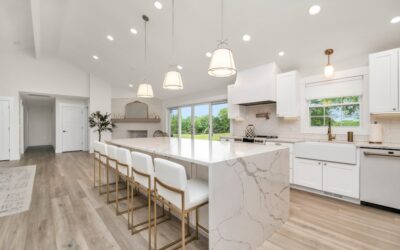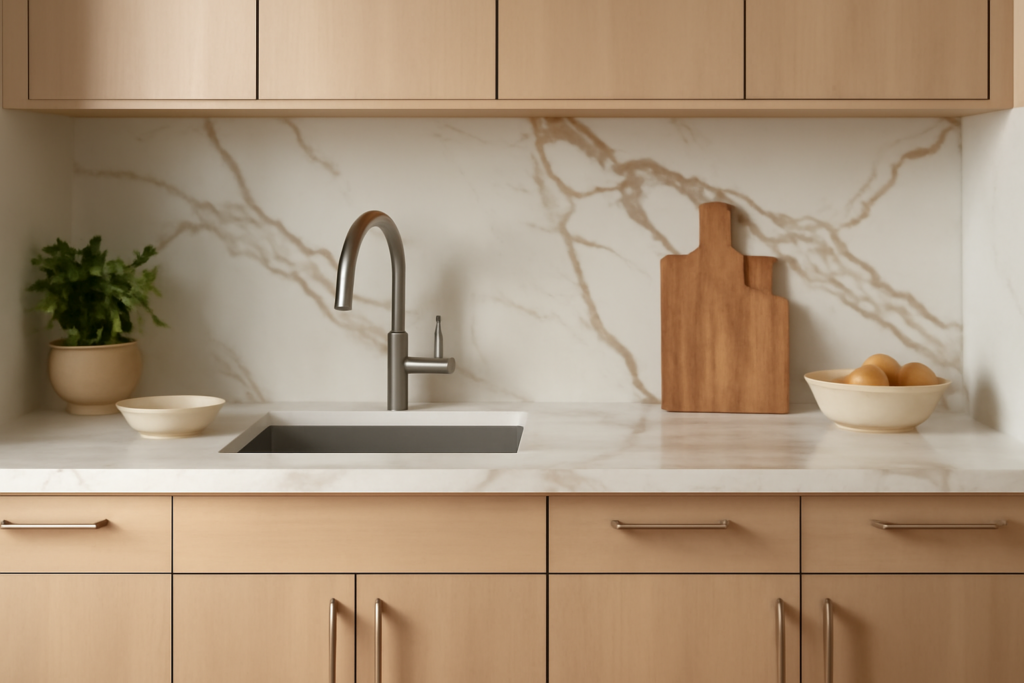
If you love the drama of Calacatta marble but want something warmer and far easier to live with, this engineered stone deserves a look. Calacatta Castana quartz is a quartz countertop color that pairs the bright, marble-inspired background and bold veining of classic Calacatta with warm brown, caramel, or taupe tones, the word castana evoking a chestnut-like warmth. The result feels rich and inviting rather than cold.
Part of our Countertops guide — explore the full guide →
This guide explains what the look entails, how engineered quartz performs compared to natural marble, what to budget, and how to care for it. Because quartz colors vary by manufacturer, treat the look described here as the general style rather than a single fixed product.
What Is Calacatta Castana Quartz?
Quartz countertops are engineered stone, made by combining roughly 90 percent ground natural quartz with resins and pigments, then forming the mixture into dense, nonporous slabs. The Calacatta family of colors imitates the prized Italian marble known for its white background and striking, often gray or gold, veining. Castana variants warm that palette with brown and earthy tones running through the veins.
So you get the high-end marble aesthetic, white field with dramatic movement, layered with cozy warmth that complements wood cabinetry, brass fixtures, and natural materials. Different brands produce their own take on this look, so patterns, vein thickness, and exact coloring differ from slab to slab and maker to maker.
The Look and Design Appeal
What sets this style apart is its versatility. The bright background keeps a space feeling open and clean, while the warm veining adds depth and prevents the stark, clinical feel that pure white surfaces sometimes have. It bridges traditional and contemporary, equally at home in a farmhouse kitchen and a modern one.
Warm-toned veining coordinates beautifully with natural wood tones, beige and greige palettes, matte black or aged brass hardware, and earthy backsplash tile. For homeowners who find cool gray marble looks too austere, the castana warmth offers a softer, more welcoming alternative that still reads as luxurious.
Quartz vs. Natural Marble
The biggest reason to choose quartz over the marble it imitates comes down to performance. Natural Calacatta marble is gorgeous but porous and soft, vulnerable to etching from acids like lemon juice and wine, and prone to staining and scratching. It demands sealing and careful daily habits.
Engineered quartz, by contrast, is nonporous, so it resists staining without sealing, stands up to daily kitchen use, and is far more forgiving of spills. You get a marble-inspired look with vastly lower maintenance. The tradeoffs: quartz is manufactured, so the veining is a designed pattern rather than geologic chance, and it is less heat tolerant than stone, which is why trivets matter.
Durability and Performance
Quartz is one of the toughest countertop surfaces available for everyday living. Its key strengths include:
- Nonporous surface: Resists staining from coffee, wine, and oil, and never needs sealing.
- Scratch resistance: Stands up to normal kitchen wear, though you should still cut on a board to protect both the surface and your knives.
- Hygienic: The sealed, nonporous surface gives bacteria nowhere to hide, a plus for kitchen prep.
- Consistent supply: As a manufactured product, you can usually match additional slabs for large projects.
The main limitation is heat. The resins that bind quartz can scorch or discolor under direct high heat, so always set hot pots and pans on trivets or hot pads rather than directly on the counter. Prolonged direct sunlight outdoors can also affect some quartz, so it is generally an indoor product.
What It Costs
Quartz countertops typically fall in a broad range depending on brand, slab quality, thickness, and edge detail, often landing somewhere around $50 to $120 per square foot installed, with premium marble-look designs like the Calacatta family tending toward the higher end because of their elaborate veining patterns. Fabrication, edge profiles, cutouts for sinks and cooktops, and installation all factor into the final price.
Prices shift by region and over time, so the figures here are general guidance, not a quote. For an accurate number, take your measurements to a local fabricator or showroom and get pricing on the specific brand and slab you like. Viewing full slabs in person also matters, since photos rarely capture the true scale and movement of the veining.
Care and Maintenance
One of the joys of quartz is how little it asks of you. Day-to-day care is simple:
- Wipe with warm water and a mild dish soap or a quartz-safe cleaner; no sealing is ever required.
- Blot spills reasonably promptly, even though staining is unlikely, to keep the surface pristine.
- Always use trivets or hot pads under hot cookware to protect against heat damage.
- Avoid harsh chemicals like bleach, oven cleaner, or abrasive scouring pads, which can dull the finish.
For stubborn residue, a non-abrasive cleaner and a soft cloth handle most messes. Avoid abrasive powders and scrub pads that could scratch the polished surface over time. With these easy habits, the surface keeps its luster for many years.
Design Pairings and Where It Works
Part of this color’s appeal is how easily it coordinates. In kitchens, the warm veining looks stunning against white shaker cabinets, natural oak or walnut, and greige tones, while brass or matte black hardware picks up the earthy notes. A simple subway or zellige backsplash lets the countertop remain the star, whereas a busy backsplash can compete with the veining, so restraint pays off.
Beyond kitchen counters, the same quartz works beautifully on bathroom vanities, waterfall-edge islands, fireplace surrounds, and accent shelving. Because it is engineered and consistent, you can carry the look from a kitchen island to a butler’s pantry or master bath for a cohesive whole-home feel, something that is harder and far pricier to achieve with natural marble, where each slab differs.
Is Calacatta Castana Quartz Right for You?
If you are drawn to the timeless beauty of Calacatta marble but want warmth instead of cool gray, plus the practicality to actually live with it, this style is a smart choice. You get bright, dramatic veining in inviting earth tones, on a surface that resists stains, never needs sealing, and shrugs off daily kitchen life. Just respect its one weakness by using trivets, view real slabs before buying since patterns vary by brand, and get a fabricator quote for accurate pricing. Done right, Calacatta Castana quartz delivers high-end marble style with the easygoing durability modern homeowners want.