
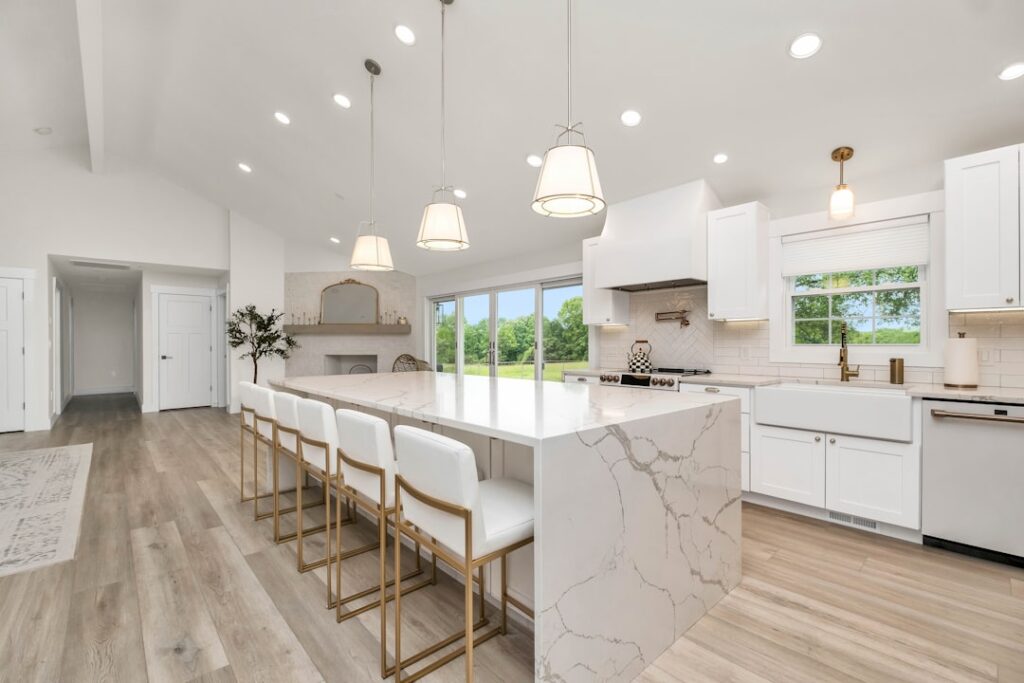
If you love the look of luxurious veined marble but want a surface that shrugs off everyday kitchen life, Eternal Calacatta Gold quartz deserves a close look. Part of Silestone’s Eternal collection, this engineered quartz recreates the drama of classic Calacatta marble with warm golden veins running across a soft white background, all in a material built to resist stains and etching. This guide explains what makes it special, where it works best, what it costs, and how to keep it looking flawless.
Part of our Countertops guide — explore the full guide →
- What Is Eternal Calacatta Gold Quartz
- The Look: Warm Veining on a Soft White Base
- Pros of Eternal Calacatta Gold Quartz
- Cons and Things to Consider
- Where It Works Best
- Design Pairings and Styling
- What It Costs
- Caring for Eternal Calacatta Gold Quartz
- How It Compares to Natural Calacatta Marble
- Planning Vein Placement and Seams
- Final Thoughts on Eternal Calacatta Gold Quartz
What Is Eternal Calacatta Gold Quartz
Eternal Calacatta Gold is an engineered quartz surface, meaning it is made from natural quartz combined with resins and pigments and manufactured into consistent slabs. Because it is manufactured rather than quarried, the pattern is more predictable than natural marble, yet it still delivers the coveted Calacatta aesthetic: a bright, warm white field crossed by broad, honeyed veins with softer grey undertones. The word Eternal refers to Silestone’s collection name, and Calacatta Gold describes this particular warm, golden-veined design within it.
The appeal is straightforward. You get the elegance of high-end Italian marble without the fragility. Where real Calacatta marble stains from wine and etches from lemon juice, engineered quartz is far more forgiving, making it a practical choice for busy kitchens.
The Look: Warm Veining on a Soft White Base
What sets this design apart from cooler Calacatta styles is its warmth. The veins carry golden and taupe tones rather than stark grey, which gives the surface an inviting, slightly traditional feel that still reads as modern and clean. The background is a soft, warm white rather than a bright cool white, so it flatters warm woods, brass fixtures, and cream cabinetry beautifully. Because it is engineered, the veining is relatively consistent from slab to slab, though you should still review your actual slabs to plan vein placement on an island or a run of counter.
Pros of Eternal Calacatta Gold Quartz
- Marble looks, quartz durability. You get the veined elegance without the maintenance anxiety of natural marble.
- Non-porous surface. Engineered quartz resists staining from coffee, wine, and oil far better than porous stone.
- No sealing required. Unlike marble and granite, quartz does not need annual sealing.
- Consistent pattern. Easier to plan and match than the wild variation of natural stone.
- Warm, versatile palette. The golden veining suits both classic and contemporary kitchens.
Cons and Things to Consider
No surface is perfect, and being honest about the trade-offs helps you plan.
- Heat sensitivity. The resins in quartz can scorch or discolor under a hot pan, so always use trivets.
- Not for heavy outdoor sun. Prolonged direct sunlight can affect quartz over time, so it is best kept indoors.
- Premium price. As a designer pattern, it sits toward the higher end of the quartz range.
- Repeating pattern. Some purists prefer the true one-of-a-kind randomness of natural marble.
Where It Works Best
Eternal Calacatta Gold is a natural fit for kitchen countertops and islands, where its bright field opens up the space and the veining creates a focal point. It also shines as a bathroom vanity top, a full-height backsplash, or a fireplace surround. Because the pattern is so striking, many homeowners let it lead the room and keep surrounding finishes calmer. It performs equally well in a traditional kitchen with shaker cabinets and in a minimalist space with handleless flat fronts.
Design Pairings and Styling
The warm undertones give you plenty of flexibility. Consider these combinations to make the stone shine.
- Cream or white cabinets for a light, airy, timeless kitchen.
- Warm wood tones such as oak or walnut to echo the golden veining.
- Soft sage or muted blue cabinetry for a gentle, sophisticated contrast.
- Brass or champagne-gold hardware to pick up the warmth in the veins.
- A full-height slab backsplash for a seamless, high-impact look.
What It Costs
Before diving into numbers, it helps to remember that with any designer quartz you are paying for the pattern and the brand as much as the raw material, and a striking veined surface like this sits at the top of that range. As a premium designer quartz, Eternal Calacatta Gold typically falls in the upper tier of quartz pricing. Installed costs vary widely by region, fabricator, edge profile, and slab thickness, but many homeowners see figures in the range of roughly 70 to 120 dollars per square foot installed, sometimes more for complex layouts or thicker slabs. Always get itemized quotes that include templating, fabrication, edge work, cutouts, and installation, and compare the total rather than the slab price alone. Buying only what you need and planning cuts carefully helps control cost. It is also worth getting quotes from more than one authorized fabricator, since labor rates, edge charges, and how they handle offcuts can vary noticeably from shop to shop, and a small difference per square foot adds up across a full kitchen.
Caring for Eternal Calacatta Gold Quartz
One of the great joys of this surface is how little it asks of you. For daily cleaning, warm water and a mild dish soap on a soft cloth are all you need. Wipe spills promptly, though the non-porous surface gives you more grace than marble would. Avoid harsh abrasive pads and strong chemicals like bleach or oven cleaner, which can dull the finish over time. Most importantly, never set a hot pot directly on the surface; always use trivets or pads, because heat is the one real vulnerability of engineered quartz.
How It Compares to Natural Calacatta Marble
The whole reason engineered versions of Calacatta exist is that homeowners adore the marble look but fear its upkeep, so a direct comparison is useful. Natural Calacatta marble is a quarried stone prized for its bright white base and bold gold and grey veins, and it is genuinely stunning, but it is also porous and reactive. It etches when acids like lemon juice, wine, or vinegar touch it, leaving dull spots in the polish, and it stains readily if spills are not wiped up fast, even with diligent sealing. Eternal Calacatta Gold gives you a comparable warm, veined aesthetic while resisting stains and etching and requiring no sealing at all. The trade-off is authenticity: a purist may prefer the truly one-of-a-kind, quarried character of real marble and its slightly softer, more natural depth. For most busy kitchens, though, the quartz version wins on practicality without giving up much on beauty.
Planning Vein Placement and Seams
Because the veining in this design is a major feature, a little planning during fabrication pays off handsomely. Ask your fabricator to lay out the slabs so the veins flow naturally across your island and along your counter runs rather than colliding awkwardly at a seam. On a large island, positioning a dramatic vein to sweep diagonally across the surface can turn an ordinary counter into a centerpiece. Where seams are unavoidable on long layouts, a skilled fabricator will place them discreetly and match the pattern across the joint as closely as the material allows. Reviewing a layout drawing or, better still, seeing the slabs marked up before cutting lets you have real input into how the finished surface will look, which is well worth the extra conversation for a premium designer pattern like this one.
Final Thoughts on Eternal Calacatta Gold Quartz
Eternal Calacatta Gold quartz offers something many homeowners have long wished for: the warm, veined luxury of classic Calacatta marble in a surface that laughs off spills, needs no sealing, and holds up to real family life. Its golden veining and soft white base make it endlessly adaptable, flattering everything from cream shaker cabinets to sleek modern fronts. Respect its one weakness by keeping hot pans off the surface, and it will reward you with a countertop that looks like a quarried masterpiece while behaving like the practical, low-maintenance workhorse a busy kitchen truly needs.


