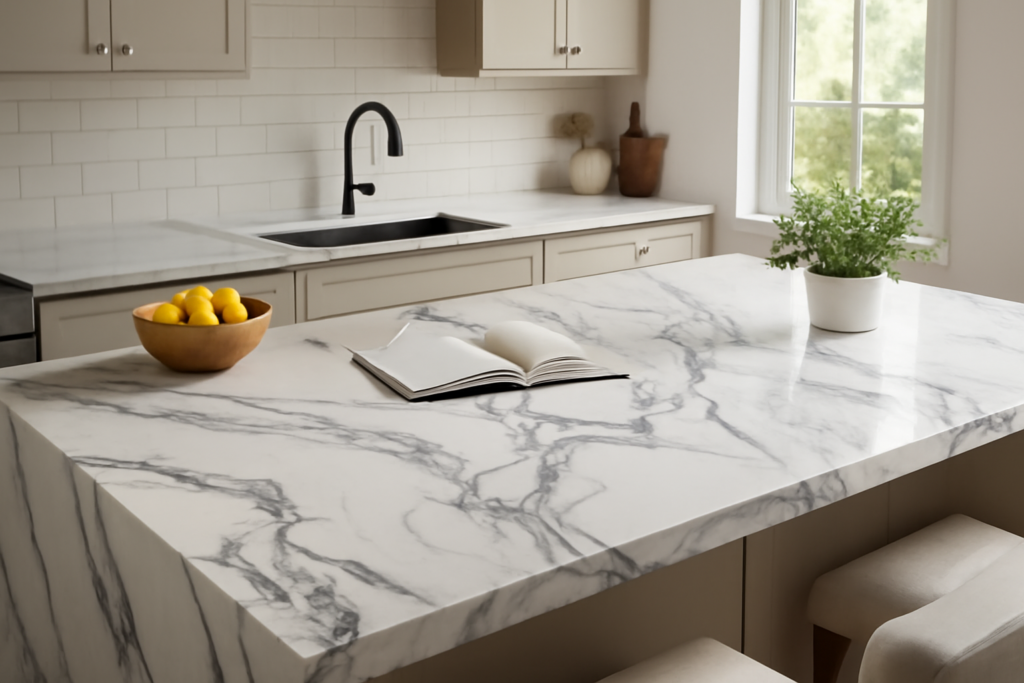
Some countertops whisper, and some make a statement the moment you walk into the room. Calacatta Cathedral quartz firmly belongs in the second group. It is an engineered quartz colorway built to capture the grand, sweeping veining associated with cathedral-cut marble, where large-scale, book-matched veins arch and mirror across the slab like stained glass. The difference is that this is man-made quartz, so you get the theatrical marble look without the sealing, etching, and fragility that come with the real thing.
Part of our Countertops guide — explore the full guide →
This guide explains what Calacatta Cathedral quartz is, why the “cathedral” name matters, what it costs, and how to use and maintain it so the drama lasts for the life of your kitchen.
- Calacatta Cathedral Quartz: What Makes It "Cathedral" Veining?
- The Visual Impact of Calacatta Cathedral Quartz
- What Calacatta Cathedral Quartz Costs
- Cathedral Quartz vs Natural Calacatta Marble
- Durability You Can Count On
- Best Places to Use Calacatta Cathedral Quartz
- Care and Maintenance
- Choosing a Finish and Edge Profile
- Is It the Right Choice for Your Home?
Calacatta Cathedral Quartz: What Makes It “Cathedral” Veining?
Calacatta is a veining style: a white or near-white base crossed by bold, dramatic veins, originally quarried as marble in Italy. “Cathedral” describes the scale and symmetry of that veining. Rather than fine, scattered lines, cathedral-pattern slabs feature large, flowing veins that often book-match, meaning two adjacent slabs mirror each other so the pattern reflects like a butterfly’s wings. The effect recalls the soaring arches and symmetry of a cathedral, hence the name.
In an engineered slab, this look is printed and structured into the quartz during manufacturing, using roughly 90 to 94 percent crushed quartz bound with resin and pigment. Because it is fabricated, the veining is consistent and reproducible, which makes it far easier to plan a book-matched island or a continuous run of counters than it would be with unpredictable natural stone.
The Visual Impact of Calacatta Cathedral Quartz
The signature of this colorway is scale. Where standard Calacatta patterns scatter medium veins across the surface, cathedral veining commits to large, uninterrupted movement. On a big island or a waterfall edge, a single slab can carry one continuous vein that draws the eye from end to end. That makes it a natural centerpiece.
Design-wise, it flexes in several directions:
- Modern minimalist — paired with flat-panel white or handleless cabinets, the veining supplies all the visual interest a clean kitchen needs.
- Transitional — with shaker cabinets and brushed nickel or brass hardware, it reads timeless and upscale.
- Dramatic contrast — against deep navy, charcoal, or black cabinetry, the bright white base and bold veins become a striking focal point.
Because the pattern is so prominent, it works best when the surrounding finishes stay relatively calm. Busy backsplashes and heavily patterned floors compete with the veining and can make a space feel cluttered.
What Calacatta Cathedral Quartz Costs
Expect pricing in the general engineered-quartz range of $50 to $120 per square foot installed, with dramatic Calacatta-style patterns tending toward the higher end because the large-scale veining and book-matching demand more careful fabrication and slab layout. For a standard kitchen of 40 to 55 square feet, a realistic installed total lands around $3,000 to $6,000, depending on region, edge details, cutouts, and whether you request book-matched slabs.
Book-matching adds cost because the fabricator must buy and lay out sequential slabs and cut them to preserve the mirrored pattern. If a waterfall island with a continuous vein is your goal, tell your fabricator up front, since it affects how much material you need to purchase. As always, gather at least three quotes; specialty veined colorways vary in price and availability between suppliers.
Cathedral Quartz vs Natural Calacatta Marble
Genuine Calacatta marble is one of the most coveted natural stones in the world, and its cathedral-cut slabs are stunning. They are also expensive, porous, and unforgiving. Acidic foods etch the surface, wine and oil can stain, and the stone needs regular sealing to stay protected. A single dropped pan can chip a delicate vein.
Calacatta Cathedral quartz keeps the visual grandeur while removing those headaches. You lose the geological authenticity and the subtle depth that only natural stone has, but you gain a surface that survives a busy household without special treatment. For families, rental properties, and anyone who wants the look without the maintenance calendar, the engineered version is the practical winner.
Durability You Can Count On
The practical payoff of choosing quartz over marble is real. The surface is nonporous, so it never needs sealing and resists stains from wine, coffee, citrus, and oils. It rates about 7 on the Mohs hardness scale, making it highly scratch resistant under normal use, though a cutting board is still smart practice. Unlike marble, it does not etch when acidic foods touch it, which removes the biggest source of anxiety for anyone who has watched a lemon slice permanently mark real stone.
The material’s weakness is heat. The polymer resins can scorch or yellow above roughly 300°F, so hot pots and pans always need a trivet. Prolonged direct sunlight may also fade certain quartz products over years, a factor to weigh for counters beneath large, unshaded windows.
Best Places to Use Calacatta Cathedral Quartz
Its bold pattern makes it a showpiece material, ideal for surfaces that command attention:
- Kitchen islands — the large scale of cathedral veining is made for a big island top.
- Waterfall edges — a continuous vein cascading to the floor is one of the most dramatic uses of this colorway.
- Full-height backsplashes — carrying the pattern up the wall behind a range creates a custom, gallery-like feel.
- Bathroom vanities and fireplace surrounds — smaller doses of the pattern add luxury without overwhelming a room.
In compact kitchens, use it as an accent rather than everywhere. A single dramatic island in Calacatta Cathedral quartz, paired with quieter perimeter counters, often looks more intentional than wrapping every surface in strong veining.
Care and Maintenance
Maintenance is refreshingly light. Clean daily with warm water and a few drops of mild dish soap or a pH-neutral stone-safe cleaner, then dry with a soft microfiber cloth to prevent streaks. Avoid abrasive scrubbers, bleach, oven cleaners, and high-alkaline degreasers, all of which can dull the polished finish over time.
For stubborn residue like dried food or wax, soften it with a warm damp cloth and lift it with a plastic scraper rather than a metal blade. Because the surface never needs sealing, that simple routine is genuinely all it takes to keep the slab looking new.
Choosing a Finish and Edge Profile
Most Calacatta Cathedral quartz ships with a polished finish, which deepens the contrast between the white base and the bold veins and gives that glossy, high-end look. A honed or matte finish is also available from many manufacturers and reads softer and more contemporary, though matte surfaces can show fingerprints and require a little more wiping.
Edge profile matters too, because it frames the veining. A simple eased or straight edge keeps the focus on the pattern and suits modern kitchens, while a beveled or mitered edge adds visual weight. A mitered waterfall edge, where the slab appears thicker and wraps to the floor, is the most dramatic choice and shows off the continuous cathedral vein at its best. Discuss edge options with your fabricator early, since some profiles add labor cost and affect how much slab you need.
Is It the Right Choice for Your Home?
Choose Calacatta Cathedral quartz when you want a genuine wow factor and a low-maintenance surface at the same time. It rewards homeowners who love bold, gallery-worthy veining and want a counter that becomes the design anchor of the room, without the sealing schedule and etching risk of natural marble. The only real reasons to look elsewhere are a firm preference for quarried stone or a need to set hot cookware directly on the surface.
For nearly everyone else, this colorway delivers the best of both worlds. View your actual slabs before fabrication, plan any book-matching in advance, and hire an experienced fabricator. Do that, and Calacatta Cathedral quartz will give you the soaring, dramatic marble look you wanted, backed by the everyday toughness only engineered quartz can provide.