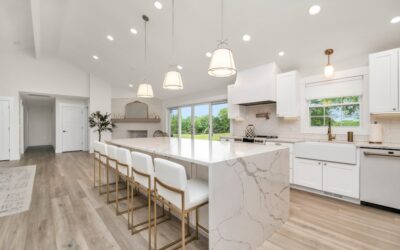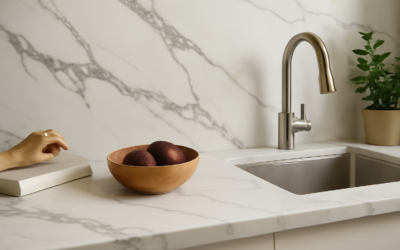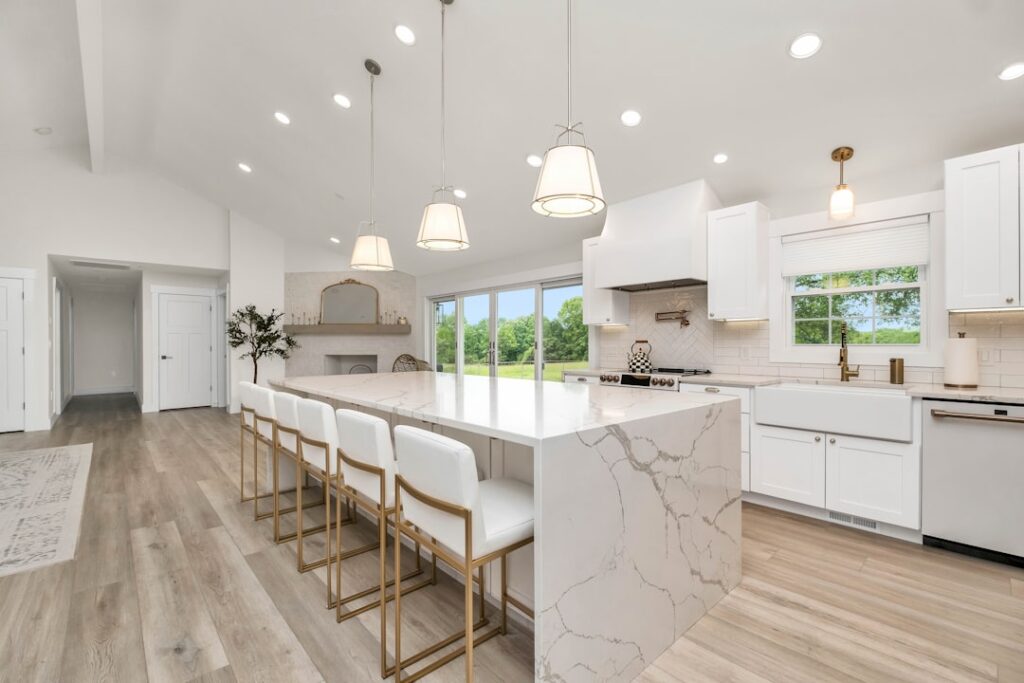
Calacatta Anava quartz is an engineered stone slab from MSI’s Q Quartz line designed to reproduce the look of high-end Calacatta marble while offering the practical performance homeowners expect from quartz. It pairs a bright white background with soft, warm gray veining that drifts across the surface in irregular, marble-like patterns, along with occasional subtle gold undertones woven into some of the vein clusters. For anyone who loves the appearance of Italian Calacatta marble but wants a countertop that resists staining and etching in daily kitchen use, Calacatta Anava is built specifically to answer that demand.
Part of our Countertops guide — explore the full guide →
Engineered Quartz Versus Natural Marble
It helps to understand what quartz countertops actually are before comparing them to marble. Engineered quartz slabs are manufactured from roughly 90 to 95 percent crushed natural quartz mineral combined with polymer resins and pigments, then compressed and cured under heat and pressure into a dense, uniform slab. This manufacturing process is what allows a product like Calacatta Anava to replicate a specific marble look with consistent veining from slab to slab, something natural stone simply cannot guarantee since every block quarried is unique.
The practical payoff is durability. Natural Calacatta marble is calcite-based and vulnerable to etching from acidic foods like lemon juice, tomato sauce, and vinegar, along with staining if spills aren’t wiped up quickly. Engineered quartz, including Calacatta Anava, is far more resistant to both etching and staining because the resin binder seals the surface at a molecular level, meaning it does not require periodic sealing the way natural marble or granite does. For a busy family kitchen, that resistance to everyday acids and stains is often the deciding factor over the real thing.
What the Veining and Color Actually Look Like
Calacatta Anava’s background reads as a clean, bright white rather than the warmer ivory tone found in some other quartz lines. Against that white field, gray veining moves in soft, feathered clusters rather than harsh, straight lines, aiming to mimic the organic, unpredictable veining found in genuine Calacatta marble quarried from the Apuan Alps in Italy. Because it is manufactured, the veining pattern will repeat to some degree across multiple slabs from the same batch, so if you’re covering a large kitchen with multiple slabs, ask your fabricator to lay them out together beforehand to check how the veining lines up at the seams.
This is one area where engineered quartz cannot fully replicate natural marble, since real Calacatta marble has truly one-of-a-kind veining with no repetition at all. Most homeowners find the tradeoff worthwhile given the durability gains, but it’s worth setting expectations before ordering: a photo of one slab online may not represent the exact veining density you’ll receive, since quartz manufacturers periodically update their production batches.
Cost Per Square Foot
Quartz pricing generally falls into recognizable tiers based on brand and design complexity, and Calacatta-style veined patterns like Anava typically sit in the mid-to-upper range of a manufacturer’s lineup because of the more elaborate printing and layering process needed to achieve realistic marble movement. Homeowners can generally expect to pay in the range of $55 to $85 per square foot installed for standard 3cm thickness, though exact pricing depends heavily on your region, fabricator, and any edge upgrades.
This puts Calacatta-look quartz roughly on par with or slightly above mid-range natural granite, and often less expensive than genuine imported Calacatta marble, which can run well past $100 per square foot installed once you factor in the premium cost of the raw material and the extra care required during fabrication and sealing. As with any quartz purchase, get a written quote that separates material, fabrication, edge treatment, and installation, since bundled quotes can make it hard to compare between showrooms.
Thickness and Finish Options
Most quartz manufacturers, including MSI, offer their Calacatta-style patterns in both 2cm and 3cm slab thicknesses. The thicker 3cm option is the more common choice for kitchen countertops in North America because it provides a more substantial edge appearance without needing a built-up or laminated edge detail, and it also tends to feel less prone to flexing over long unsupported spans like a peninsula or island overhang.
A 2cm slab, typically installed over a plywood substrate, can reduce material cost somewhat and is a common choice for vertical applications like a full-height backsplash or shower wall panel. For finish, a polished surface is the standard offering and gives the veining the most depth and reflectivity, closely mimicking the sheen of polished natural marble. Some quartz lines also offer a honed or matte finish on select colors, which mutes the shine and can hide fingerprints and light surface scratching more effectively, though matte finishes generally show water spots more readily than polished ones, so weigh that tradeoff against your household’s habits.
Where Calacatta Anava Works Best
Kitchens are the primary use case, and Calacatta Anava is especially popular for large islands where a dramatic, marble-look centerpiece anchors an otherwise simple white or gray kitchen. It also performs well on bathroom vanities, where it pairs naturally with polished chrome, brushed nickel, or matte black fixtures, and its stain resistance makes it a practical choice for a busy shared bathroom.
Because it does not etch the way real marble does, it is also a sensible choice for a home bar or butler’s pantry surface where wine, citrus, and coffee spills are common. It is generally not recommended for exterior kitchens or covered patios in regions with significant temperature swings, since resin-based quartz can be more sensitive to prolonged direct UV exposure and extreme heat than natural stone, and manufacturers typically limit warranty coverage on outdoor installations.
Care and Maintenance
One of the strongest selling points of engineered quartz is low maintenance. Unlike granite or marble, Calacatta Anava does not require sealing, ever, since the resin binder itself is nonporous. Day-to-day care is simple:
- Wipe down with warm water and a mild dish soap or a dedicated quartz cleaner.
- Avoid harsh alkaline cleaners, bleach in high concentrations, or anything with a very high or very low pH, since these can dull the resin surface over time.
- Use a trivet under hot pots and pans; while quartz resists heat better than laminate, sudden extreme heat can still cause thermal shock and discoloration in the resin.
- Avoid direct, prolonged sunlight exposure near large windows if possible, since UV can gradually affect color consistency on some quartz products over many years.
Is Calacatta Anava the Right Choice for You
Calacatta Anava makes the most sense for homeowners who love the bright white, softly veined Calacatta marble aesthetic but want a countertop that shrugs off daily kitchen abuse without a sealing routine. It’s a strong middle path between the higher upkeep of natural marble and the flatter, less organic look of solid-color quartz. If your heart is set on the absolute uniqueness of natural stone, with no repeating pattern anywhere in the house, genuine marble or a high-movement granite will still outperform any engineered slab on that specific point.
For most kitchens, though, the visual difference between a well-chosen engineered Calacatta-style quartz and genuine Calacatta marble is subtle enough that guests won’t notice, while the practical difference in maintenance and long-term durability is significant. Ask to see a full slab in person under your own kitchen’s lighting, request the specific batch number if ordering multiple slabs, and confirm thickness and finish with your fabricator before signing a contract.