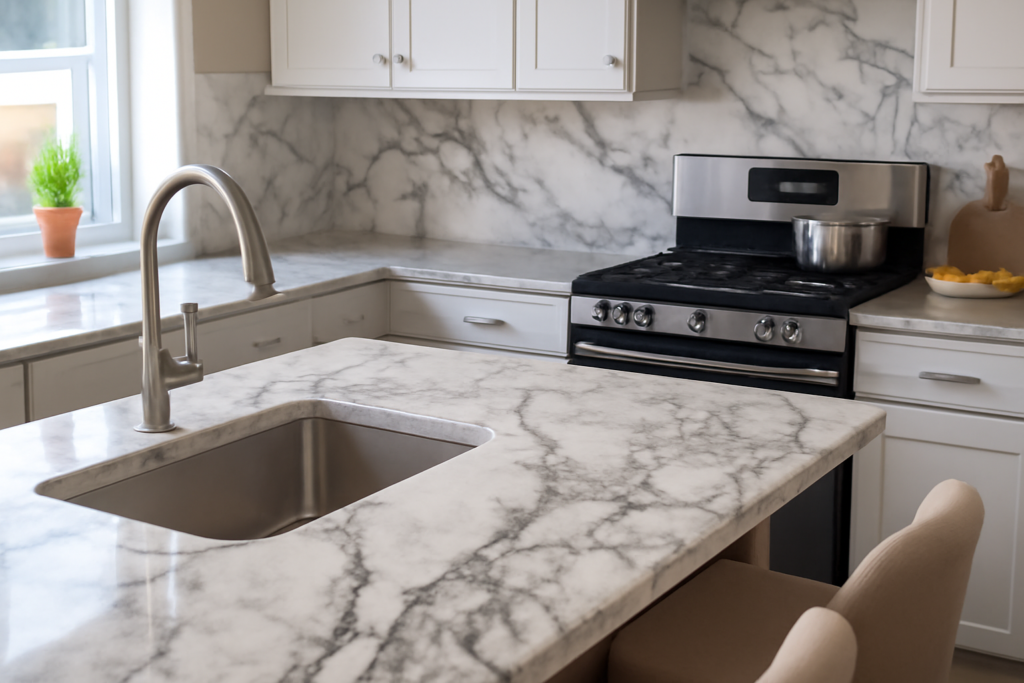
If you love the high-drama look of white stone streaked with bold gray and gold veins, calacatta granite countertops probably caught your eye at the slab yard. That name promises the luxury of classic Calacatta marble without the fragility that scares people off. Before you sign a fabrication order, it helps to know exactly what you are buying, because “Calacatta granite” is a marketing description more than a strict geological label. Get the terminology straight and you will shop smarter, negotiate better, and end up with a counter that performs the way you expect for the next 20 years.
Part of our Countertops guide — explore the full guide →
- What "Calacatta Granite" Actually Means
- The Look: White Background, Bold Veins
- Durability: Granite and Quartzite Strength
- Sealing and Maintenance
- Cost Per Square Foot
- Pros and Cons at a Glance
- Where to Use Calacatta Granite
- Edge Profiles and Finishes That Suit the Look
- How It Compares to Engineered Quartz
- Buying and Installation Tips
- Final Thoughts
What “Calacatta Granite” Actually Means
True Calacatta is marble quarried in the Carrara region of Italy. It is prized for a bright white background and thick, sweeping veins in gray, taupe, or gold. Marble, however, is a soft calcium-based stone that etches when acid touches it and scratches more easily than most people want in a busy kitchen. That is where the confusion starts.
When suppliers list a slab as “Calacatta granite,” they usually mean a granite or quartzite slab that mimics the white-with-bold-veining Calacatta aesthetic. Some are genuine granite, an igneous rock built from quartz, feldspar, and mica. Many white “Calacatta” slabs sold today are actually quartzite, a metamorphic stone that is even harder than granite. Ask the fabricator to confirm the true stone type in writing. It changes how the slab seals, cuts, and holds up.
The Look: White Background, Bold Veins
The whole appeal is contrast. You get a light, creamy-to-bright-white field crossed by dramatic veining rather than the busy speckled pattern most people picture when they hear “granite.” That makes these slabs read as elegant and modern instead of dated.
Because natural stone is never uniform, no two slabs match. Vein thickness, color saturation, and background whiteness vary from block to block. Always hand-select your actual slabs at the yard instead of ordering from a small sample. On a 3-foot by 8-foot slab, a vein you loved in a 4-inch chip might dominate the whole island, so you want to see the full sheet and even lay out where the sink and seams will fall.
Durability: Granite and Quartzite Strength
This is the payoff for choosing a granite or quartzite look-alike over real marble. Granite rates about 6 to 7 on the Mohs hardness scale, and quartzite runs 7 or higher, versus roughly 3 to 4 for marble. In practical terms you get a surface that shrugs off knife nicks, resists heat, and stands up to daily kitchen abuse far better than a marble Calacatta.
- Scratch resistance: Everyday utensils will not gouge the surface, though you should still use a cutting board to protect your knives.
- Heat tolerance: A hot pan set down briefly will not scorch the stone, but repeated thermal shock can weaken any natural stone, so use trivets for pots straight off a 400°F burner.
- Etch resistance: Genuine granite and quartzite resist acid etching from lemon juice and wine much better than marble, which is the single biggest reason to choose the look-alike.
Sealing and Maintenance
Natural stone is porous to varying degrees, so most white granite and quartzite slabs benefit from a penetrating sealer. Lighter stones can show stains more readily than dark granite simply because a coffee ring is easier to see on white.
Do the water test: drip a tablespoon of water on the counter and watch it. If it soaks in and darkens the stone within 10 to 15 minutes, the surface needs sealing. Many homeowners reseal every 12 to 18 months, though a high-quality impregnating sealer can last several years. Wipe up wine, citrus, oil, and tomato quickly no matter how well sealed the stone is.
Daily Cleaning
Use warm water with a few drops of dish soap or a pH-neutral stone cleaner and a soft microfiber cloth. Skip vinegar, bleach, ammonia, and abrasive scrubbing pads, all of which can dull the polish or degrade the sealer over time.
Cost Per Square Foot
Pricing depends on whether your slab is granite or quartzite, its rarity, and your local labor market. As a general guide for installed countertops in the United States:
- Calacatta-look granite: roughly $50 to $100 per square foot installed for common patterns, climbing toward $120 for exotic slabs.
- Calacatta-look quartzite: often $80 to $175 per square foot installed, since quartzite is harder to quarry and fabricate.
- Real Calacatta marble: frequently $100 to $250 per square foot installed, and it demands far more babying.
Those numbers usually include templating, fabrication, edging, and installation, but confirm what your quote covers. Sink cutouts, waterfall edges, and extra seams add cost.
Pros and Cons at a Glance
Pros
- High-end marble aesthetic without marble’s fragility
- Excellent scratch and heat resistance
- Each slab is one of a kind
- Strong resale appeal in kitchens and baths
Cons
- Requires periodic sealing, unlike engineered quartz
- Light color shows stains and crumbs more than dark stone
- Premium look-alikes can cost as much as real marble
- Terminology confusion means you must verify the true stone type
Where to Use Calacatta Granite
These slabs shine as kitchen island tops and perimeter counters, where the veining becomes a focal point in an otherwise neutral room. They pair beautifully with white shaker cabinets for a bright, timeless look, or against deep navy and forest-green cabinetry for stronger contrast. In bathrooms they make elegant vanity tops, and a bookmatched slab behind a range makes a stunning full-height backsplash. Just keep in mind that lighter stone in a heavily used prep zone means more diligent wiping.
Edge Profiles and Finishes That Suit the Look
The edge you choose changes how the stone reads. A clean eased or straight edge keeps the mood modern and lets the veining stay the star. A slightly softened quarter-round or beveled edge feels a touch more traditional, while a chunky mitered edge that creates a 2-inch or thicker apparent thickness gives a substantial, high-end presence on an island.
Finish matters too. A polished surface deepens the veining and boosts that glossy, luxurious marble look, but it also shows fingerprints and water spots more readily on lighter stone. A honed matte finish softens the whole surface for a more understated feel, though honed stone can be a bit more prone to showing stains, so seal it well. Ask to see both finishes on your actual stone type before deciding, because the same slab can look like two different materials depending on how it is finished.
How It Compares to Engineered Quartz
Homeowners cross-shopping this look almost always compare it to a marble-look engineered quartz. Both give you the white-and-veined aesthetic, but they behave differently. Natural granite and quartzite deliver genuine one-of-a-kind veining and superior heat tolerance, at the cost of periodic sealing. Engineered quartz is non-porous and never needs sealing, but its resin binder makes it more vulnerable to scorching from a hot pan.
If you love the idea that no one else on earth has your exact slab and you do not mind a simple sealing routine, natural stone wins. If you want zero maintenance and a perfectly predictable pattern across a big kitchen, quartz makes more sense. Neither is objectively better; it comes down to how you cook and how much upkeep you will actually do.
Buying and Installation Tips
- Measure your real square footage before you shop so you know how many slabs your project needs; a typical kitchen uses 40 to 55 square feet.
- Reserve the full slabs you selected in writing so the yard does not sell them before your template is ready.
- Plan seam placement with your fabricator; seams are unavoidable on long runs but can be hidden near sinks or in low-traffic corners.
- Confirm the sealer used and ask for the reseal interval in writing so you know the maintenance schedule up front.
- Get everything itemized: template, fabrication, edge, cutouts, delivery, and installation should all appear on the quote.
Final Thoughts
Choosing calacatta granite countertops gives you the coveted white-and-veined marble look with a surface tough enough for real family cooking. The key is knowing what you are actually buying: confirm whether your slab is granite or quartzite, hand-select the full sheet, and plan on a simple sealing routine. Do that, and you get a countertop that turns heads at every dinner party while holding up to a decade or two of everyday use.