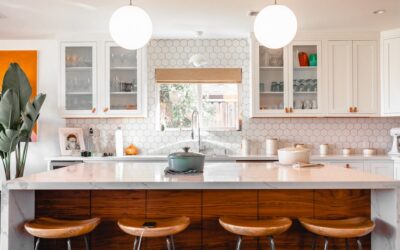
If you want the timeless look of natural stone without the stark coldness of solid white, white and grey granite countertops hit a sweet spot that has stayed in demand through every kitchen trend cycle. The pale background reads bright and clean while the grey veining and mineral flecks add depth that a manufactured surface struggles to match.
Part of our Countertops guide — explore the full guide →
Having specified and installed a lot of stone over the years, I’ll give you the straight version: which patterns to look at, what they actually cost installed, how much maintenance they really need, and where quartz might serve you better. Let’s dig in.
What Makes Granite White and Grey
Granite is an igneous rock, and its color comes from the minerals that crystallized as the molten rock cooled. White comes largely from feldspar and quartz, grey and black flecks from minerals like biotite mica and amphibole, and any warm undertones from iron staining. Because it’s a natural stone, no two slabs are identical, and even slabs cut from the same block vary along their length.
That variability is the appeal and the catch. You are buying a one-of-a-kind surface, so you should always select your actual slabs at the yard rather than approving from a small sample chip. A 4-inch sample cannot show you the movement and grey patterning across a full 9-foot slab.
Granite also comes in different finishes, and the finish shifts how the white and grey reads. A polished finish is glossy and makes colors pop, a honed finish is matte and softens the look while hiding fingerprints, and a leathered finish adds subtle texture that masks smudges best of all. For a bright kitchen, polished keeps things crisp, but honed is having a real moment for a more understated, contemporary feel.
Best White and Grey Granite Patterns
These are the go-to options I steer clients toward when they want a white field with grey character.
- Alaska White: A creamy white base with grey and burgundy-brown speckles and occasional garnet flecks. Busy and forgiving of crumbs, making it a practical everyday choice.
- Bianco Antico: Warm white to light grey with soft brown and pink mineral deposits. It pairs beautifully with white or grey shaker cabinets.
- River White: A light grey-white background with fine burgundy garnet dots and grey veining that gives gentle movement without looking chaotic.
- Colonial White: A clean grey-white with darker grey and near-black speckling. One of the more consistent, less busy options in this family.
- Steel Grey and Silver Cloud: Deeper grey fields for anyone who wants grey to dominate rather than white.
If your heart is set on the dramatic grey-on-white veining of high-end marble, know that granite rarely mimics that exact look. For that specific aesthetic, a veined quartz or genuine marble may be closer, though each carries its own tradeoffs.
What White and Grey Granite Countertops Cost
Granite is priced per square foot and grouped into tiers. White and grey varieties usually fall in the middle to upper-middle range because the popular imported patterns command a premium.
- Entry-level slabs: roughly $40 to $60 per square foot installed.
- Mid-tier patterns (most of the ones above): about $60 to $100 per square foot installed.
- Premium or exotic slabs: $100 to $175 per square foot installed.
For a typical kitchen with 40 to 50 square feet of counter, that puts a realistic installed budget around $3,000 to $6,000 for a mid-tier white and grey granite. Installed pricing generally bundles templating, fabrication, edge work, a standard sink cutout, and setting the stone. Confirm what’s included, because some fabricators charge extra for cutouts, cooktop openings, or premium edges.
Edge Profiles That Suit the Look
The edge you choose changes both the style and the price. Standard profiles like an eased (square with a softened corner) or quarter-round edge are usually included. Upgraded profiles cost more per linear foot.
- Eased/straight: clean and modern, typically no upcharge.
- Bullnose or half-bullnose: softly rounded, timeless, small upcharge.
- Ogee: an S-curve for traditional kitchens, often $10 to $25 per linear foot extra.
- Mitered thick edge: a chunky modern look built by joining pieces, the priciest option.
For a bright white-and-grey kitchen I usually recommend an eased or half-bullnose. They keep the focus on the stone’s pattern rather than the profile.
Sealing and Daily Maintenance
Granite is porous, so it needs sealing, but modern penetrating sealers make this easy. Most quality slabs need sealing once at installation and then re-sealing every 1 to 3 years. Lighter stones like these can show staining a touch more than dark granite, so staying on top of sealing matters.
Here’s the simple test: drip a tablespoon of water on the counter and wait 15 minutes. If it beads or sits on top, the seal is good. If the stone darkens where the water sat, it’s time to reseal, which is a 20-minute DIY job with a bottle of stone sealer costing $15 to $30.
For daily care, wipe with warm water and a pH-neutral stone cleaner or a drop of mild dish soap. Skip vinegar, lemon, bleach, and abrasive pads, all of which can etch or dull the finish over time. Use a cutting board and trivets even though granite tolerates heat well, since thermal shock can occasionally crack any stone. Blot spills like wine, coffee, and oil promptly rather than letting them sit, because a properly sealed but light-colored granite still resists staining better when it isn’t given hours to soak.
White and Grey Granite vs. Quartz
This is the question I field most. Both are excellent, and the right pick depends on your priorities.
Granite is 100 percent natural, tolerates hot pans better than quartz, and gives you that unrepeatable organic pattern. The tradeoffs are periodic sealing and less color consistency slab to slab. Quartz is engineered, non-porous, never needs sealing, resists stains almost completely, and offers highly uniform veining if you want a marble look. Its weaknesses are lower heat tolerance (a hot pot can scorch the resin) and, to some eyes, a slightly less natural appearance.
Cost is roughly comparable in the mid-range, generally $60 to $120 per square foot installed for either. If you cook aggressively and love the idea of a unique natural surface, granite wins. If you want zero maintenance and precise color matching, lean quartz. Resale is a wash in most markets, since buyers view both as premium upgrades over laminate or solid surface.
One practical note: quartz can discolor under prolonged direct sunlight, so for a kitchen with a big south-facing window, natural granite is the safer pick near that light. In a shaded interior kitchen, either performs the same for decades.
Making the Final Decision
My recommendation: shortlist two or three patterns like River White, Bianco Antico, or Colonial White, then visit the stone yard and view full slabs in daylight next to a door or cabinet sample. Tape a piece of paper to the slab and mark the section you want cut for your island, because slab positioning dramatically changes the finished look.
Get itemized quotes from at least two fabricators, confirm the sealer and warranty, and ask how they handle seams on runs longer than 9 to 10 feet. Done thoughtfully, white and grey granite countertops deliver a bright, durable, genuinely one-of-a-kind kitchen surface that should look great for decades.