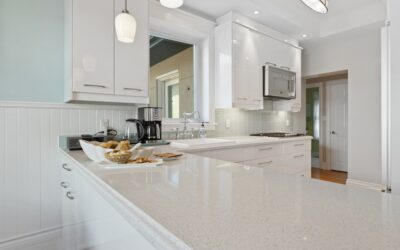
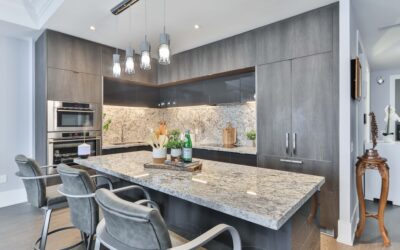
White cabinets have led kitchen design for 15 straight years, and the natural-stone counter sitting on top is the decision that either dates the space immediately or holds up for two decades. Granite with white cabinets remains a top pairing in 2026 for one reason: natural stone moves at a pace cabinet trends cannot. Pick the right slab, edge, and finish and the kitchen reads as classic. Pick the wrong one — busy patterns with orange flecks, ogee edges, glossy polish on rustic styling — and you guarantee a redo within ten years. This guide walks through proven combinations, pricing tiers, and the details that get the look right.
Part of our Countertops guide — explore the full guide →
Color Picks That Stay Timeless
The granite-and-white-cabinet kitchens that age best stick to a tight palette: cool grays, soft whites with veining, deep charcoals, and a few warm neutrals. Avoid heavily multicolored stones with three or more dominant tones — they fight with the simplicity of white cabinetry.
- White Ice — light gray and white with soft black veining
- Bianco Romano — warm cream base with subtle gold flecks
- Black Pearl — deep charcoal with silver and copper flake
- Steel Gray — solid gray honed for a concrete look
- Alaska White — bright white with subtle gray veining
- Colonial White — light cream with deep burgundy and gray accents
- Kashmir White — soft white with garnet flecks
- Volga Blue — dramatic dark blue with silver iridescence
- Galaxy Black — black base with gold and silver flake
- Andromeda White — cool white with deep gray movement
Cool-toned whites like Pure White (Sherwin-Williams) and Decorators White (Benjamin Moore) pair with cool granites: White Ice, Steel Gray, Alaska White. Warm-toned cabinet whites like Alabaster and Swiss Coffee work better with Bianco Romano or Kashmir White.
Finish: Polished, Honed, or Leathered
Polished granite shows the deepest color and highest gloss but reflects every overhead light. It is the standard for traditional kitchens and the default at most fabricators.
Honed granite has a matte, satin finish that reads as modern and hides fingerprints. It does require sealing more frequently — every 6 to 12 months versus every 12 to 24 months for polished. Honed light-colored granites stain more easily; reserve the finish for darker stones like Steel Gray or Absolute Black.
Leathered finish is the textured option, giving granite a soft handfeel and dimensional surface. It hides water spots, fingerprints, and minor scratches. Leathered Black Pearl with white shaker cabinets has become one of the most-requested combinations in transitional kitchens since 2024.
Edge Profiles That Match the Cabinet Style
The edge profile signals the kitchen’s style as much as the stone color. Pair the wrong edge with the cabinet style and the design falls apart.
- Eased (square with slight chamfer) — modern or transitional kitchens, shaker cabinets
- Half bullnose — most popular all-purpose edge, transitional to traditional
- Full bullnose — soft, family-friendly, transitional
- Ogee — traditional, raised-panel cabinets, formal style
- Mitered (3 cm appearance) — modern, flat-panel cabinets, premium look
- Beveled — Arts and Crafts, Mission style
Edge profile upgrades from standard eased add $8 to $25 per linear foot to the slab cost. The premium mitered edge runs $30 to $50 per linear foot but delivers the appearance of a 3-inch-thick slab from a 3 cm material.
Slab Thickness Choices
Granite slabs come in 2 cm (3/4 inch) or 3 cm (1-1/4 inch) thickness. 3 cm is the residential standard, supports overhangs up to 10 inches without bracket reinforcement, and feels substantial. 2 cm requires plywood underlayment and is mostly used for vertical applications or budget remodels.
For islands with seating, a 3 cm slab is the only sensible choice. A 12-inch overhang for bar seating with a 3 cm granite needs steel corbels every 24 inches per the Marble Institute of America Dimension Stone Design Manual.
Backsplash Decisions That Pair Well
A 4-inch granite backsplash matching the counter dates a kitchen instantly. Modern installations skip the granite backsplash and run subway tile, large-format porcelain, or zellige to the underside of cabinets.
For white shaker cabinets with cool-toned granite, white 3-by-6 subway tile with gray grout reads as classic. For warmer granites, cream zellige or Cle Tile bone-colored handmade subway adds dimension without competing with the stone.
Full slab backsplash matching the counter works only in modern kitchens with dramatic veining you want to feature. The cost runs $1,200 to $4,500 in additional granite depending on backsplash height and run.
Pricing Tiers and Sourcing
Granite pricing in 2026 ranges widely based on the rarity of the slab and the fabricator’s overhead.
- Builder-grade (Uba Tuba, Santa Cecilia) — $45 to $65 per sq ft installed
- Mid-tier (Bianco Romano, White Ice) — $65 to $95 per sq ft installed
- Premium (Kashmir White, Galaxy Black) — $90 to $130 per sq ft installed
- Exotic (Volga Blue, Patagonia, Blue Bahia) — $130 to $250 per sq ft installed
For a 50-square-foot kitchen counter, the difference between builder-grade and premium runs $2,200 to $4,500. Visit the stone yard in person and pick your specific slab — granite varies dramatically piece to piece even within the same name.
Sealing and Maintenance
Test sealer absorption monthly. Drop a small amount of water on the counter and watch. If it beads, the seal is working. If it absorbs within 2 minutes, reseal. Use Granite Gold Sealer ($16 a bottle) or DuPont StoneTech Bulletproof Sealer ($35 a bottle) — both wipe-on, wipe-off application.
Clean daily with pH-neutral spray cleaner (Method Granite, Bona Stone, Granite Gold Daily Cleaner). Avoid vinegar, lemon juice, and standard household cleaners — acid etches granite over time. Wipe spills of red wine, coffee, and citrus immediately.
Granite with white cabinets remains a winning combination because the stone brings character without the maintenance demands of marble. Get the color, edge, and finish to match your overall style direction and the kitchen reads as deliberate for the long haul.