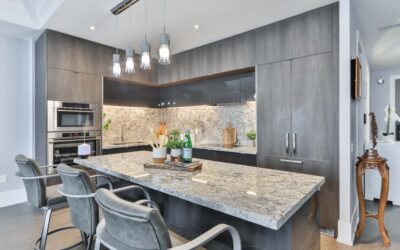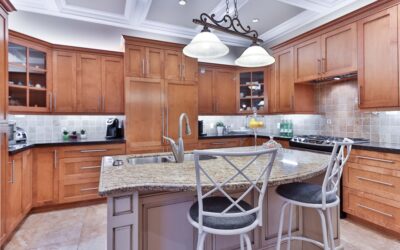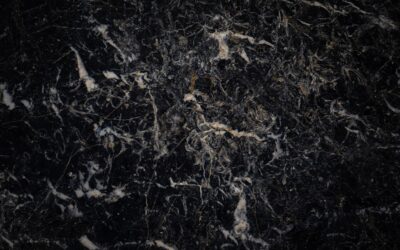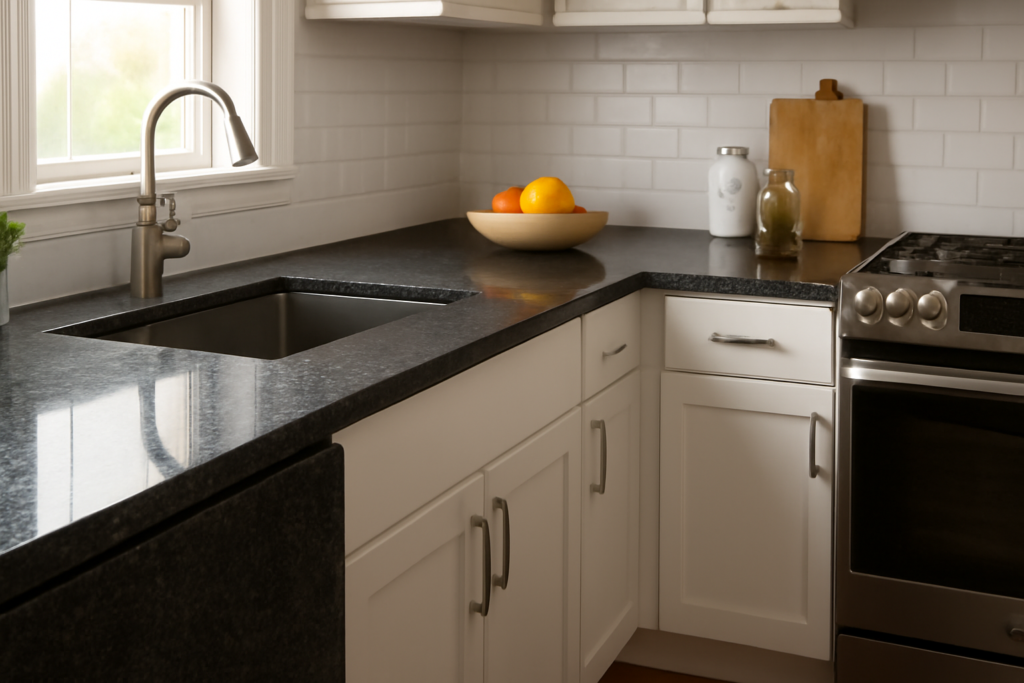
If you want the drama of black countertops without the maintenance headaches and price tag of true black granite, there’s a stone that splits the difference. Black Pearl granite countertops deliver a deep charcoal-to-black base flecked with silver, bronze, and the iridescent shimmer that gives the stone its name. Quarried mainly in India, it lands in the affordable-to-mid tier at roughly $40 to $70 per square foot installed. It’s dense, forgiving, and hides crumbs and water spots far better than a flat jet-black slab, which is why it shows up in so many real kitchens, not just showrooms.
Part of our Countertops guide — explore the full guide →
What Black Pearl Granite Looks Like
Technically Black Pearl is a gabbro or norite, not a true granite, but in the countertop world that distinction doesn’t change how it performs. The surface is a dark gray-black peppered with small to medium flecks of silver-gray, steel blue, and brown. Catch it at an angle and the mica crystals flash with a pearlescent sheen that gives the stone its depth.
Slabs vary, so this is one stone where you absolutely want to hand-pick your actual slab. Some lean more silver and uniform, others show larger bronze flecks or subtle banding. The version you see online may not be the one you get, so visit the yard and tag the specific slabs for your job.
Finishes: Polished, Honed, and Leathered
The finish changes the personality of the stone more than most buyers expect.
- Polished: the classic glossy finish that brings out maximum shimmer and depth. Reflective, easy to clean, shows water spots and fingerprints more.
- Honed: a matte, satin surface with a softer, more contemporary look. Hides smudges well but can show oils if left unsealed.
- Leathered: a textured finish with subtle dimension that masks fingerprints and water marks beautifully, increasingly popular for modern kitchens.
For a busy family kitchen, leathered or honed Black Pearl forgives daily life better than high-polish. For a sleek, formal look that pops, polished is hard to beat.
What Black Pearl Granite Costs
Pricing depends on slab grade, thickness, finish, and your fabricator, but here’s a realistic range for budgeting a full kitchen.
- Material only: $25 to $45 per sq ft.
- Installed (fabrication plus install): $40 to $70 per sq ft.
- Leathered or honed finishes: often a $5 to $10 per sq ft upcharge.
- Edge upgrades: ogee, waterfall, and mitered edges add to the total.
For an average kitchen with around 40 square feet of counter, plan on roughly $1,600 to $2,800 installed. That puts Black Pearl among the better values in natural stone, well below premium exotics while still being genuine granite.
Sealing and Maintenance
Black Pearl is dense, which means it’s less porous than lighter granites and may not need frequent sealing. Run the water test: pour a tablespoon on the surface and watch. If it beads, you’re sealed. If it soaks in and darkens within a few minutes, it’s time to apply an impregnating sealer.
Most installs benefit from one application of a quality stone sealer at install and a check every year or two after that. Day to day, clean with a pH-neutral stone cleaner or mild dish soap and warm water. Skip vinegar, lemon, and ammonia, which dull the polish and degrade sealer over time. Wipe spills promptly, use trivets under hot pans, and cut on a board to protect both the stone and your knives.
What to Pair It With
Black Pearl’s flecks are a designer’s gift because they tie into so many palettes. The silver and bronze specks let you pull cabinet and hardware colors directly from the stone.
- White or cream cabinets: high contrast, timeless, makes the counter the star.
- Gray cabinets: a tonal, modern look that leans on the stone’s silver flecks.
- Natural wood cabinets: warm oak or walnut plays off the bronze in the stone.
- Backsplash: a light subway tile keeps things bright, or a glass mosaic picks up the shimmer for a richer effect.
For flooring, light to mid-tone wood-look floors keep a dark counter from feeling heavy, while a matching dark tile creates a dramatic, cohesive space.
Pros and Cons to Weigh
No stone is perfect, so go in clear-eyed. On the plus side, Black Pearl is durable, heat-resistant, dense, hides daily mess, and costs less than most dark exotics. The flecks add movement that flat black surfaces lack, and it’s widely available, so matching or sourcing more is rarely a problem.
On the downside, slab variation means you can’t order sight unseen with confidence, and polished versions still show water spots and smudges to some degree. Like all natural stone, it requires occasional sealing and acid-safe cleaning. None of these are dealbreakers, they’re just the trade-offs of choosing a natural material over an engineered one.
Is Black Pearl Right for Your Kitchen
If you love the look of dark stone but want something practical and budget-friendly, Black Pearl granite countertops are one of the smartest picks in the category. They bring real depth and shimmer, take heavy use in stride, and pair with nearly any cabinet color you throw at them.
Before you commit, visit the stone yard, view full slabs in natural light, and choose a finish that matches how you actually live in your kitchen. Tag your slabs, confirm the edge profile, and ask your fabricator for a sealer recommendation. Do that homework and you’ll get a countertop that looks high-end for years at a price that doesn’t sting.
Edge Profiles and Finishing Details
The edge you choose changes the whole feel of the counter and affects the price. A standard eased or beveled edge reads clean and modern and usually comes at no upcharge. Step up to a bullnose for a soft, rounded look that’s easy on hips and toddlers, or an ogee for a traditional, decorative profile that catches the light and shows off the stone’s thickness.
For a bolder statement, a mitered edge stacks two pieces of stone to create a thick, chunky look, and a waterfall edge runs the granite down the side of an island to the floor. Both add material and labor cost, often several hundred dollars, but they dramatically elevate a kitchen. Whatever you pick, ask your fabricator how the flecks will look along the cut edge, since the shimmer that makes the surface special carries onto the profile too.