
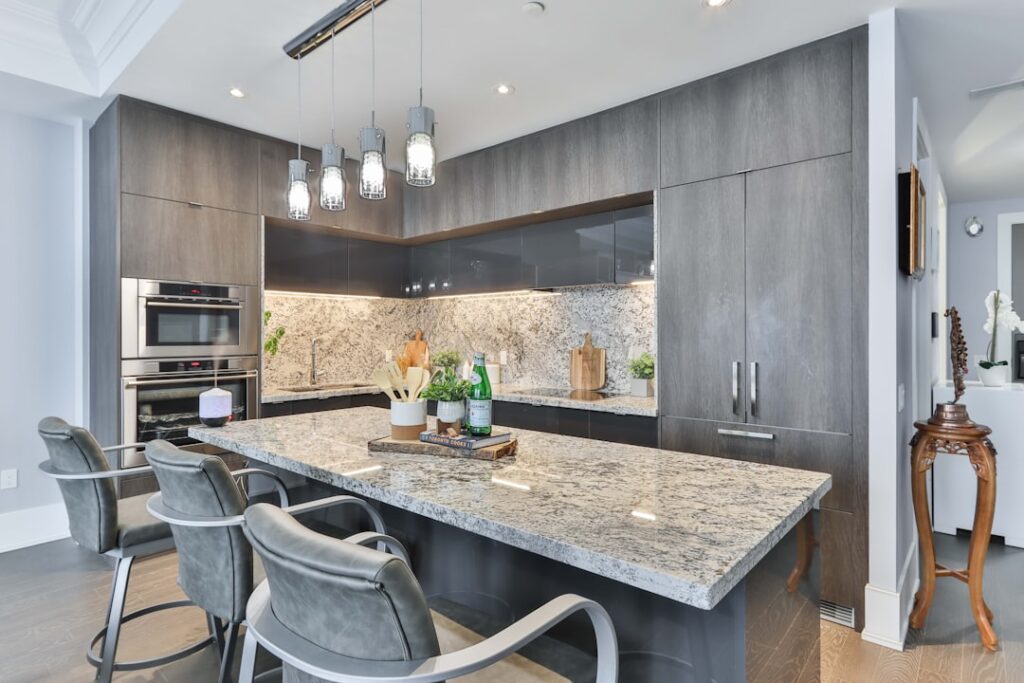
If you love the drama of dark stone but dislike the mirror-like shine and constant smudging of a polished slab, black leather granite deserves a spot on your shortlist. The leathered finish keeps granite’s natural depth and color while adding a soft, textured, low-sheen surface that reads more modern and far more forgiving day to day. It has become one of the most requested countertop treatments in kitchens that lean contemporary, industrial, or organic-modern.
Part of our Countertops guide — explore the full guide →
This guide walks you through what the finish actually is, how it behaves in a real kitchen, what it costs, and how to keep it looking sharp for decades. By the end you should know whether leathered black granite is the right call for your space or whether a polished or honed surface would serve you better.
What “Leathered” Actually Means
Granite arrives from the quarry as raw stone, and the finish is applied afterward through fabrication. A polished finish is buffed with progressively finer abrasives until it reflects light like glass. A honed finish stops short of that, leaving a flat matte surface. Leathering goes a step further: diamond-tipped brushes are run across the slab to gently remove softer minerals while leaving harder crystals slightly raised. The result is a subtle, rippled texture you can feel with your fingertips.
On dark stone the effect is striking. Black granite that looks gray and dusty when honed often regains its deep, saturated color once leathered, because the textured surface scatters light differently than a flat matte finish. You get richness without glare. Run your hand across a leathered slab in a showroom and the difference from a polished sample is immediately obvious.
Why Homeowners Choose the Leathered Look
The practical appeal is hard to overstate. Polished black stone is notorious for showing every fingerprint, water spot, and crumb under kitchen lighting. The textured surface of a leathered finish hides those everyday marks remarkably well, which makes it a favorite for busy households and anyone tired of wiping the counter every time someone walks past.
Visually, the finish bridges styles. It is dressy enough for a refined kitchen yet earthy enough for a rustic or industrial one. Paired with white cabinets it delivers crisp contrast; paired with walnut or matte navy cabinetry it feels warm and grounded. The texture also pairs beautifully with matte black or brushed brass hardware, which is part of why designers reach for it so often.
Popular Black Granite Stones That Take a Leathered Finish
Not every black stone is created equal, and the natural pattern matters as much as the finish. A few options you are likely to encounter:
- Absolute Black — the deepest, most uniform option, with almost no visible movement. Leathering softens its severity and gives it a velvety look.
- Black Pearl — dark gray to black with shimmering silver and bronze flecks that catch light through the texture.
- Cosmic Black and similar exotics — black backgrounds with bold gold, gray, or white veining that leathering renders dramatic and tactile.
- Steel Gray — technically charcoal rather than true black, but a popular near-black choice with subtle directional movement.
Always view a full slab rather than a small sample. Granite is a natural material, and the bottle of an exotic black can vary wildly from one corner to another. What you approve at the stone yard is what ends up in your kitchen.
Pros and Cons You Should Weigh
Every surface involves trade-offs. Here is an honest accounting before you commit.
- Hides smudges and water spots far better than polished stone.
- Keeps deep color that honing tends to wash out.
- Naturally heat and scratch resistant like all granite.
- Texture can trap residue in the low points if you wipe with greasy cloths, so it benefits from a degreasing cleaner now and then.
- Slightly harder to clean spills from than a perfectly smooth surface, though the difference is minor.
- Availability varies by region and fabricator, so confirm your chosen stone can be leathered before you fall in love with it.
What Black Leather Granite Costs
Granite is typically priced per square foot installed, and the leathered finish usually adds a modest premium over polished because it requires an extra fabrication step. As a general estimate, expect installed pricing in the range of roughly $50 to $120 per square foot, with exotic black stones and complex edge profiles pushing toward the upper end. These are ballpark figures only; your final number depends on slab rarity, local labor rates, the number of cutouts, and edge detailing.
To get an accurate price, take your measurements to two or three local fabricators and ask for quotes on the specific stone you want with a leathered finish. Confirm whether removal of an old counter, sink cutouts, and sealing are included. Getting line-item quotes is the only reliable way to compare, and it protects you from surprise charges later.
Sealing, Cleaning, and Long-Term Care
Despite the texture, care is straightforward. Most black granite is dense and less porous than lighter stones, but you should still confirm whether your slab needs sealing. A simple test: drip a little water on the surface and watch. If it beads, the stone is well protected; if it darkens within a few minutes, it is time to seal. Many leathered black slabs need sealing only once a year or even less.
For daily cleaning, use warm water and a few drops of mild dish soap, or a cleaner labeled safe for natural stone. Avoid acidic products like vinegar and lemon, as well as abrasive scouring powders, which can dull the finish over time. Wipe with a soft microfiber cloth and dry the surface to prevent any film from settling into the texture. An occasional pass with a stone-safe degreaser keeps the low points of the leathered surface from holding onto cooking residue.
Is It the Right Choice for Your Kitchen?
Leathered black granite rewards homeowners who want bold color, low maintenance, and a finish that forgives real life. It works hardest in high-traffic kitchens where polished stone would constantly betray fingerprints, and it photographs beautifully in design-forward spaces. If you crave a glossy, formal look or you want the cheapest possible surface, another option may suit you better.
Before deciding, bring home a large sample if your fabricator allows it, set it under your actual kitchen lighting, and live with it for a few days. Test how it looks in morning light versus evening, and how easily your everyday spills wipe away. When the texture, the color, and the maintenance all feel right, black leather granite can be the quiet centerpiece that ties an entire kitchen together for years to come.


