Some granites earn their popularity through drama. Luna Pearl earned it by being impossible to get wrong. Luna Pearl granite countertops are among the most widely installed natural stone surfaces in American kitchens, and the reasons are simple: the color works with nearly every cabinet on the market, slabs are so consistent that what you see in the showroom is what arrives in your kitchen, and the installed price undercuts most engineered quartz by a comfortable margin. Quarried in Sardinia, Italy, this fine-grained gray-white stone belongs to the Bianco Sardo family, and it has quietly become the default recommendation fabricators make when a customer wants real granite without a slab-yard treasure hunt. Here is everything worth knowing before you buy it.
Part of our Countertops guide — explore the full guide →
Luna Pearl Granite Countertops: What Luna Pearl Actually Is
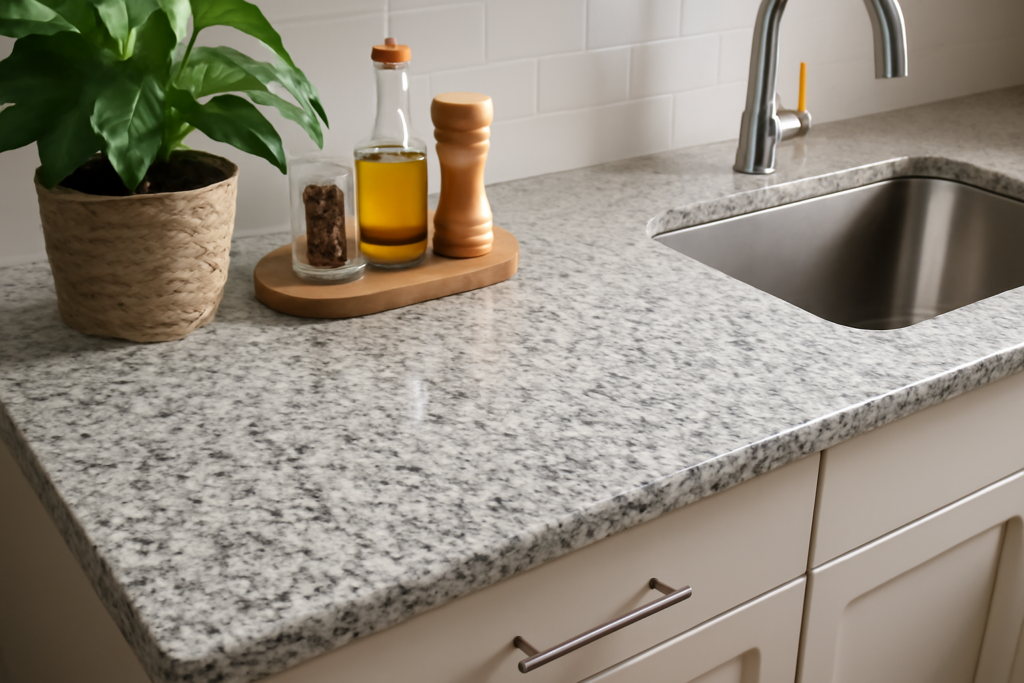
Luna Pearl is a granodiorite-to-granite stone from the island of Sardinia, sold under several trade names including Bianco Sardo, Sardinian White, and sometimes Grigio Sardo depending on the block and the importer. The look is a fine, even salt-and-pepper texture: a light gray to grayish-white field of quartz and feldspar peppered uniformly with small black biotite flecks, none of them much bigger than a pencil eraser. What separates Luna Pearl from generic gray speckle granites is the mica. Small plates of muscovite and biotite catch light across the surface, giving the polished stone a subtle silvery shimmer that shifts as you move around the kitchen. It is a quiet effect, more moonlight than glitter, and it is where the “pearl” in the name comes from.
Geologically, the stone is dense and tight-grained, with water absorption typically under 0.4 percent and hardness on par with the classic commercial granites. Sardinian quarries have been producing it at industrial scale for decades, supplying everything from countertops to curbstones across Europe, which is exactly why supply into the US is steady and pricing stays low.
Consistency: The Underrated Superpower
Buy a heavily veined exotic granite and you must visit the yard, tag your slabs, and approve a dry layout, because every slab is different. Luna Pearl removes all of that friction. The grain is so uniform that two slabs cut from different blocks usually match closely enough that even fabricators have to look hard to find the transition. Seams virtually disappear, which matters enormously in L-shaped and U-shaped kitchens where a seam lands in a visible run. It also means you can confidently order from a sample, expand the project later, or replace a damaged section years down the road and still get a match. For rental properties, flips, and multi-unit work, that repeatability is worth as much as the price.
What Luna Pearl Costs
Plan on $35 to $55 per square foot installed for 3cm slab material, including fabrication and standard installation. That makes a typical 40-square-foot kitchen a $1,400 to $2,200 project, which is remarkable for genuine imported Italian stone. Two things keep the price down: enormous quarry output and the stone’s popularity as a prefabricated product. Prefab Luna Pearl counters, cut overseas to standard sizes like 96×26 inches with the front edge already polished and profiled, sell through stone yards and big-box suppliers for as little as $12 to $20 per square foot in material, leaving only cutouts, seaming, and installation to pay for locally. If your kitchen layout fits standard depths, prefab can bring the whole job under $1,500. Custom slab work costs more but buys you seamless corners, custom overhangs on islands, and full-height backsplash options.
Compare that against $70 to $120 per square foot for mid-range quartz or $60 to $100 for popular white granites like Colonial White, and the value story is obvious. Luna Pearl is consistently one of the three or four cheapest true granites in any US market, alongside stones like Dallas White and Santa Cecilia.
Kitchens and Palettes Where Luna Pearl Shines
Gray-white speckle is the closest thing natural stone has to a true neutral, so the pairing question is less “what works” than “what mood do you want.” With white shaker cabinets, Luna Pearl reads clean and bright, and the black flecks add just enough texture to keep an all-white kitchen from looking sterile. Against espresso or black cabinets, the stone lightens the room and the salt-and-pepper pattern echoes the contrast. Wood-tone cabinetry, from honey oak to walnut, benefits from the stone’s cool cast balancing the warmth of the grain.
Backsplash choices are wide open. White subway tile is the safe classic; gray glass mosaic picks up the flecks; and a simple 4-inch splash in the same granite keeps prefab budgets tight. Stainless appliances and brushed nickel hardware match the stone’s silvery mica almost exactly, while matte black fixtures emphasize the biotite flecks. The one pairing to approach carefully is busy patterned tile, because the stone’s fine speckle plus a busy splash can create visual static; give one of them room to breathe.
Luna Pearl also performs beyond the kitchen. Its low price makes it a favorite for bathroom vanities, laundry counters, and utility spaces, and its density makes it a legitimate outdoor kitchen candidate, where UV stability and freeze-thaw resistance rule out many engineered surfaces.
Finishes and Edge Profiles
Polished is the standard finish and shows the mica shimmer at full strength. Honed Luna Pearl trades the shimmer for a soft, matte, almost concrete-like look that suits modern kitchens, though it slightly darkens the gray and shows fingerprints a bit more until it develops a patina. Leathered finishes are less common on fine-grained stone like this, but some fabricators offer it, and it adds grip and hides water spots around sinks. On edges, an eased or quarter-round profile fits the stone’s understated character and comes standard on prefab pieces. Bullnose and demi-bullnose remain popular in traditional kitchens, and upgraded profiles typically add $10 to $20 per linear foot on custom work.
Sealing, Cleaning, and Long-Term Care
Luna Pearl is dense but light-colored, so sealing is cheap insurance against oil shadows. Most fabricators apply an impregnating sealer at installation; after that, test annually by pooling a tablespoon of water on the counter for 15 minutes. If the stone darkens, apply a fresh coat of solvent-based impregnator, which takes about 30 minutes for an average kitchen. Daily care is warm water with a drop of dish soap or any pH-neutral stone cleaner. Avoid vinegar, bleach, and abrasive powders, which dull the polish and strip sealer over time. Heat tolerance is excellent, so a hot pan will not scorch it, though trivets remain smart practice near seams. If an oil stain does develop, a poultice of baking soda and water covered with plastic wrap for 24 hours will draw it out of the stone.
Chips are rare and repairable. Because the pattern is a fine speckle, a fabricator’s epoxy fill tinted gray disappears into the surface far better than it would in a veined stone, which is one more way consistency pays off over a countertop’s 25-plus-year life.
Luna Pearl vs. the Alternatives
Shoppers usually cross-shop Luna Pearl against three options. Against white speckle granites like Dallas White or Colonial White, Luna Pearl runs slightly grayer and often a few dollars cheaper, with equal consistency. Against gray quartz, the granite wins on price by $30 or more per square foot and on heat resistance, while quartz wins on stain-proofing and offers a whiter, cleaner base if that is the goal. Against Bianco Sardo sold under other names, be aware you may be quoted different prices for effectively the same stone, so ask your fabricator directly whether their Luna Pearl and Bianco Sardo come from the same Sardinian quarries. Shopping the name variations is one of the easiest ways to save a few hundred dollars on the identical product.
Bottom Line
Luna Pearl is the sensible-shoes stone that still manages a little sparkle. If your project needs real granite durability, a neutral that flatters any cabinet color, seam-friendly consistency, and a price that leaves budget for better appliances, it is one of the strongest value plays in natural stone. See a full slab in person once to confirm the gray tone suits your light, then buy with confidence, because with this stone, what you see really is what you get.