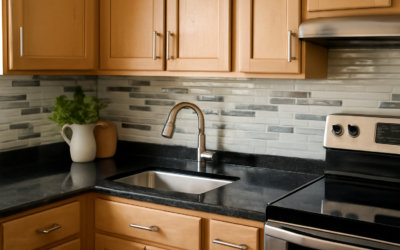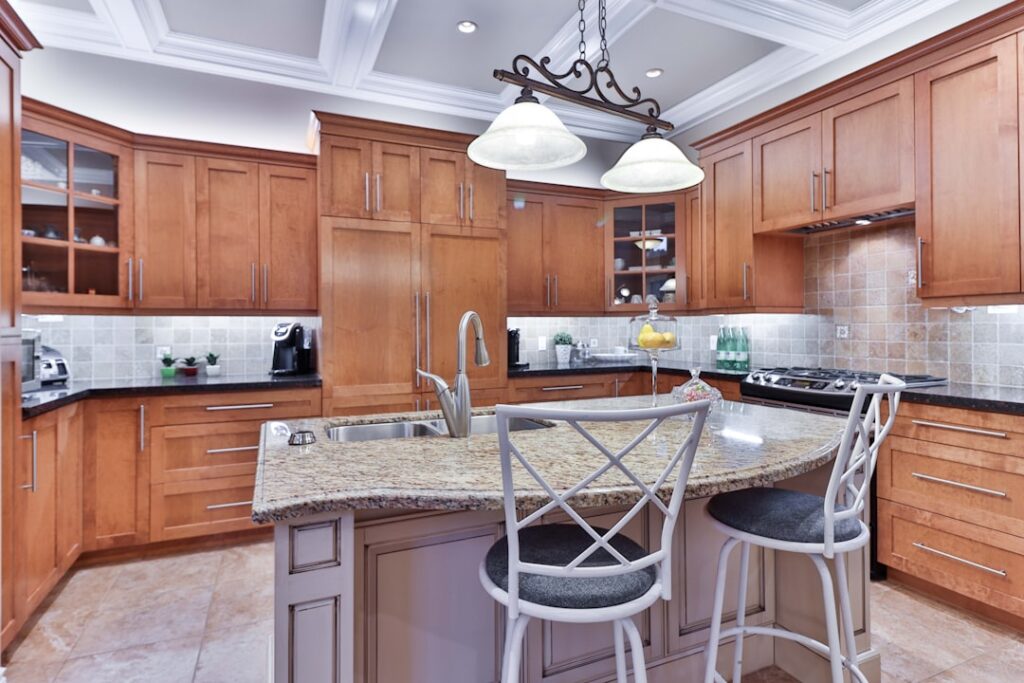
Oak cabinets get called dated, but the truth is most of them were just paired with the wrong stone. Choosing granite countertops with oak cabinets comes down to one skill: reading the orange-yellow undertone in the wood and picking a slab that either echoes it or deliberately cuts against it. I have templated hundreds of kitchens with honey oak, golden oak, and red oak boxes, and the same eight or nine granite colors solve almost all of them. This guide names those slabs, explains the undertone logic, and covers finish, edge, and pricing so you walk into the stone yard knowing what you are looking at.
Part of our Countertops guide — explore the full guide →
Start With Oak’s Undertone, Not the Granite Aisle
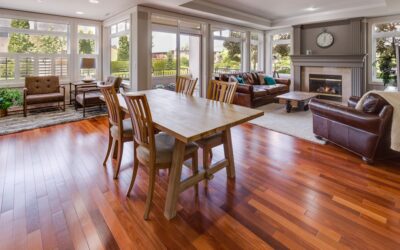
Every stained oak cabinet sits somewhere on a warm spectrum. Honey and golden oak, the classic 1990s builder finish, throws a strong orange-yellow cast. Red oak with a natural or cherry-tinted stain leans pink-orange. Newer white oak in lighter finishes reads more neutral tan. Before you look at a single slab, take a cabinet door off its hinges, because you will need it at the slab yard anyway, and look at it in daylight. Whatever hue dominates the grain is the undertone your granite has to answer.
Two strategies work. Harmonize by picking granite with gold, beige, or brown movement that repeats the wood’s warmth, which makes the kitchen feel cohesive and forgiving. Or contrast by going dark or cool-gray, which makes the oak read as the deliberate warm element instead of the thing the countertop is fighting. What fails is the middle ground: a granite with faint pink or violet undertones, like some Brazilian whites, sitting next to orange oak turns muddy. Bring the door, set it against the actual slab, not a 4-inch sample, and step back 10 feet.
Warm Golds That Harmonize: The Safe Bets
New Venetian Gold is the single most common granite I have set on honey oak, and for good reason. Its cream base with soft gold veining and small garnet flecks picks up the cabinet color without matching it so closely that everything blurs together. Santa Cecilia runs a step deeper, more pronounced gold and brown mineral movement with black flecks, and it hides crumbs and water spots better than any light stone I know. Giallo Ornamental splits the difference: a grayer cream background with amber patches, useful when your floor is tile in a cool tone and you need the counter to bridge warm cabinets and a cool floor.
All three are Brazilian workhorses in constant supply, which keeps them in the entry pricing tier, typically $40 to $60 per square foot installed for 3 cm slabs at most fabricators. A typical 45-square-foot kitchen lands around $2,000 to $2,700 installed. If the budget allows a step up, Colonial Gold and Kashmir Gold give similar warmth with larger, more dramatic veining for $55 to $75 per square foot.
Dark Contrast: Uba Tuba and Black Pearl
When a client wants the oak to look intentional rather than surrounded, I steer them dark. Uba Tuba, a Brazilian green-black loaded with gold and green mica flecks, was practically made for golden oak; the flecks echo the cabinet color while the near-black field gives crisp contrast. It is dense, takes a polish beautifully, and usually prices at $35 to $55 per square foot installed, making it one of the best values in the category.
Black Pearl, an Indian stone, reads charcoal-black with a subtle silver-green shimmer from its mica content. Against medium oak it looks tailored, and in a leathered finish, more on that below, it is my single favorite pairing for oak kitchens being updated on a budget. Expect $45 to $65 per square foot installed. Absolute Black is the third dark option: a true uniform black with almost no pattern, $50 to $70 installed for the genuine Indian material. It is striking but unforgiving, since a solid black polished surface shows every fingerprint, so I only recommend it polished for low-traffic kitchens or in a honed finish for everyone else.
Grays and Whites: Cooling Down Orange Oak
Gray granite can modernize oak, but the undertone rule gets strict here. Steel Grey, another Indian quarry staple, is a mid-tone gray with fine, even black-and-silver grain and zero pink cast, which is exactly why it works where pinkish grays like Luna Pearl can fail next to orange wood. Leathered Steel Grey on honey oak with a matte black faucet is a combination I have installed a dozen times in the last few years, and it photographs like a kitchen twenty years newer than its cabinets. Pricing runs $45 to $60 per square foot installed.
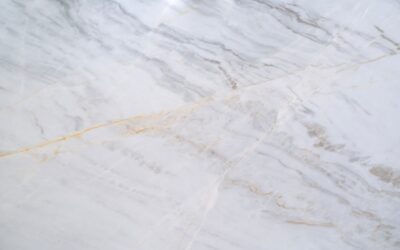
For light and bright, look at White Ice or Alaska White, both Brazilian whites with gray and silver veining over a cool white base, often carrying small amber or bronze garnet flecks that quietly nod to the oak. These run $55 to $80 per square foot installed depending on lot quality. Inspect white granite lots carefully; veining density varies wildly slab to slab, and some Alaska White lots carry a beige wash that shifts the whole stone warm. That can be a feature with oak, but decide with the cabinet door in hand.
Polished vs. Leathered: Finish Changes the Pairing
Finish alters how granite reads next to wood grain more than most homeowners expect. Polished stone reflects light and saturates color, so a polished Santa Cecilia looks golder and glossier against oak, amplifying the warmth. Leathered finish, a textured matte produced with diamond brushes at the factory, knocks the shine down and mutes color a half shade, which tones down busy stones and makes dark granite look expensive rather than builder-grade. Leathering typically adds $5 to $15 per square foot over polished for the same stone, and not every color is stocked leathered, though Black Pearl, Steel Grey, and Absolute Black commonly are.
Honed, a smooth matte, is the third option, but on true black granite it can show hazy hand marks unless treated with an enhancing sealer. Practical note: leathered and honed surfaces hide water spots and fingerprints better than polish, but their opened texture means you should seal annually with an impregnating sealer such as StoneTech BulletProof, about $30 a quart, versus every two to three years for polished.
Edge Profiles That Suit Oak Kitchens
Oak cabinetry has visual weight, so the edge profile should hold its own without getting fussy. An eased edge, a squared profile with the sharp corner softened, is the default and usually free in the fabrication quote. Half bullnose and full bullnose suit traditional raised-panel oak doors and typically add nothing or $5 to $10 per linear foot. Ogee, the S-curve, pairs with cathedral-arch oak doors in formal kitchens but adds $10 to $20 per linear foot and collects grime in its cove.
Skip the fancy laminated double edges on busy granite like Santa Cecilia; the pattern is doing enough work. One more spec worth insisting on: 3 cm slab thickness rather than 2 cm with a glued-on drop edge. The laminated seam on 2 cm material shows as a horizontal line at the edge, and next to strong oak grain it reads cheap. Most US fabricators quote 3 cm as standard anyway.
How to Shop the Slab Yard Like a Pro
Granite is a natural product, so the name gets you to the neighborhood but the individual slab closes the deal. Ask the fabricator which slab yard holds their material and go tag your own slabs; a 45-square-foot kitchen typically needs two. View them upright in natural light, wet a section with a spray bottle to preview the polished depth of color, and hold your cabinet door directly against the stone. Check the whole slab for rust-colored iron blooms and cross-hatch fissures near where your sink cutout will land.
Get seam placement drawn on the quote, insist on a color-matched epoxy seam under 1/16 inch, and confirm the bid includes sink cutout, faucet holes, sealing, and tear-out of the old tops, which together can hide $400 to $700 in extras. Do that, and granite countertops with oak cabinets stop being a compromise and start being the reason the wood finally looks right.