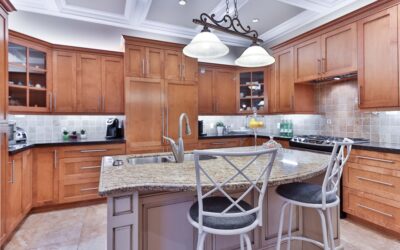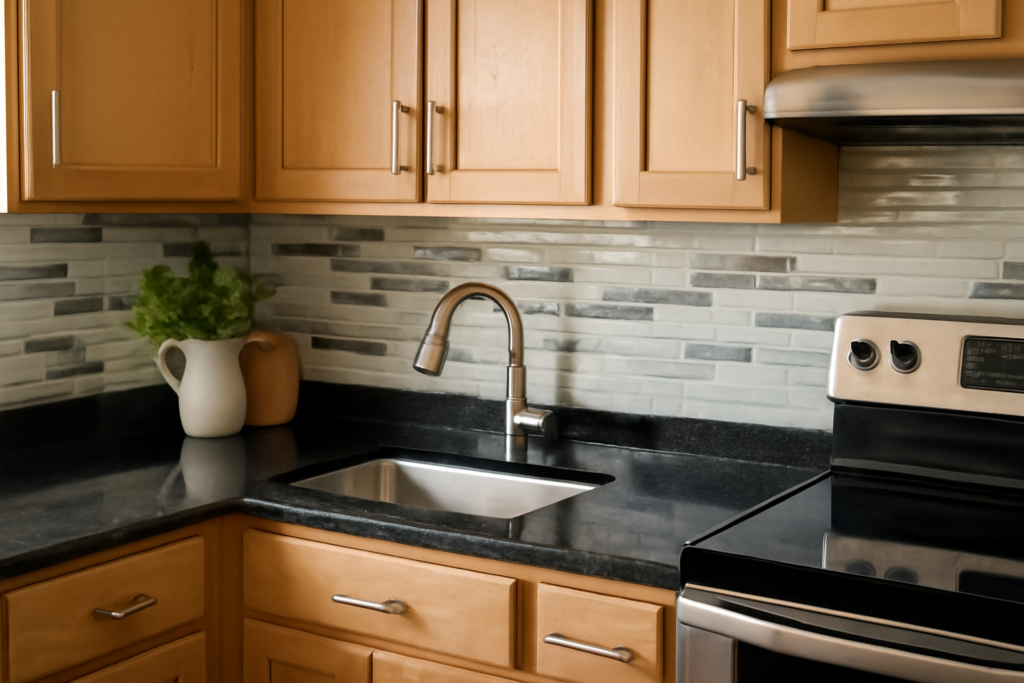
Black granite and maple is one of the most common kitchen pairings in America, and it’s also one of the easiest to ruin with the wrong tile. The best backsplash ideas for black granite countertops and maple cabinets all start from the same insight: maple is not a neutral wood. Whether your doors are natural blond or a caramel glaze, maple carries a distinct warm yellow undertone, and it sits against granite that is doing the exact opposite — dark, dense, and high-contrast. The backsplash is the referee between them. Pick a tile that respects maple’s warmth and the kitchen looks intentional; pick a stark cool tile and the cabinets suddenly read orange and dated. After twenty-plus years of setting tile over this exact combination, here is what actually works.
Part of our Countertops guide — explore the full guide →
- Read Your Granite First: Absolute Black, Black Pearl, or Uba Tuba
- Warm White and Cream Subway Tile: The Safe Bet That Isn't Boring
- Travertine and Beige Stone: The Natural Partner
- Glass Mosaic Blends: Tie Both Finishes Together
- Gray, Greige, and Matte Black: The Modern Direction
- Grout Choices That Make or Break the Wall
- What to Avoid With This Combination
- Budget and Installation Numbers
Read Your Granite First: Absolute Black, Black Pearl, or Uba Tuba
Not all “black” granite behaves the same on the wall above it. Absolute Black is a true solid black with almost no pattern, which makes it a blank slate — nearly any warm-leaning tile works, and the counter provides pure contrast. Black Pearl is different: it’s loaded with silver, gray, and gold-green mica flecks that shimmer under lighting, so your backsplash needs to stay calmer or the two surfaces fight. Uba Tuba reads black from across the room but is actually a deep green with gold and cream speckles, and that green undertone pairs unusually well with beige stone and cream tile.
Take a cabinet door and a granite sample, or at least good photos in daylight, to the tile store. Hold candidate tiles vertically against both. Under warm 2700K kitchen lighting, maple pushes yellower and Black Pearl’s flecks go gold, and a tile that looked perfect under showroom fluorescents can shift cold at home. Buy two or three $5 sample tiles and tape them to the wall for a week before committing. That $15 test has saved more of my clients than any design rule I know.
Warm White and Cream Subway Tile: The Safe Bet That Isn’t Boring
Subway tile remains the volume leader for a reason, but the shade matters enormously here. Skip bright, blue-white glossy subway — against maple it makes the wood look muddy and orange. What you want is a warm white or cream: think biscuit, almond, antique white, or a hand-glazed look with tonal variation. Daltile’s Rittenhouse in Almond or Biscuit runs about $2 to $4 per square foot and threads the needle perfectly. If the budget allows, a handmade-look glazed tile with an undulating face — a Zellige-style ceramic at $12 to $18 per square foot — catches light the way Black Pearl’s mica does and elevates the whole wall.
Sizing is your other lever. Classic 3×6 laid in a running bond is timeless; a larger 4×12 in the same cream tones feels more current and cuts grout lines by a third. In a kitchen with only 30 square feet of splash, upgrading from $3 builder subway to $15 artisan tile costs about $360 more in material. Against a black counter, that upgrade is visible from the front door.
Travertine and Beige Stone: The Natural Partner
If you want the combination that decorators reach for first with this pairing, it’s warm natural stone. Travertine in a 3×6 subway or a tumbled 2×2 mosaic picks up maple’s honey tones and softens black granite’s severity in one move. Ivory and Noce travertine blends run $6 to $12 per square foot, and a split-face or tumbled finish adds texture that a flat ceramic can’t match. Crema Marfil marble and beige limestone do the same job with a more formal, polished character.
Two contractor warnings before you fall in love. First, travertine is porous and sits directly behind a cooktop catching grease and tomato splatter, so seal it with a penetrating sealer like Miracle 511 before grouting and again after, then annually. Second, honed stone shows oil darkening over time near the range; a glazed porcelain travertine-look tile, such as Daltile or Marazzi lines at $4 to $7 per square foot, gives you 90 percent of the appearance with zero maintenance. With Uba Tuba counters especially, the beige-stone route is nearly foolproof because the granite’s gold speckles repeat in the tile.
Glass Mosaic Blends: Tie Both Finishes Together
A glass mosaic is the one backsplash that can literally contain both halves of your kitchen. Look for linear or brick-pattern blends that mix black or smoke glass with amber, bronze, and cream pieces — the black chips echo the granite while the warm chips echo the maple, and the eye reads the whole kitchen as one composed palette. Blends like these run $10 to $20 per square foot on 12×12 mesh sheets, so a typical 30-square-foot kitchen lands at $300 to $600 in material.
Restraint pays here, particularly over Black Pearl or Uba Tuba. Speckled granite plus a busy multicolor mosaic is visual static. My rule on installs: the mosaic gets no more than three colors, and at least one must already exist in the counter or the cabinets. Also insist on a bright white thinset behind glass — standard gray mortar telegraphs through translucent chips and dulls the amber tones you paid for.
Gray, Greige, and Matte Black: The Modern Direction
Maple kitchens skew traditional, but the right tile pulls the combination firmly into contemporary territory. A warm gray or greige ceramic — gray with a beige base, not a blue base — bridges black counters and warm wood without the yellow-versus-white tension. Large-format 12×24 greige porcelain at $3 to $6 per square foot, stacked or offset, gives a clean modern field with minimal grout. Picket and elongated hexagon shapes in the same tones add geometry without adding color.
Matte black is the bolder move: a matte black picket or 2×6 finger tile used on the range wall only, with cream field tile elsewhere, extends the granite vertically and makes caramel-glazed maple glow by contrast. Full walls of black tile work in bright kitchens with generous windows, but in a north-facing galley they close the room down fast. Brick-look thin tile is the third modern-rustic option — reclaimed-style brick veneer in whitewashed or tan blends runs $8 to $15 per square foot and its rough texture plays surprisingly well against polished Absolute Black.
Grout Choices That Make or Break the Wall
Grout is 10 percent of the surface and 50 percent of the impression. With cream or almond subway over black granite, match the grout to the tile — warm whites like Mapei Biscuit or Bone — so the field reads as one calm surface and the granite supplies all the contrast. Choosing bright white grout with cream tile is the most common DIY error I see; it makes the tile look dirty. Charcoal grout on white tile is trendy, but over black counters it doubles down on contrast and gets busy quickly; reserve it for kitchens with true Absolute Black and very simple tile.
With travertine and stone mosaics, stay tonal: a sanded grout in Linen or Chamois disappears into the blend. For glass, use unsanded or, better, a premium product like Mapei Flexcolor CQ or an epoxy grout, since sanded grout can scratch glass faces. Whatever you choose, spend the extra $15 on grout with integrated sealer or seal cementitious grout after cure. Budget $1 to $2 per square foot for grout and setting materials on top of tile cost.
What to Avoid With This Combination
Some choices fail against black granite and maple almost every time. Stark cool white — bright glossy white tile with white grout — clashes with maple’s warmth and shifts the cabinets orange under evening light; if you want white, warm it up. Busy multicolor mosaics over speckled Black Pearl or Uba Tuba create pattern-on-pattern noise with no place for the eye to rest. Primary-color accents like cobalt or cherry-red deco strips date a kitchen within a decade and fight the earthy palette. Yellow-beige builder tile from the early 2000s, the classic 4-inch almond wall tile, amplifies maple’s yellow until the whole room reads jaundiced. And skip 4-inch granite backsplash strips matching the counter with painted drywall above; that half-measure was standard in 2005 tract homes and now visually shortens the wall. Run tile the full 18 inches from counter to upper cabinets.
Budget and Installation Numbers
A typical kitchen carries 25 to 40 square feet of backsplash. At the material level, plan on $2 to $4 per square foot for basic ceramic subway, $4 to $8 for quality porcelain and stone-look tile, $6 to $12 for real travertine or marble, and $10 to $20 for glass mosaic blends. Add roughly $2 per square foot for thinset, grout, edge trim like Schluter Jolly profiles, and sealer. Professional installation runs $10 to $25 per square foot depending on tile size and layout complexity, with mosaics and stone at the high end, so a full professionally installed splash lands between $500 and $1,500 for most kitchens.
This is also one of the most DIY-friendly tile projects in the house: flat wall, no waterproofing, minimal cuts, one weekend. A wet saw rents for $50 a day, though a $30 score-and-snap cutter handles ceramic subway fine. However you get it done, let the pairing you already own make the decision. The strongest backsplash ideas for black granite countertops and maple cabinets aren’t about finding a spectacular tile — they’re about choosing a warm, quiet bridge that lets an inherently high-contrast kitchen finally look like it was designed on purpose.