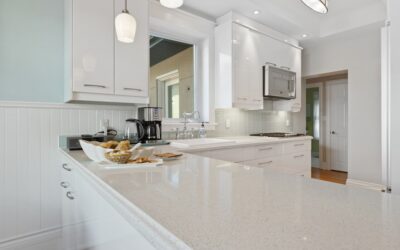
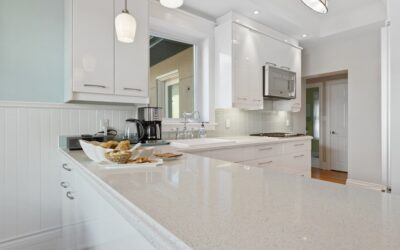
White granite has become one of the most requested countertop choices for homeowners who want the brightness of a light kitchen with the durability of natural stone. Unlike pure-white engineered surfaces, white granite carries the depth, flecking, and subtle veining that only nature produces, giving each slab a one-of-a-kind look. It pairs beautifully with everything from dark navy cabinets to warm wood, and it brings real heat resistance to the kitchen. Here is what to know before choosing white granite for your home.
Part of our Countertops guide — explore the full guide →
What White Granite Looks Like
True white granite is rarely a flat, uniform white. Instead, it features a light background scattered with gray, black, beige, or even gold mineral specks, plus occasional veining. That natural movement is part of its appeal, but it also means the slab you see in a showroom sample will not perfectly match the full slab. Because granite is quarried natural stone, no two pieces are identical, so it is important to view and approve the actual slab before fabrication.
Popular White Granite Styles
Several well-known granite varieties read as white or light, each with a different character.
- Fine-flecked whites: Stones with small, evenly distributed black and gray specks give a clean, salt-and-pepper look that suits modern kitchens.
- Veined whites: Some granites show marble-like gray veining over a white base, offering drama without marble’s fragility.
- Warm whites with beige and gold: These lean creamy and pair well with warm woods and brass fixtures.
- Cool gray-whites: Crisp tones that complement white or navy cabinetry and stainless appliances.
When shopping, focus on the overall tone and the size and color of the mineral specks rather than a specific trade name, since names vary between suppliers.
Durability and Heat Resistance
Granite is one of the hardest countertop materials, resisting scratches and everyday wear extremely well. It is also highly heat resistant; you can briefly set a hot pan on it, though using trivets remains a smart habit to protect both the stone and any sealer. Like all natural stone, granite can chip at an edge under a sharp, hard impact, so avoid dropping heavy cookware on corners.
Sealing and Maintenance
Because granite is porous, white granite in particular benefits from proper sealing, since light stone can show stains more readily than dark stone. Most fabricators seal the surface at installation, and you should plan to reseal periodically, typically every one to three years depending on the stone’s density and how heavily the counter is used.
A quick water test reveals when resealing is due: pour a small puddle of water on the surface and wait several minutes. If the water beads up, the seal is intact. If it soaks in and darkens the stone, it is time to reseal. For daily cleaning, use a soft cloth and a pH-neutral stone cleaner or mild soap and water. Avoid acidic cleaners, vinegar, and abrasive pads, which can dull the polish and degrade the sealer over time.
White Granite vs. White Quartz and Marble
Homeowners drawn to a white counter often weigh three materials.
White Granite vs. White Quartz
Quartz is engineered, nonporous, and never needs sealing, with a more consistent pattern. White granite offers natural, unrepeatable character and stronger heat resistance, but it requires periodic sealing and varies slab to slab.
White Granite vs. Marble
Marble has a softer, more elegant veining but is far more prone to etching and staining from acids like lemon and wine. White granite delivers a bright look with much better stain and scratch resistance, making it the more practical choice for busy kitchens.
Cost of White Granite
Installed white granite generally runs about $40 to $100 per square foot, though rare or heavily veined slabs can cost more. The final price depends on the specific stone, slab thickness, edge profile, number of cutouts for sinks and cooktops, and the complexity of your layout. Getting quotes from multiple fabricators and selecting your own slab helps control both cost and appearance.
Design Pairings
White granite is wonderfully versatile. It brightens small kitchens, balances dark cabinetry, and gives white-on-white kitchens needed texture. For a classic look, pair it with white shaker cabinets and a subway tile backsplash. For contrast, set it against navy or charcoal cabinets. Warm-toned white granites with gold and beige flecks flatter wood cabinetry and brass hardware, while cool gray-whites suit modern stainless and matte black fixtures.
Choosing the Right Slab
With white granite especially, selecting the actual slab in person is essential. Showroom chips show only a small piece of a stone that can vary enormously across a full slab, with veining and mineral concentration shifting from edge to edge. Visit the stone yard, view the full slabs under good light, and tag the specific ones you want fabricated. Pay attention to how busy or calm the pattern is; a quiet white granite suits a minimalist kitchen, while a dramatically veined slab becomes a statement piece on an island. If your kitchen needs more than one slab, confirm they come from the same block so the color and movement coordinate.
Edge Profiles and Backsplash Options
The edge profile you choose affects both the look and the price. A straight or eased edge feels modern and is the most economical, while ogee and bullnose edges add a traditional, decorative touch at extra cost. Many homeowners pair white granite counters with a matching full-height granite backsplash for a seamless, easy-to-clean look, or with a contrasting tile backsplash such as white subway tile for classic style. Discuss thickness too; a 3 cm slab feels substantial and often needs no extra support, while a 2 cm slab may be built up at the edge for a thicker appearance.
Final Thoughts
White granite offers a rare combination of bright, natural beauty and rugged durability. It resists heat and scratches, complements nearly any cabinet color, and brings the unrepeatable character of real stone to your kitchen. The main commitment is periodic sealing, especially because lighter stone shows stains more easily. Choose your actual slab in person, keep it sealed, and clean it gently, and white granite will stay a stunning, hardworking centerpiece for decades.