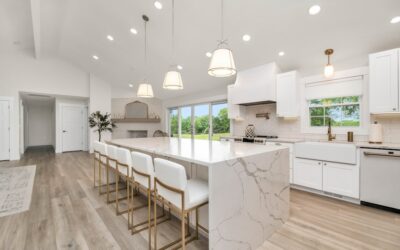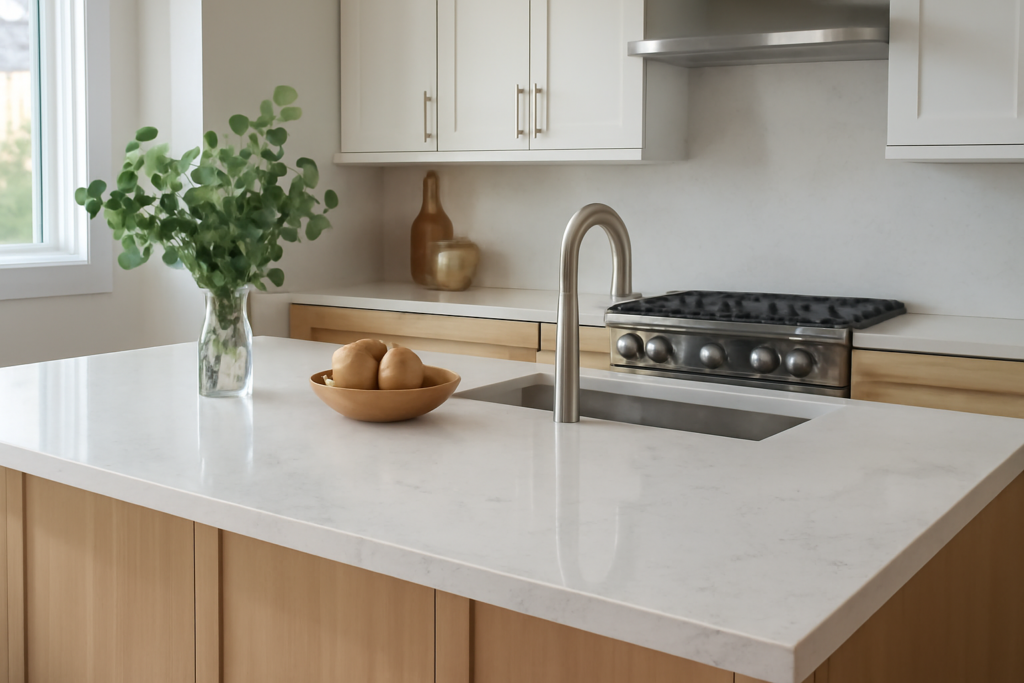
Perla White quartz has become a go-to countertop for homeowners who want a bright, clean kitchen without the icy severity of a pure white slab. It sits in that flattering middle ground: a warm white to cream background scattered with fine gray and beige speckling that reads as subtle movement from across the room. That gentle pattern is exactly why it works so hard in real kitchens, where a stark solid white shows every crumb and a busy veined stone can fight your cabinetry. If you are weighing this surface for a remodel, here is what you actually need to know about the look, the cost, and how it performs day to day.
Part of our Countertops guide — explore the full guide →
What Perla White Quartz Looks Like
The defining trait is a soft, pearl-like field peppered with tiny flecks rather than dramatic veins. Depending on the manufacturer, the base ranges from a crisp cool white to a warmer cream, and the speckles vary from light silver-gray to muted tan. Some lines carry a very fine sparkle from mirror or quartz chips catching the light, while others stay flat and matte. Because the pattern is small-scale and evenly distributed, slabs look remarkably consistent, which makes it far easier to match seams and multiple pieces than it is with heavily veined stone.
Several brands sell a product under the Perla White name or a close variant, and the exact tone shifts between them. Always view a full slab in person or at least a large sample before you commit, because a two-inch chip never tells the full story of how the speckling and undertone read across a whole countertop.
Quartz Basics: Why It Performs
Engineered quartz is roughly 90 to 93 percent ground natural quartz bound with resins and pigments, then compacted into slabs. That composition gives Perla White its two biggest advantages over natural stone. It is non-porous, so it never needs sealing and it resists staining from wine, coffee, and cooking oils. And it is extremely hard, shrugging off the scratches and chips that worry granite and marble owners.
The one real limitation is heat. Resin binders can scorch or discolor if you set a screaming-hot pan directly on the surface, so always use a trivet. That single habit aside, this is one of the lowest-maintenance countertop surfaces you can buy, which is a large part of its appeal for busy households.
Cost and What to Budget
Perla White quartz typically falls in the mid tier of quartz pricing. Expect material and fabrication together to run roughly $50 to $85 per square foot installed, depending on your region, edge profile, and the specific brand. That usually breaks down as follows:
- Material: about $30 to $55 per square foot for the slab.
- Fabrication and installation: roughly $20 to $35 per square foot, covering templating, cutting, edging, and setting.
- Extras: undermount sink cutouts, waterfall edges, and premium edge profiles add cost.
A typical 40-square-foot kitchen therefore lands somewhere around $2,500 to $3,800 installed. Get at least two or three quotes, because fabricator pricing varies widely, and confirm whether the estimate includes tear-out of your old countertop and plumbing reconnection.
Best Cabinet and Backsplash Pairings
The versatility here is genuinely broad. With white or off-white shaker cabinets, Perla White quartz creates a bright, seamless, timeless kitchen that photographs beautifully and appeals to future buyers. Against gray cabinetry, the tan and silver flecks bridge the two tones and keep the space from feeling cold. It is especially flattering with warm wood cabinets, where the cream undertones echo the wood and soften the whole room.
For backsplashes, a classic white subway tile keeps things clean and lets the counter stay the quiet hero. If you want more warmth, a beige or greige natural-stone-look tile picks up the speckling. Homeowners chasing a bolder statement sometimes run the same quartz up as a full-height backsplash for a seamless, high-end look that also wipes clean behind the stove.
Pros and Cons at a Glance
No surface is perfect, so weigh the trade-offs honestly before you buy:
- Pros: non-porous and stain-resistant, never needs sealing, highly scratch-resistant, consistent slab-to-slab appearance, hides crumbs better than solid white.
- Cons: sensitive to direct high heat, less dramatic than marble-look veined quartz, quality and exact color vary by brand, seams are visible if not placed thoughtfully.
For most families, the pros heavily outweigh the cons, especially in a kitchen that sees daily cooking and cleanup. The speckled pattern is forgiving in a way that pure white and heavily veined slabs simply are not.
Care and Everyday Cleaning
Maintenance could hardly be simpler. Wipe the surface with warm water and a drop of mild dish soap, then dry with a soft cloth. For stuck-on residue, a non-abrasive surface cleaner works fine, but skip bleach, oven cleaner, and any product with high pH or strong solvents, which can dull the finish over time. Never cut directly on the quartz, both to protect your knives and to avoid faint scratch marks in the resin.
Because it never needs sealing, there is no annual ritual to remember. Keep a couple of trivets near the stove, use a cutting board, and wipe spills when you see them, and Perla White quartz will look the same in ten years as it did the day it was installed.
How It Compares to Other White Surfaces
It helps to see where Perla White quartz sits among the alternatives homeowners typically weigh. Against a solid white quartz, it hides crumbs, water spots, and light scratches far better because the speckling breaks up the surface, which is a real advantage in a working kitchen. Against a marble-look veined quartz, it is quieter and more forgiving, less of a statement but easier to pair with busy backsplashes and patterned floors without the room feeling chaotic.
Compared to natural marble, the contrast is stark: marble stains and etches from everyday acids and needs sealing, while Perla White quartz shrugs all of that off with zero maintenance. Compared to granite, quartz offers more color consistency and never needs sealing, though granite tolerates direct heat better. For a homeowner who wants a bright, low-drama, low-upkeep counter that flatters almost any kitchen and holds broad resale appeal, this speckled white quartz lands in a genuine sweet spot that few other surfaces match at the same price and performance level.
Is Perla White Quartz Worth It?
If you want a bright, welcoming kitchen that stays low-maintenance and pairs with almost any cabinet color, Perla White quartz is an easy recommendation. It delivers the light, airy feel homeowners love while hiding daily mess better than a solid white slab, and its neutral speckling has broad, lasting appeal that supports resale value. View a full slab first, budget in the $50 to $85 per square foot installed range, and keep a trivet handy, and you will have a countertop that quietly does its job for decades.