White quartz countertops have held the top of the American kitchen design index for nine years running, and the demand keeps climbing because the surface delivers what marble cannot — the same crisp, light-reflecting visual without the etching, staining, or annual sealing. A well-designed white quartz kitchen hinges on three decisions: which white slab to specify, how to pair it with cabinet and backsplash finishes, and how to vet fabricator quotes that can swing from $50 to $150 per square foot installed for visually similar product. Get those right and the kitchen reads as timeless rather than dated within five years.
Part of our Countertops guide — explore the full guide →
Why White Quartz Dominates Right Now
The 2017-2024 design cycle favored gray, navy, and warm wood cabinets — all of which read sharper against a true white countertop than against beige granite or honed marble. Quartz outperforms both because the resin matrix prevents staining from red wine, coffee, and turmeric, and the surface needs zero sealer for the life of the slab. Cambria, Silestone, and Caesarstone all carry lifetime warranties on the resin bond.
The MOHS hardness of quartz hits 7, beating granite at 6 to 7 and crushing marble at 3 to 4. That means a dropped Wusthof knife chips the blade before it scratches the counter. The non-porous surface also resists bacterial growth, which earned NSF/ANSI 51 certification for food contact across major brands.
The Big Three Pure-White Slabs
Cambria Whitney runs $95 to $130 per square foot installed and delivers a near-pure white with extremely subtle gray flecking. The pattern reads as solid white from across the room and gains texture up close. Caesarstone Pure White at $75 to $110 per square foot installed is the cleanest, most uniform white available — no veining, no specks, just flat white.
Silestone White Storm at $70 to $105 per square foot installed splits the difference with very fine gray micro-veining. It reads warmer than Caesarstone Pure White and slightly more textured than Cambria Whitney. For a marble-look white, both Caesarstone Statuario Maximus ($95 to $135) and Cambria Brittanicca ($110 to $150) deliver convincing veining at lower maintenance than real Calacatta marble.
Marble-Look Veined Whites
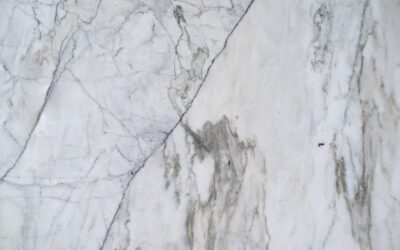
The veined whites have dominated specifications since roughly 2021. Cambria Ella, Brittanicca, and Skara Brae deliver gray and gold veining patterns that read as honed Carrara from arm’s length. MSI Q Quartz Calacatta Classique and Calacatta Laza run $55 to $85 per square foot installed and deliver 70 percent of the visual punch at half the Cambria price.
Caesarstone Calacatta Nuvo and Statuario Maximus push the photo-realistic veining further with gold and warm gray tones running through a pure white field. The slabs are bookmatched in fabrication for islands and full-height backsplashes, which means the veining flows continuously across seams rather than abruptly changing direction.
Cabinet Pairings That Work
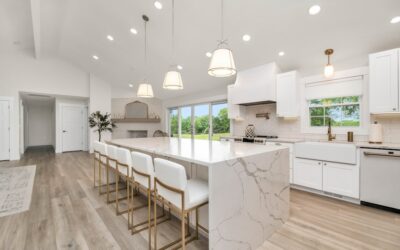
White quartz with white shaker cabinets is the safest specification — and the most overdone. To avoid the bridal-cake look, mix in a contrast island in navy (Benjamin Moore Hale Navy), forest green (Sherwin-Williams Pewter Green), or natural rift-cut white oak. The contrast island grounds the kitchen and gives the white quartz something to reflect against.
For pure white kitchens, vary the texture instead of the color. Shaker cabinets on the perimeter and slab-front cabinets on the island read differently in the same paint color. Add brass or matte black hardware from Top Knobs or Rejuvenation to anchor the white-on-white scheme without introducing competing colors.
Backsplash Choices
The most current specification continues the quartz slab up the wall as a full-height backsplash. A bookmatched Cambria Brittanicca slab behind the range delivers a single uninterrupted veining pattern from counter to underside of upper cabinets. Expect $40 to $75 per square foot installed for the slab backsplash, including templating and fabrication.
Subway tile remains the traditional choice and runs $14 to $30 per square foot installed depending on tile size and pattern. For a contemporary white quartz kitchen, scale up to 4 by 12 inch handmade ceramic from Heath Ceramics or Fireclay Tile at $28 per square foot retail. The slightly irregular surface and visible grout lines balance the precision of the quartz counters.
Hardware and Faucet Specs
Brass hardware from Top Knobs, Rejuvenation, or Schaub has dominated white quartz kitchens since 2019 and shows no sign of cooling. Specify unlacquered brass for an aged finish that develops a natural patina, or satin brass for a stable look that holds color permanently. Drawer pulls at 6 to 8 inches on base cabinets and 3 to 4 inch knobs on uppers is the standard scaling.
Pair with a Kohler Artifacts, Brizo Litze, or Delta Trinsic faucet in matching brass or polished nickel. Avoid mixing finishes between cabinet hardware and faucet — the unified metal finish reads more intentional. Budget $480 to $1,200 for the main faucet and another $120 to $280 for a soap dispenser and air gap in matching finish.
Realistic Total Project Cost
A typical 45 square foot quartz countertop in mid-tier slab like Silestone White Storm runs $3,400 to $4,800 installed. Step up to Cambria Whitney and the same kitchen lands $4,275 to $5,850. Premium marble-look slabs like Cambria Brittanicca with a waterfall island edge push $5,400 to $7,200 for the same square footage.
Add backsplash, demo, plumbing reconnect, and finish work and the total kitchen surface budget typically runs $6,800 to $12,500 for the countertop and backsplash portion of a remodel. The full kitchen including cabinets, flooring, appliances, and lighting hits $35,000 to $95,000 for most US markets.
Maintenance Across the Years
Daily maintenance is dish soap and warm water on a microfiber cloth. Avoid alkaline cleaners with pH above 10 — Method, Mrs. Meyer’s, and 7th Generation kitchen sprays are safe. Acidic cleaners under pH 4 — full-strength vinegar, CLR, bleach — can dull the resin polish over time. Stick to neutral pH cleaners.
Heat resistance hits roughly 300 degrees Fahrenheit before the resin softens or yellows. Pulling a 425-degree cast iron pan straight from the oven onto the counter can leave a permanent mark. Use a trivet or hot pad even though the marketing implies otherwise. Across the typical 25 to 30 year life of a quartz counter, the only routine maintenance is the soap-and-water wipedown.