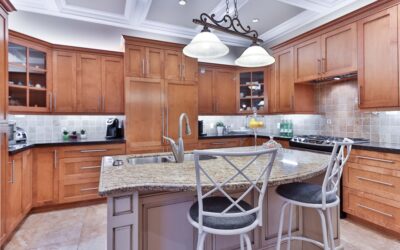
Cherry is the one cabinet wood that keeps changing color after you install it, which makes stone selection trickier than most homeowners realize. Pairing quartz countertops with cherry cabinets means choosing a slab that flatters the wood’s red-brown warmth today and still works when the cherry deepens two shades over the next few years. Engineered quartz is unusually good at this job because the color you approve in the showroom is the color you get, edge to edge, with no lot-to-lot surprises. I have templated enough cherry kitchens to know which specific products earn their keep, and this guide names them.
Part of our Countertops guide — explore the full guide →
Why Quartz Suits Cherry Better Than Most Stone
Cherry’s grain is fine and calm, and its color does the talking, a saturated red-brown that dominates any kitchen it is in. Natural slabs fight that in two ways: busy granite competes with the wood, and natural marble or quartzite varies so much between slabs that the undertone you fell for at the yard may not be the undertone that shows up on the truck. Quartz eliminates both problems. It is roughly 90 percent ground quartz in a resin binder, manufactured to a controlled recipe, so a Cambria or Caesarstone design looks the same in the sample, in the slab, and at every seam.
That consistency matters doubly with cherry because the wood itself is the variable. You want exactly one thing in the room changing color over time, and quartz guarantees the counter is not it. Add the practical wins, no annual sealing, stain resistance that shrugs off red wine, NSF-rated surfaces, and a nonporous face that never needs the babysitting natural marble demands, and quartz is the default recommendation I make for cherry kitchens.
Plan for the Darkening: Cherry Is a Moving Target
Fresh natural cherry installs looking almost pink-blond. Within six months of UV exposure it shifts to a rich amber-red, and over three to five years it settles into the deep russet most people picture. Stained cherry, the common Bordeaux and merlot factory finishes, starts dark and moves less, but it still deepens. So judge any quartz sample against where the wood is headed, not where it is now. If your cabinets are under a year old, assume they will land one to two shades darker and noticeably redder.
Practically, that means avoiding quartz that only works because the wood is currently light. A dark brown slab that looks great against new blond cherry can disappear into the cabinets by year three, killing all contrast. My rule: with natural or lightly stained cherry, pick a counter at least four shades lighter or darker than the projected mature color. With espresso-stained cherry, go light, full stop. Ask the dealer for a full 4×4-inch sample, take it home, and view it against the doors at noon and again under your actual evening lighting, because resin-based quartz can shift subtly warm under 2700K bulbs.
Warm Whites and Creams: The Reliable Winners
Cool, blue-cast whites make red wood look harsh; warm whites make it glow. Caesarstone 4600 Organic White is a cream-white with soft oatmeal speckling that flatters cherry without yellowing next to it, usually $55 to $75 per square foot installed. Cambria Swanbridge and Colton bring creamy backgrounds with gentle taupe-gold veining, and Cambria’s pricing typically runs $70 to $100 installed since the brand sells only through its premium dealer network. Silestone Coral Clay, a greige-cream solid, is a sleeper pick when the kitchen also has a warm tile floor to tie in.
Among the marble-look whites, warmth is the sorting test. Silestone Eternal Calacatta Gold layers gray veining with distinct gold threads on a warm white base, and those gold threads shake hands with cherry beautifully; expect $65 to $90 per square foot installed. Caesarstone 5131 Calacatta Nuvo is whiter and cooler with bold gray veining, and it works with cherry when the rest of the kitchen leans modern, but hold the sample against the door before committing, because against some Bordeaux stains its cool base can read stark. If you are torn between two whites in the showroom, take both samples home and let the cabinets vote.
Veined Showpieces vs. Quiet Solids
Because cherry grain is subdued, the counter can carry pattern without the room feeling busy. Cambria Brittanicca is the flagship move: sweeping gray rivers across a warm white field, dramatic enough to anchor a 10-foot island, around $80 to $110 per square foot installed. Its warmer sibling, Brittanicca Warm, swaps in taupe-gold veining and is, in my experience, the single most-complimented pairing with mature cherry. MSI’s Calacatta Laza offers a similar big-vein look in a value tier, $50 to $70 installed, and MSI Carrara Grigio gives a soft, diffuse gray marble effect for the same money when you want movement without drama.
Solids and near-solids play the opposite game, letting the wood be the pattern. Caesarstone 2141 Blizzard is a clean warm-leaning white; Silestone Miami Vena and LG Viatera Minuet sit in the lightly veined middle ground. One caution on dark solids: Caesarstone 3100 Jet Black or Silestone Negro Tebas against espresso cherry produces a handsome but heavy room unless you have generous natural light and a pale floor. In galley kitchens under 120 square feet, I steer clients light every time.
Grays, Concretes, and the Undertone Trap
Gray quartz modernizes cherry, but only grays with warm or neutral undertones. Caesarstone 4030 Pebble and Cambria’s Carrick offer greige tones that bridge red wood and stainless appliances gracefully. Concrete-look designs, Caesarstone 4004 Raw Concrete or its textured Rugged Concrete sibling, pair surprisingly well with Shaker-door cherry in transitional kitchens, typically $60 to $85 installed.
What to avoid: grays with a blue or violet cast. Blue-gray sitting against red-brown wood creates a subtle visual clash, the two undertones sit opposite each other and vibrate rather than harmonize, and it is the most common regret I hear from homeowners who picked from a 2-inch chip online. The showroom test is simple. Set the gray sample on the cherry door next to a plain white sheet of paper. If the sample suddenly looks purple, it will look purple in your kitchen forever.
Finish, Thickness, and Edge Choices
Polished is the default quartz finish and suits cherry’s formal side, but matte options deserve a look. Caesarstone’s Honed and Silestone’s Suede textures cut glare and give a soft, stone-like hand, usually adding $5 to $10 per square foot, with the tradeoff that matte surfaces show fingerprints on dark colors and want a quick daily wipe. Go 3 cm thickness for perimeter counters and islands; 2 cm with a built-up edge saves little in a quartz quote and the lamination line cheapens the look next to furniture-grade wood.
For edges, cherry kitchens split by door style. Raised-panel traditional doors take an ogee or half bullnose well, while Shaker cherry looks sharpest with a simple eased or 1/4-inch bevel edge, which fabricators typically include free. A mitered 2 1/2-inch built-up edge on the island, roughly $30 to $50 per linear foot extra, gives the slab visual mass that balances dark cabinetry.
Budgeting the Job by Tier
Installed quartz pricing clusters into three tiers, and cherry-friendly options exist in each. Value tier, $50 to $70 per square foot: MSI Q line, Wilsonart, and big-box house brands, solid quality with simpler patterns. Mid tier, $65 to $90: Silestone, Caesarstone core colors, LG Viatera, and Hanstone, where most of the products named above live. Premium tier, $80 to $120: Cambria’s full line and the boldest veined designs from other brands. A typical 45-square-foot cherry kitchen therefore runs roughly $2,500 to $4,500 installed, including template, fabrication, sink cutout, and installation.
Get the seam layout drawn on the contract, confirm the quote includes tear-out, and ask whether the fabricator book-matches veined designs at seams, Cambria dealers will for Brittanicca, and it is worth requesting. Choose a warm-based slab with your eyes on where the cherry is going, not where it started, and quartz countertops with cherry cabinets become one of the easiest decisions in the whole remodel.