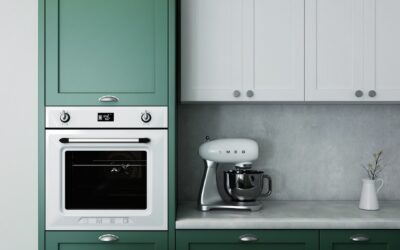
The cabinet color you choose today gets photographed for the listing in eight to twelve years. Modern cabinet colors have shifted hard since 2020 — out went the cool gray that dominated 2015 to 2019, in came warm whites, deep greens, navy blues, and natural rift-cut oak. The shift is not just trend chasing. The undertones of today’s lighting, flooring, and countertop materials all read better against warm bases. Here are the cabinet colors actually working in 2026 kitchens and bathrooms, plus the pairing rules that keep the whole room cohesive.
Part of our Kitchen Remodeling guide — explore the full guide →
Warm Whites — The Reliable Default
White cabinets are not going anywhere, but the right white has changed. Pure cool whites like Sherwin Williams Extra White SW 7006 and Benjamin Moore Chantilly Lace OC-65 look stark against warm woods and brass hardware. The current default is a warm white with soft yellow or pink undertones.
Sherwin Williams Alabaster SW 7008 is the king of cabinet whites — it reads white in bright light, creamy in evening light, and works with both warm and cool finishes. Benjamin Moore White Dove OC-17 is the close second, slightly cooler but still warm enough for natural wood floors. Both spray clean from a HVLP gun in two coats over a tinted primer and hold up better than the cooler whites under daily wiping.
Deep Greens — The Rising Winner
Green is the color of the decade for kitchens. Sherwin Williams Pewter Green SW 6208, Benjamin Moore Black Forest Green 2047-10, and Farrow and Ball Studio Green No. 93 are showing up in every magazine spread and Realtor staging book. Green works because it pairs cleanly with brass, natural wood, marble counters, and most of the warm whites.
The trick with green cabinets is light. North-facing kitchens push green toward gray and muddy gray-green. South-facing kitchens make green pop and stay vibrant. Sample any green color at four times the size of a typical paint chip — at least 12 by 12 inches — and view it at 8 a.m., noon, and 6 p.m. before committing.
Navy and Deep Blue
Navy held strong through 2022 and 2023 and remains a safe choice for islands and lower cabinets. Benjamin Moore Hale Navy HC-154 is the workhorse — deep enough to read as navy in any light, soft enough not to dominate the room. Sherwin Williams Naval SW 6244 and Benjamin Moore Newburyport Blue HC-155 are close alternatives.
Navy pairs cleanly with brushed brass, polished nickel, and matte black hardware. It struggles with chrome — the cool undertones fight each other. Pair navy lowers with white uppers for the most flexible long-term look, or run navy floor to ceiling on a small kitchen island only.
Natural Rift-Cut White Oak
The painted-vs-stained pendulum has swung back toward stained wood, specifically rift-cut white oak. Cabinet makers from RTA shops like Walcraft Cabinetry up to custom shops are spraying rift-cut white oak with a clear matte conversion varnish that lets the grain show. The look reads warm, modern, and architectural at the same time.
The cost premium is real — rift-cut oak veneer adds $1,500 to $4,000 to a typical 10-by-10 kitchen versus painted MDF. The payoff is durability (no chips to touch up) and a finish that hides daily wear far better than any painted cabinet. Specify a clear conversion varnish with at least 30 percent solids, not a water-based polyurethane, which yellows over time.
Two-Tone and Mixed Colors
The strictly white kitchen has given way to two-tone configurations. The standard formula puts warm white on the perimeter cabinets, a deeper color on the island, and natural wood somewhere — a hood surround, open shelves, or a built-in pantry. This three-way split adds depth without committing the entire room to one strong color.
A popular 2026 combination is Sherwin Williams Alabaster perimeter, Sherwin Williams Pewter Green island, white oak floating shelves, and unlacquered brass hardware. Another is Benjamin Moore White Dove perimeter, Hale Navy island, walnut hood surround, and polished nickel. Both work because the white provides the visual rest, the color island anchors the room, and the wood adds texture.
Hardware Pairings That Hold Up
Cabinet color and hardware finish make or break the look. Three finishes are dominating modern kitchens:
- Unlacquered brass — develops a patina over time, pairs with warm whites, greens, navy, and natural oak
- Matte black — clean and graphic, works with cool and warm cabinet colors, easy to source from any builder
- Polished nickel — softer than chrome, pairs with greens and navy especially well, hides fingerprints
Avoid mixing more than two metal finishes in a single kitchen unless one is a clear accent like a single brass pendant. The exception is plumbing fixtures, which can stay one finish (often chrome or polished nickel for budget reasons) while cabinet hardware is brass.
Paint Brands and Finishes That Last
For DIY cabinet painting, Benjamin Moore Advance and Sherwin Williams Emerald Urethane Trim Enamel are the two products worth using. Both are alkyd-modified water-based formulas that self-level on cabinet doors with a quality synthetic brush or a HVLP sprayer. Skip latex wall paint — even the premium ones — for cabinet refinishes, because they never harden enough to resist fingernail dings.
Spray, do not brush, if you are doing the whole kitchen. Rent a Fuji Q4 PRO HVLP for $80 a day from Sherwin Williams or buy a Wagner Flexio 3500 for $200. Two coats of primer (BIN shellac or Stix bonding primer) plus two thin coats of finish gives you a 5- to 8-year cabinet face before any touch-up.
Picking the Color That Will Age Well
The colors most likely to look dated in five years are the highest-saturation trend colors. The colors most likely to age well are warm whites, soft sages, deep but muted greens, and any natural wood. If the photograph of the kitchen looks like a 2026 catalog, the color will look dated in 2031. If it looks like a 1962 Eero Saarinen interior or a 1928 Greene and Greene bungalow, it will not.
Pick the color that suits your house, your light, and your countertops. Trends move; classics last. The modern cabinet colors that survive past their cycle are the ones grounded in warm undertones, natural materials, and restraint.