If you love the drama of Calacatta marble but want a surface that shrugs off a splash of red wine, Calacatta Verde quartz is worth a serious look. It is an engineered quartz colorway, not a natural stone, designed to mimic the bold veining of classic Italian Calacatta while adding an unexpected twist: soft green veins running through a bright white background. The result reads as luxurious and organic, yet it delivers the stain resistance and low maintenance that only man-made quartz can offer.
Part of our Countertops guide — explore the full guide →
Understanding what this material actually is, and what it is not, helps you buy with confidence. Below, we cover how Calacatta Verde quartz is made, what it costs, where it shines in a home, and how to keep it looking new for decades.
What Is Calacatta Verde Quartz?
Start with the name. Calacatta refers to a veining style, not a specific mineral. In natural marble, Calacatta is prized for its stark white base and thick, dramatic veins, and it comes from the Apuan Alps in Italy. “Verde” is Italian for green. So Calacatta Verde quartz is a factory-made slab engineered to reproduce that bold Calacatta look while threading green veining through the pattern instead of the usual gray or gold.
The slab itself is roughly 90 to 94 percent crushed natural quartz bound with polymer resins and pigments, then pressed and cured into a dense, nonporous surface. Because the pattern is engineered rather than quarried, it is consistent from slab to slab, which makes matching seams and planning a large kitchen far more predictable than working with real marble. It also means the green you see on a showroom sample is very close to what lands in your kitchen.
The Look: Why Green Veining Works
Green is having a moment in kitchen design, and Calacatta Verde quartz taps into it without overwhelming a room. The veining ranges from muted sage to deeper emerald depending on the manufacturer, layered over a crisp or slightly warm white base. From across the room it reads as a classic white marble-look counter; up close, the green veins add character and a nature-inspired calm.
This colorway pairs beautifully with several kitchen palettes:
- Warm woods — white oak or walnut cabinetry echoes the organic feel of the green veins.
- Deep green cabinets — a monochromatic scheme where the counter ties the room together.
- Matte black hardware and fixtures — a modern contrast that lets the veining pop.
- Brass or unlacquered gold accents — warm metals that flatter the green undertones.
Because the veining varies from slab to slab, always view the actual slab you are buying, not just a small sample. Ask the fabricator to lay out your slab so you can approve vein placement before it is cut.
Calacatta Verde Quartz Cost
Engineered quartz generally runs $50 to $120 per square foot installed, and Calacatta-style patterns tend to sit in the middle to upper part of that range because the dramatic veining is more complex to produce. For a typical 40- to 50-square-foot kitchen, expect a total project cost somewhere between $2,500 and $5,500 including fabrication and installation, depending on your region, edge profile, and cutout complexity.
Compare that with natural Calacatta marble, which frequently exceeds $100 to $200 per square foot installed and demands ongoing sealing and careful use. The quartz version costs less over its lifetime because you skip the sealing, the etching repairs, and the constant worry. Always get at least three quotes, since fabricator pricing varies widely and slab availability for specialty colorways can affect the final number.
Calacatta Verde Quartz vs Natural Green Marble
It is worth being clear about what you are and are not buying. Natural green stones like Verde Alpi or Guatemala marble are genuinely quarried, one-of-a-kind, and beautiful, but they are also more porous, prone to etching from acids, and demanding to maintain. Some green “marbles” are actually serpentine, which can be sensitive to water over time.
The engineered Calacatta Verde quartz sidesteps all of that. You trade the true uniqueness and geological authenticity of natural stone for consistency, durability, and freedom from sealing. For most homeowners cooking real meals in a real kitchen, that trade strongly favors quartz. Purists who want a genuine slab pulled from the earth will still prefer natural stone, and that is a fair choice, as long as you go in knowing the upkeep it requires.
Durability and Everyday Performance
This is where engineered quartz earns its keep. The surface is nonporous, so it never needs sealing and resists staining from coffee, wine, and cooking oils far better than marble. Bacteria and moisture cannot soak in, which makes it a hygienic choice for food prep. On the Mohs scale, quartz rates about 7, so it resists scratches from normal kitchen use, though you should still use a cutting board.
The one real limitation is heat. The resins that bind the quartz can scorch or discolor if you set a hot pan directly on the surface. Temperatures above roughly 300°F can cause damage, so always use trivets and hot pads. Direct, prolonged sunlight can also fade some quartz over many years, which is worth keeping in mind for a slab near a large south-facing window.
Where to Use Calacatta Verde Quartz
The material is versatile enough for nearly any interior surface. Kitchen countertops and islands are the most popular application, where the veining becomes a natural focal point. It also works well as:
- Bathroom vanity tops, where its water resistance is a real advantage.
- A full-height backsplash that showcases the veining behind a range.
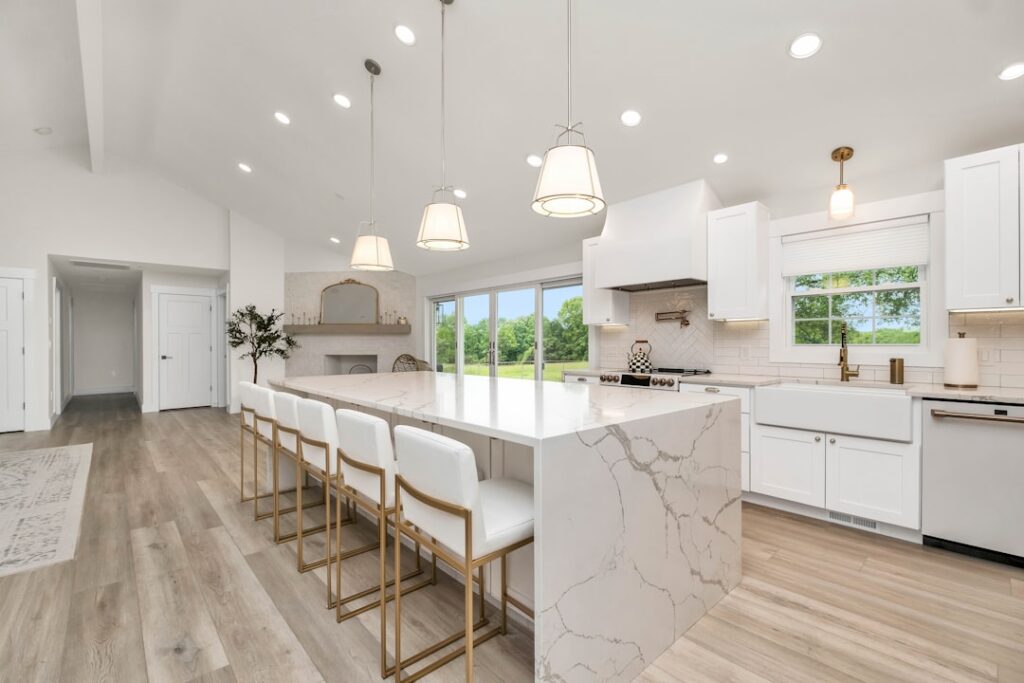
- A waterfall island edge, letting the pattern cascade to the floor.
- Fireplace surrounds and built-in shelving accents.
For a cohesive look, many homeowners carry the same slab from the countertop up the backsplash, which makes a small kitchen feel larger and more custom. Just budget for the extra square footage, since a full-height backsplash can add noticeably to the material total.
How to Care for Calacatta Verde Quartz
Daily care could not be simpler. Wipe the surface with warm water and a mild dish soap or a pH-neutral cleaner, then dry with a soft cloth. Skip anything abrasive, and avoid harsh chemicals like bleach, oven cleaner, or high-alkaline degreasers, which can dull the finish or damage the resin over time.
For dried-on spills, let a damp cloth sit on the spot to soften it rather than scraping. A plastic putty knife lifts stubborn residue like candle wax or gum without scratching. Never use scouring pads or powdered cleansers. With this minimal routine, the surface stays bright and glossy for the life of the counter, with no sealing ever required.
Is Calacatta Verde Quartz Right for You?
Choose it if you want the high-end, veined marble aesthetic with a fresh green accent and none of the fragility of natural stone. It suits busy family kitchens, rental-quality durability, and anyone who wants a low-maintenance surface that still looks custom. Reconsider only if you are set on genuine, quarried marble or if your heart is set on a surface you can set hot pans on directly, which no resin-based quartz will tolerate.
For most homeowners, Calacatta Verde quartz hits a genuine sweet spot: the beauty of Italian marble, the practicality of engineered stone, and a distinctive green veining that sets your kitchen apart from the sea of gray-veined counters. View the actual slab, hire a reputable fabricator, and you will have a striking, worry-free surface that holds its looks for decades.