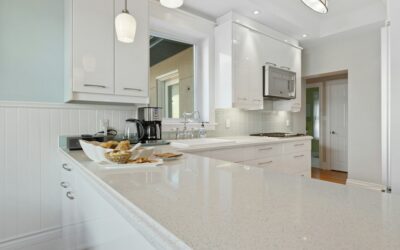
Real Calacatta Borghini marble is one of the most dramatic white stones ever quarried: thick, sweeping charcoal and gold veins over a bright white field, the kind of slab that looks like a painting. It also etches the moment lemon juice touches it. Calacatta borghini quartz is an engineered surface built to copy that bold movement while staying nonporous, stain resistant, and free of a sealing schedule. For a busy kitchen, it offers most of the drama with a fraction of the upkeep.
Part of our Countertops guide — explore the full guide →
The catch with any bold-veined slab is layout. Heavy veins that look stunning on a single slab can look chopped up and random at seams if the fabricator does not plan carefully. Island vein matching, slab selection, and choosing the right cabinet and hardware palette are what separate a showpiece kitchen from a merely expensive one.
- What Calacatta Borghini Quartz Looks Like
- Quartz vs Real Borghini Marble
- Vein Matching on Islands and Long Runs
- Cabinet, Hardware, and Backsplash Pairings
- Care and Cleaning
- Cost: Quartz vs Real Marble
- Choosing Thickness and Edge Profile
- Troubleshooting Common Complaints
- Installation and Silica Dust
- When to Call a Licensed Professional
- Frequently Asked Questions
What Calacatta Borghini Quartz Looks Like
The natural marble has a very white, slightly creamy base with wide veins in deep gray, soft charcoal, and warm gold or caramel. The veins are thick and directional, often running in long diagonal sweeps with thinner branches feathering off them. Calacatta borghini quartz recreates this with veins that run through the full thickness of the slab in better products, so edges and cutouts show consistent color rather than a printed surface layer.
Patterns differ from one product line to another. Some versions lean cool, with gray dominating and only a hint of gold. Others push the warm caramel tones. Some have a single bold vein crossing the whole slab, while others repeat medium veins every foot or so. Look at a full slab image or visit a yard to see the scale, because small samples rarely capture the movement.
Finish options
- Polished: the most marble-like look, with deep color in the veins and high reflectivity.
- Honed: a soft matte finish that reads like aged European marble and hides fingerprints.
- Through-body veining: a manufacturing feature worth asking about, since it makes mitered edges and waterfalls look like solid stone.
Quartz vs Real Borghini Marble
| Factor | Engineered quartz | Natural marble |
|---|---|---|
| Etching from acids | Does not etch | Etches easily |
| Staining | Highly resistant | Stains if unsealed |
| Sealing | Never needed | Every 6 to 12 months |
| Heat | Use trivets | Tolerates heat well |
| Slab consistency | Predictable | Every slab unique |
Natural marble develops a patina that some homeowners love: small etch marks and a softening of the polish over time. If you prefer a counter that looks the same in ten years as the day it was installed, quartz is the better fit. Marble also tends to cost substantially more for a slab with true Borghini-level veining, since high-grade blocks are rare.
Vein Matching on Islands and Long Runs
Bold veins make seams obvious. Planning layout is the single most important step with this kind of slab.
- Choose slabs in person or by photo. Ask the fabricator for full slab photos with serial numbers. Consecutive slabs from the same production run match more closely.
- Ask for a digital layout. Many shops overlay your countertop template on slab photos so you can see exactly where veins will land and where seams fall.
- Keep the island seam-free if possible. Standard jumbo slabs often measure about 63 by 126 inches, which covers most islands without a seam. Size your island with that in mind.
- Match waterfalls. On a waterfall end, the vein should flow from the top around the miter and down the side. This needs a slab cut from one piece with careful planning.
- Bookmatch where seams are unavoidable. Some patterns allow two slabs to be laid as mirror images, creating a symmetrical design at the seam.
- Place perimeter seams in low-visibility spots, such as at the sink or cooktop, where a cutout naturally interrupts the pattern.
Expect some extra material cost when you prioritize vein flow. Fabricators may need to waste more of a slab to get the right section on the island.
Cabinet, Hardware, and Backsplash Pairings
Because the veining combines gray and gold, it pairs with both cool and warm palettes.
- White or warm white cabinets: timeless and gallery-like, letting the veins dominate.
- Charcoal or black lower cabinets: pull from the darkest veins for a dramatic two-tone kitchen.
- Natural white oak or rift-sawn oak: picks up the gold tones and softens the contrast.
- Greige and taupe: mid-tone neutrals that bridge the gray and gold.
- Muted sage or deep green: a fresh option that works especially well with brass hardware.
Brass and champagne bronze hardware emphasize the warm veins, while polished nickel highlights the gray. For backsplash, a full slab of the same material is the strongest choice. If you use tile, keep it plain: white glossy subway, matte white squares, or a soft cream handmade look. Strongly veined tile will clash.
Care and Cleaning
Day to day, all this surface needs is a soft cloth, warm water, and a mild dish soap or a cleaner formulated for quartz. Dry polished areas to prevent water spots. A few habits protect the finish for decades:
- Use trivets under hot pans, slow cookers, and air fryers. Resin can discolor from prolonged heat.
- Cut on cutting boards to protect knives and the surface.
- Keep oven cleaner, paint strippers, drain openers, and strong solvents off the counter.
- Remove dried food with a plastic scraper rather than steel wool.
- Wipe up dyes such as turmeric, hair color, and food coloring quickly on white areas.
Cost: Quartz vs Real Marble
As a general range, bold-veined calacatta borghini quartz runs roughly $75 to $140 per square foot installed, with premium through-body lines at the top of that band. High-grade natural Borghini marble can range from roughly $120 to $250 or more per square foot installed, depending on slab grade and availability. Waterfall edges, mitered thick edges, full-height backsplashes, and vein-matching waste all add cost on either material.
For a typical 45 square foot kitchen, quartz often saves several thousand dollars over comparable marble, plus the ongoing cost of sealing and occasional professional polishing to remove etches.
Choosing Thickness and Edge Profile
Thickness affects both look and cost. A 3 cm slab (about 1 1/4 inches) is standard for kitchens because it is strong enough to span cabinets without a plywood subtop and gives a substantial edge. A 2 cm slab (about 3/4 inch) costs less and suits vanities and backsplashes, but kitchen installs usually need a laminated or mitered edge to look thick enough, which adds labor.
Edge profile changes how the veining reads. A simple eased or slightly rounded square edge keeps the focus on the pattern and is the most common choice for bold slabs. A mitered edge, where a strip of the same slab is joined at a 45 degree angle, lets veins wrap continuously down the front so the counter looks like a solid block 2 to 4 inches thick. Decorative profiles such as ogee or bullnose tend to distort the pattern at the edge and can look dated against such a modern-feeling stone.
Troubleshooting Common Complaints
- Visible seam lines: a good fabricator tints the seam epoxy to match the background. If a seam darkens over time, ask the installer to clean and refill it.
- Pattern looks different from the sample: always approve the actual slab. Small samples rarely show the bold veins.
- Dull patches on polished quartz: usually residue from the wrong cleaner or a scorched spot from heat. Residue cleans off with a quartz-specific cleaner; heat damage generally needs professional repair.
- Gray marks on honed surfaces: metal transfer from pots and utensils. These usually lift with a soft, nonabrasive cream cleanser approved for quartz.
- Yellowing near a window: UV exposure can fade or shift resin over many years. Window film or shades help in very sunny kitchens.
Installation and Silica Dust
Installing quartz slabs is usually a job for a professional fabricator. Slabs are heavy, a 3 cm island top can weigh several hundred pounds, and cutting them requires water-cooled saws and dust control. Engineered quartz has a very high crystalline silica content, and dry cutting or grinding releases dust that can cause serious lung disease. If you must trim or drill a piece, cut wet, wear a fitted N95 or P100 respirator, and clean up with a HEPA vacuum.
When to Call a Licensed Professional
An experienced stone fabricator should handle templating, cutting, seaming, and setting. Moving or adding a sink, dishwasher, or pot filler is work for a licensed plumber, and many cities require permits for relocated lines. New island outlets or appliance circuits belong to a licensed electrician, and counter outlets need GFCI protection. Gas cooktop changes are for a licensed gas fitter only. If cabinets are out of level or flimsy, have a carpenter reinforce them before the slab arrives.
Frequently Asked Questions
Does calacatta borghini quartz look like real marble?
Quality versions come very close, especially with through-body veining and a honed or polished finish. Up close, natural marble shows more depth and randomness.
Will it etch like marble?
No. Engineered quartz is not made of calcite, so acidic foods and drinks do not dull the surface.
How do I avoid an ugly seam?
Size the island to fit one slab, ask for a digital layout on slab photos, and place unavoidable seams at sinks or cooktops.
Is it good for a waterfall island?
Yes, if the product has through-body veining and the fabricator matches the vein around the miter.
Does it need sealing?
No. Quartz is nonporous and only needs routine cleaning.