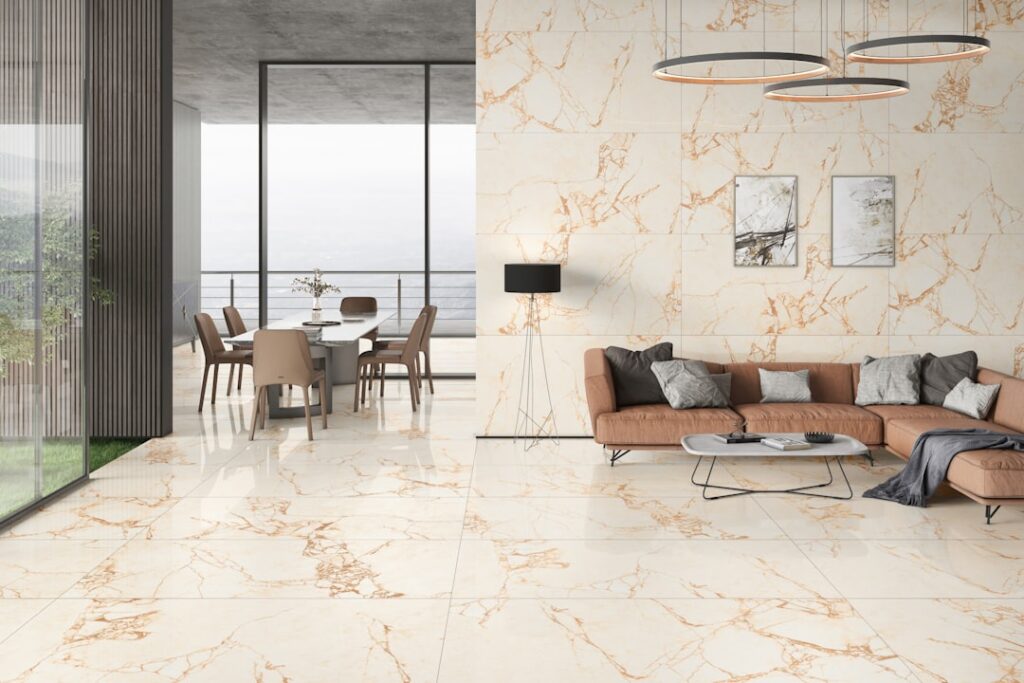
There’s a reason designers keep reaching for it: nothing reads as luxurious quite like the bold, golden-veined drama of calacatta gold tile. With its bright white background and thick, dramatic veining in warm gold and gray, it turns an ordinary backsplash, floor, or bathroom into a statement. The catch is that genuine Calacatta marble is expensive and demanding to maintain, which is why the tile world now offers a spectrum of options that capture the look at very different price points and effort levels.
What Calacatta Gold Actually Is
Calacatta is a prized Italian marble quarried in the Apuan Alps near Carrara. What distinguishes the “Gold” variety is its warm-toned veining, threads of gold, beige, and brown running across a clean, bright white field. Compared to the more subtle, feathery gray veins of Carrara marble, Calacatta Gold is bolder, more dramatic, and more sought-after, which makes it both more striking and more costly. True Calacatta is rarer than Carrara, and that rarity drives the premium.
Real Marble vs. Porcelain Look-Alikes
This is the single most important decision you’ll make. Calacatta gold tile comes in two very different forms:
- Natural Calacatta marble tile: the genuine stone, with unmatched depth, translucency, and one-of-a-kind veining. It’s also softer, porous, prone to etching and staining, and the most expensive option.
- Porcelain Calacatta-look tile: high-definition printed porcelain that mimics the marble’s veining. It’s far more durable, non-porous, stain- and etch-resistant, and a fraction of the maintenance.
For floors and busy kitchens, porcelain is often the smarter choice; it delivers the look without the babysitting. For a low-traffic feature wall or a vanity where authenticity matters, natural marble rewards the extra care. Modern porcelain has gotten convincing enough that many people can’t tell at arm’s length.
Where to Use It
Calacatta gold works almost anywhere, but the form should match the location:
- Kitchen backsplash: a classic showcase, often in large-format slabs or subway shapes.
- Bathroom walls and showers: dramatic and spa-like; porcelain resists the constant moisture better than marble.
- Floors: stunning underfoot, but choose honed or porcelain for slip resistance and durability.
- Accent and feature walls: a single wall of book-matched veining as a focal point.
- Fireplace surrounds: a luxurious frame that draws the eye.
Finishes and Formats
The finish changes both look and practicality. Polished surfaces are glossy and reflective, deepening the veining but showing etches and water spots more on real marble. Honed surfaces are matte, softer underfoot, and more forgiving of wear, a better pick for floors and high-use areas. Format ranges from classic subway tiles and hexagons to large-format slabs and even full bookmatched panels that mirror the veining for a dramatic, continuous flow. Large formats mean fewer grout lines and a more seamless, high-end look.
Cost Expectations
Pricing spans a wide range depending on material and format. As a general guide, porcelain Calacatta-look tile typically falls in the moderate range comparable to other quality porcelain, while genuine Calacatta marble commands a significant premium, often several times the price of porcelain, and rises further for large slabs and bookmatched pieces. Installation adds labor on top, and marble’s special handling and sealing can increase that. Get quotes for your specific format and square footage rather than relying on a single figure, since natural stone prices vary by slab.
Caring for Natural Calacatta Marble
If you choose the real stone, maintenance is part of the deal. Marble is calcium-based, so acids, lemon juice, vinegar, wine, coffee, even some cleaners, can etch the surface, leaving dull marks. To protect it:
- Seal it on installation and reseal periodically, often once or twice a year depending on use.
- Wipe spills immediately, especially anything acidic.
- Use only pH-neutral stone cleaners; never vinegar or generic bathroom sprays.
- Use cutting boards and trivets on marble counters to prevent scratches and etching.
- Blot, don’t scrub, and avoid abrasive pads that scratch the polish.
Caring for Porcelain Versions
Porcelain Calacatta is gloriously low-maintenance. It’s non-porous, so it won’t stain or etch, and it needs no sealing. Routine cleaning is just a damp mop or cloth with a mild cleaner. The only ongoing care is keeping the grout lines clean, which a periodic grout sealer makes easier. This durability is exactly why porcelain has become the go-to for homeowners who love the look but don’t want a fussy floor.
Calacatta vs. Carrara: Knowing the Difference
Shoppers constantly confuse these two Italian marbles, and the distinction affects both look and price. Carrara is the more common and more affordable, with a softer gray background and fine, feathery, linear gray veining. Calacatta has a whiter, brighter background and bolder, more dramatic veining, and Calacatta Gold specifically brings those warm gold and brown tones. Calacatta is rarer and reads as more luxurious, which is why it commands a higher price. If you love a subtle, understated marble look, Carrara may suit you and save money; if you want statement-making drama, Calacatta Gold is the one.
Design Tips for Using It Well
Because Calacatta gold is bold, a little restraint goes a long way. Let it be the star and keep surrounding finishes calm, solid cabinets, simple hardware, and quiet wall colors. The warm gold veining pairs beautifully with brass and gold fixtures, which echo the tones in the stone, as well as with crisp white and soft gray. For grout on porcelain versions, choose a color close to the tile’s background so the veining flows uninterrupted. In small spaces like powder rooms, a full Calacatta wall creates impact, while in larger kitchens a focal backsplash or island surround often hits the right balance.
Final Thoughts
The luxurious, golden-veined drama of calacatta gold tile earns its reputation as a designer favorite, and the choice today comes down to authenticity versus practicality. Genuine marble offers unmatched depth and prestige but demands sealing, careful cleaning, and a real budget. Porcelain look-alikes deliver nearly the same visual impact with a fraction of the maintenance and cost. Decide how much care you’re willing to give, match the finish to the room, and you’ll bring that timeless marble elegance home in a way that actually lasts.
Prefer to explore on your own?
See how new flooring looks in your actual room in seconds — free, no signup.
Try the free Floor Studio →