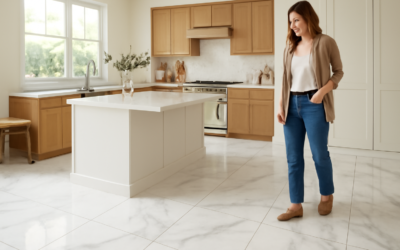
The dramatic white-and-gold veining of Italian Calacatta marble is one of the most coveted looks in design, and calacatta gold porcelain tile delivers that exact aesthetic without the fragility, staining, and steep price of real marble. Modern printing technology reproduces the bold golden veins on a warm white background so convincingly that most people cannot tell the difference underfoot. For homeowners who want a luxury marble look in a kitchen, bathroom, or entryway that will actually survive daily life, this tile is one of the smartest choices on the market.
Part of our Tile & Grout guide — explore the full guide →
- What Makes Calacatta Gold So Distinctive
- Porcelain vs. Real Calacatta Marble
- Sizes, Formats, and Finishes
- Where to Use Calacatta Gold Porcelain
- What It Costs
- Installation Tips
- Rectified Edges and Grout Lines
- Cleaning and Maintenance
- Design Pairings That Make It Shine
- Book-Matching and Slab Layouts
- Frequently Asked Questions
What Makes Calacatta Gold So Distinctive
Calacatta is a specific type of marble quarried in Carrara, Italy, prized for its bright white base and thick, dramatic veining. The “gold” variety features warm golden and honey-toned veins rather than the cool gray of Carrara marble. On porcelain, this signature look is achieved with high-definition inkjet printing that layers realistic veins across each tile. The best products vary the vein pattern from tile to tile so the finished floor looks like natural stone rather than a repeating print, which is the hallmark of a quality reproduction.
Porcelain vs. Real Calacatta Marble
Understanding why porcelain wins for most homeowners means comparing it directly to the natural stone it imitates:
- Durability: Porcelain is denser and far harder than marble, resisting chips and cracks that marble suffers.
- Stain resistance: Marble is porous and etches from wine, citrus, and coffee. Porcelain is nonporous and shrugs off spills.
- Maintenance: Marble needs regular sealing; porcelain needs none.
- Water resistance: Porcelain absorbs almost no water, making it ideal for showers and wet areas where marble struggles.
- Cost: Porcelain typically runs a fraction of natural Calacatta’s price.
- Consistency: You can reorder matching porcelain later; every marble slab is unique.
The one edge marble keeps is the depth and value of genuine stone, but for performance and price, porcelain is the practical winner.
Sizes, Formats, and Finishes
Calacatta gold porcelain comes in a wide range of formats. Popular sizes include 12×24 inch rectangles, large 24×48 inch tiles, and even large-format slabs up to 5 feet or larger for a seamless, grout-minimized look. Smaller mosaics and hexagons suit shower floors and accent walls. Finishes matter too:
- Polished: A glossy, reflective surface that maximizes the luxury marble look, best for walls and low-traffic floors since it can be slippery when wet.
- Matte or honed: A softer, non-reflective finish with better slip resistance, ideal for bathroom and kitchen floors.
- Textured or structured: Added grip for wet areas and shower floors.
Where to Use Calacatta Gold Porcelain
This versatile tile works almost anywhere in the home. It is a favorite for bathroom floors and shower walls, where its water resistance shines. In kitchens, it makes a stunning backsplash or floor and pairs beautifully with white or navy cabinets and brass or gold hardware that echoes the veining. Large-format slabs work as dramatic countertops and even fireplace surrounds. In entryways and open living areas, the bright white base makes spaces feel larger and more luminous. Because it is frost-resistant, exterior-rated versions can extend the look to covered patios.
What It Costs
Pricing depends on size, quality, and brand, but calacatta gold porcelain is far friendlier than marble:
- Standard tile (12×24): $3 to $8 per square foot.
- Large-format tile (24×48): $6 to $15 per square foot.
- Premium slabs and high-end imports: $12 to $25 per square foot.
- Installation labor: $8 to $20 per square foot, higher for large-format tiles requiring extra skill and leveling.
By comparison, natural Calacatta marble often starts around $20 per square foot for material alone and climbs steeply, before you add sealing and repair costs over the years.
Installation Tips
Large-format Calacatta tiles look spectacular but demand precision. The subfloor must be dead flat, within an eighth of an inch over 10 feet, because big tiles telegraph any dip or hump. Use a high-quality large-format thinset and a tile leveling system to prevent lippage, where one tile edge sits higher than its neighbor. Choose a grout color that either blends with the white base for a seamless look or subtly matches the veins; avoid a stark contrasting grout that fights the marble illusion. For the most realistic result, dry-lay several boxes first and arrange the tiles so veins flow naturally and no two identical patterns sit side by side.
Rectified Edges and Grout Lines
One spec worth understanding is whether the tile is rectified. Rectified tiles are mechanically ground to precise, perfectly straight edges after firing, which lets an installer set them with very tight grout lines, sometimes as narrow as a sixteenth of an inch. Tight lines are exactly what you want for a seamless marble illusion, since wide grout joints break up the veining and betray that it is tile rather than a continuous stone slab. Non-rectified tiles have slightly irregular edges and need wider grout lines to accommodate the variation. For the most convincing Calacatta gold look, choose rectified tiles and a grout color that closely matches the white base, so the eye reads the surface as one continuous piece of marble rather than a grid.
Cleaning and Maintenance
This is where porcelain rewards you every single day. There is no sealing, no special stone cleaner, and no fear of acidic spills. Simply sweep or vacuum regularly and mop with warm water and a pH-neutral cleaner. Avoid harsh abrasives on polished finishes to protect the sheen. Keep the grout lines clean with an occasional grout brush, and consider sealing only the grout, not the tile, to keep those lines looking crisp. That is the entire maintenance routine, which is exactly why so many homeowners choose porcelain over the real stone.
Design Pairings That Make It Shine
Calacatta gold works hardest when the rest of the room supports its warm veining. The golden tones pair beautifully with brass, gold, and champagne-bronze fixtures and hardware, which pick up the veins and tie the palette together. Against cabinetry, the bright white base is stunning with deep navy, forest green, or classic white shaker cabinets, and it warms up nicely alongside natural wood tones. For walls, a soft warm white or greige keeps the focus on the tile, while a bold matte black accent, on a vanity or window frame, creates striking contrast. In a bathroom, running the same tile from the floor up a feature wall or into the shower creates a seamless, luxurious envelope that reads as far more expensive than it cost.
Book-Matching and Slab Layouts
One of the most dramatic ways to use large-format Calacatta gold porcelain is book-matching, where two slabs are laid as mirror images so the veining flows symmetrically across a wall or countertop like an open book. Manufacturers that produce matched slab pairs make this possible, and the effect on a shower feature wall or fireplace surround is genuinely high-end. If you cannot source matched slabs, you can still control the look: dry-lay your tiles before setting them, rotate and rearrange until the veins flow naturally across the whole floor, and number the backs so your installer reproduces your layout. Avoiding two identical vein patterns side by side is the single trick that keeps porcelain from looking like a repeating print and instead reads as convincing natural stone.
Frequently Asked Questions
Is calacatta gold porcelain tile better than marble?
For everyday use, yes. It delivers the same white-and-gold marble look but resists stains, scratches, and water, needs no sealing, and costs far less. Real marble offers genuine stone depth but demands ongoing care and repair.
How much does calacatta gold porcelain tile cost?
Standard tiles run $3 to $8 per square foot, large-format tiles $6 to $15, and premium slabs $12 to $25. Installation adds $8 to $20 per square foot, with large formats costing more due to the skill required.
Can I use calacatta gold porcelain in a shower?
Absolutely. Porcelain is nonporous and highly water-resistant, making it excellent for shower walls and floors. Choose a matte, honed, or textured finish on the floor for better slip resistance when wet.
Does calacatta gold porcelain need to be sealed?
No. Unlike marble, porcelain is nonporous and never needs sealing. You may choose to seal the grout lines to keep them clean, but the tile itself requires no sealing at all.
What size calacatta gold tile should I choose?
Large-format tiles like 24×48 inches minimize grout lines for a seamless, high-end look but need a very flat subfloor. Standard 12×24 tiles are more forgiving and cheaper to install, while mosaics suit shower floors and accents.
Prefer to explore on your own?
See how new flooring looks in your actual room in seconds — free, no signup.
Try the free Floor Studio →