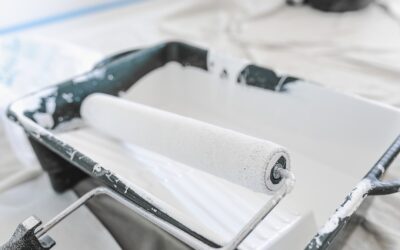
Oriented strand board is the most common subfloor and sheathing material in residential construction, but it shows up more often in finished spaces too. Garage walls, accent rooms, basement playrooms, and modern industrial offices all use exposed OSB as a design choice. The question of can you paint OSB board comes up because the wax-coated surface, the absorbent edges, and the visible wood chips behave very differently from drywall or smooth plywood. The short answer is yes, but only with the right primer and the right number of coats.
Part of our Paint & Walls guide — explore the full guide →
What OSB Is and Why It Resists Paint
OSB is manufactured by hot-pressing wood strands with a phenol-formaldehyde or MDI resin and a thin paraffin wax coating. The wax helps the finished panel shed water on a job site before the building gets dried-in. That same wax is the reason paint beads up if you skip primer. The strand pattern also means parts of the surface are smooth resin and parts are open end-grain, and those areas absorb paint at completely different rates.
APA-rated OSB also has a smooth face and a textured face. The smooth face usually carries the stamp, the brand mark, and the orientation arrows. Most homeowners paint the smooth face because it produces a more uniform finish. The textured face, with its visible strand pattern, can become the design feature when sealed with a clear coat instead.
Prep Work That Determines Success
Skipping prep is the single most common cause of failed OSB paint jobs. The wax coat, dust from handling, and any moisture in the panel all need to be addressed before primer goes on.
- Acclimate the panels to the room temperature and humidity for 48 hours before painting
- Vacuum the surface with a brush attachment to remove dust
- Wipe with a tack cloth to grab final particles
- Sand the smooth face lightly with 120-grit on a random-orbit sander
- Vacuum again and tack-cloth wipe
- Confirm moisture content is below 12 percent with a pin meter ($25 from Harbor Freight)
If panels were stored outside or in a humid garage, the moisture content can be 18-22 percent. Painting at that moisture level traps water inside the strand pattern and causes peeling within months. A few days of acclimation in a heated indoor space pulls the moisture down to a paintable level.
Primer Choice Is the Whole Game
The single biggest decision in painting OSB is which primer to use. The wrong primer guarantees telegraphing, where the strand pattern bleeds through every coat of finish paint. The right primer locks down the surface and gives you a true blank slate.
- Zinsser BIN Shellac Primer: $50 per gallon, blocks tannin and resin bleed, dries in 45 minutes, best on smooth face
- Kilz Original Oil-Based: $35 per gallon, classic oil seal, smelly but bulletproof, dries in 8 hours
- Zinsser Cover Stain Oil: $32 per gallon, faster recoat than Kilz, good for interior walls
- Zinsser Bullseye 1-2-3 (water-based): $34 per gallon, works only on smooth-face OSB with light sanding, two coats minimum
For best results, plan on two coats of primer regardless of brand. The first coat fills the open end-grain and the second coat smooths the surface for finish paint. Skipping the second coat is what causes the patchy, blotchy look most DIY OSB paint jobs end up with.
Finish Paint and Sheen Selection
Once primed properly, OSB takes finish paint like any other wood surface. The sheen choice depends on the room. Matte and flat finishes look more like drywall but hide less of the strand pattern. Eggshell and satin give a slight luster that works well in offices and accent walls. Semi-gloss is appropriate for garage walls and basements where scrubbing matters.
Behr Marquee, Sherwin-Williams Emerald, and Benjamin Moore Aura are the three top-tier interior paints that perform best on OSB. Plan on two coats of finish paint over two coats of primer. The total is four coats, which is more than most homeowners expect. The thickness builds a film that resists future moisture cycling and keeps the panel face stable.
Sealing the Edges Is Mandatory
OSB edges are far more porous than the face. Water wicks into a cut edge fast and causes swelling that no paint can hide. Every cut edge needs to be sealed with two coats of a 100 percent acrylic exterior caulk or a bead of polyurethane construction adhesive before the panels go on the wall.
For panels already installed, run a bead of Sherwin-Williams Sher-Max or DAP Alex Plus along every visible edge before priming. Smooth the bead flat with a wet finger. This single step is the difference between an OSB wall that looks crisp in five years and one that has swollen mushroom edges at every corner.
Exterior Versus Interior Considerations
Paint protects interior OSB from light moisture and gives a finished look. It cannot make standard OSB suitable for exterior exposure. Standard OSB is not weather-rated and will delaminate within 18-30 months even under thick paint. If you need exposed OSB on an exterior, specify LP SmartSide or AdvanTech, both of which use moisture-resistant resins designed for sheathing left exposed during construction.
For garage interior walls behind a shingled roof, standard OSB plus the primer-and-paint method above works fine because the moisture exposure is limited. For a screened porch ceiling or a covered patio wall, upgrade to LP SmartSide and follow the manufacturer’s paint recommendations.
Cost Breakdown for a Typical Project
A 12 by 14 garage wall covered in OSB and painted properly runs about as follows in 2026 pricing. The cost stays affordable because OSB itself is cheap; the labor and paint are the bigger line items:
- OSB panels (5 sheets at 4×8): $130-$160
- Construction adhesive and fasteners: $40
- Primer (2 gallons Zinsser BIN): $100
- Finish paint (2 gallons Behr Marquee): $100
- Caulk, rollers, brushes: $50
- Total materials: roughly $420
Labor adds another $400-$700 if you hire someone, mostly for the multiple primer and paint coats. A DIY weekend project nets a finished accent wall for under $500 in materials.
When to Skip Paint Entirely
If you actually like the strand pattern, embrace it. Two coats of Minwax Polycrylic clear satin over light-sanded OSB locks in the look without changing the color. It is moisture-resistant, scrubbable, and lets the natural variation in the wood become the design feature. This option is popular in modern industrial offices and high-end garage workshops where the OSB itself is the aesthetic.