Choosing the right carpet sizes for a living room is the difference between a space that feels pulled-together and one where the floor looks like an afterthought. Whether you are ordering wall-to-wall broadloom or hunting for the perfect area rug, size is the decision that trips up most people — a rug that is too small makes an entire room feel cramped and disconnected, while the correct size anchors your furniture and visually enlarges the space.
Having sized carpet for rooms of every shape, I can tell you the rules are more forgiving than they seem once you understand two things: the standard widths carpet actually comes in, and the simple layout principles that tie a rug to your furniture. Get those down and you can walk into any showroom or scroll any website and know exactly what dimension to order for your particular living room.
Standard Broadloom Carpet Widths
Wall-to-wall carpet, known in the trade as broadloom, is manufactured on rolls of a standard width — and in North America that width is almost always 12 feet. A few mills produce 13-foot-6-inch and 15-foot rolls for wider rooms, but 12 feet is the default you will encounter everywhere. This single number quietly governs how your living room carpet gets laid and where seams end up.
Because the roll is 12 feet wide, any room dimension under 12 feet can be covered in one continuous piece with no seam — a real advantage for both appearance and cost. The moment a room exceeds 12 feet in both directions, the installer must join two pieces with a seam, which requires extra material for pattern matching and careful placement so the join lands in a low-traffic, low-light spot rather than straight through the middle of the room.
When you measure for wall-to-wall, always add a few inches on every side for trimming, and share your room’s exact dimensions with the retailer so they can plan seam placement and calculate waste. A 12-foot roll and a 12-foot room dimension are a happy match; an awkward 14-foot span means buying wider material or accepting a seam, and that affects both your budget and the final look.
Common Area Rug Sizes
If you are going the area-rug route instead of wall-to-wall, the market has settled on a handful of standard sizes, and knowing them makes shopping far easier. The workhorses for living rooms are 5×8, 8×10, 9×12, and the larger 10×14. Smaller accent sizes like 3×5 and 4×6 exist but are almost never right as the main rug in a living room — they end up looking like a postage stamp marooned in the middle of the floor.
For most living rooms, the 8×10 and 9×12 sizes do the heavy lifting. An 8×10 suits a small-to-medium living room and comfortably sits under a sofa and coffee table arrangement. A 9×12 is the go-to for a standard-to-large living room, giving you enough surface to bring seating fully or partially onto the rug. Larger great rooms and open-concept spaces often call for a 10×14 or bigger to keep the rug in proportion to the furniture.
Runners and round rugs have their place — a runner behind a sofa or a round rug in a reading nook — but the rectangular sizes above are what you will choose from for the primary floor covering. When you are between two sizes, size up. An oversized rug reads as intentional and expansive; an undersized one always looks like a mistake.
Sizing the Rug to Your Sofa and Room
The most reliable way to pick a size is to work from your seating, not the room walls. The guiding principle is that your rug should be wide enough that it extends a bit past the ends of your sofa on both sides — roughly 6 to 8 inches beyond each arm at a minimum. A rug that stops short of the sofa’s width looks pinched and draws the eye to the imbalance.
From the walls, the classic target is to leave a consistent border of exposed flooring around the rug — commonly 8 to 24 inches of floor showing between the rug edge and the walls. In a small living room, aim for the lower end so the rug still feels generous; in a large room you can leave more floor exposed. What you want to avoid is a rug that either crowds right up to the baseboards or floats as a tiny island — both extremes fight the proportions of the room.
A quick real-world method: tape out your candidate rug size on the floor with painter’s tape before you buy. Stand back, walk the room, and see how it relates to your sofa and coffee table. This five-minute test has saved countless people from ordering a rug that looked right online and wrong in the room.
Layout Rules: Where the Furniture Goes
Once you have a size in mind, how the furniture sits on the rug determines whether the arrangement feels cohesive. There are three accepted layouts. In the all-legs-on layout, every piece of seating sits entirely on the rug — this requires the largest rug and reads as luxurious and grounded, ideal for big living rooms with a 9×12 or 10×14.
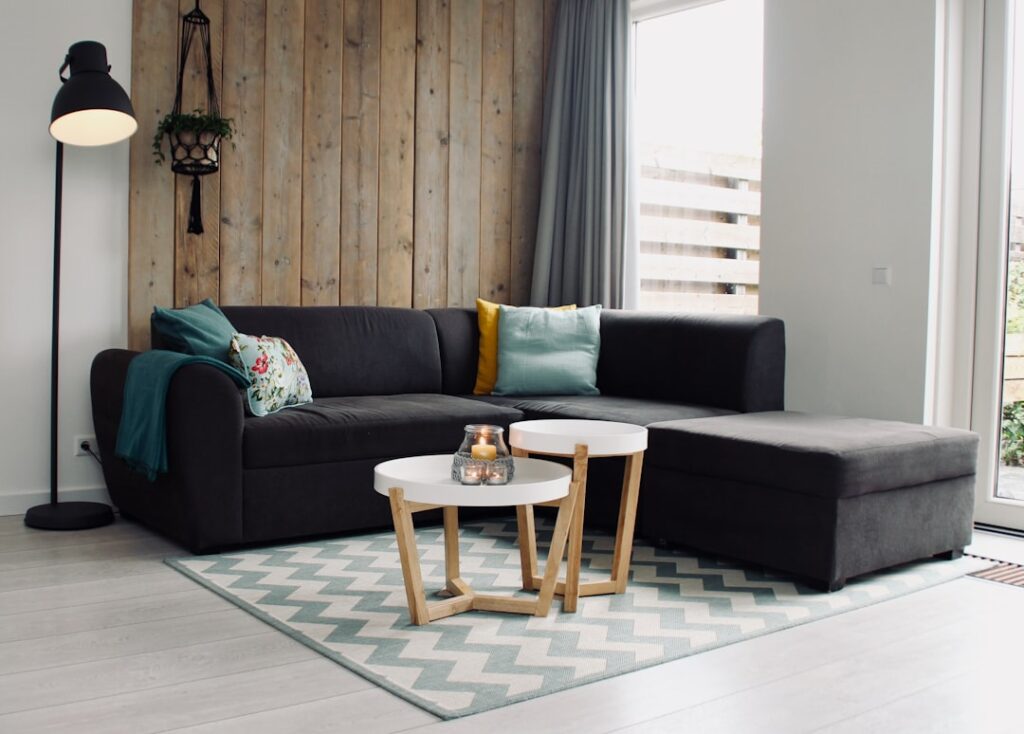
The most common and forgiving layout is front-legs-on: the front two legs of each sofa and chair rest on the rug while the back legs sit on the bare floor. This ties all the seating together visually, works beautifully with an 8×10 or 9×12 in a typical room, and stretches your rug budget because you do not need the piece to span the entire seating group. It is the layout I recommend to most homeowners.
The third option, all-legs-off, keeps every furniture leg off a smaller rug that floats in the center under just the coffee table. This works only in compact spaces or apartments and tends to look best when the rug is at least as wide as the sofa. Whichever you choose, the key is consistency — do not put the sofa’s front legs on while a nearby chair floats completely off, because the mismatch breaks the visual anchor the rug is supposed to provide.
How to Measure Your Living Room
Accurate measuring turns all this guidance into a confident purchase. Start by measuring the full length and width of the room wall to wall with a tape measure, and write both numbers down — these set the outer limit for any rug and the requirement for wall-to-wall. Then measure your primary seating group: the width of the sofa plus any flanking chairs, and the depth from the sofa front to the far edge of where you want the rug to reach.
From those seating measurements, add your desired overhang — remember the rug should extend past the sofa ends — and you arrive at a target rug dimension, which you then round to the nearest standard size, sizing up when in doubt. For a floating coffee-table arrangement, make sure the rug is large enough that the table sits well within its borders with room to set a drink down without hanging over the edge.
Do not forget clearances for how the room is used. Leave enough exposed floor that a door swings freely over the rug edge, and in walkways aim to keep foot traffic either fully on or fully off the rug rather than clipping a corner. A minute spent sketching the room to scale on paper prevents the expensive mistake of an ill-fitting rug.
Seams and Considerations for Wall-to-Wall
If you have decided on wall-to-wall carpet, seam planning is the technical detail that separates a clean install from an obvious one. Because broadloom is 12 feet wide, a living room wider than 12 feet will have at least one seam. A skilled installer places that seam running toward the main window or light source and away from the highest-traffic path, so it is as invisible as possible. Ask your installer where the seam will fall before the carpet is cut — it is a fair question and a good installer will have already planned it.
Order extra material for seams and pattern matching. Patterned carpet especially needs additional yardage so the design lines up across the join, and a good rule is to allow roughly 5 to 10 percent overage on any wall-to-wall job. Skimping here is how you end up with a mismatched pattern or a seam that had to land somewhere you will see it daily.
Finally, weigh wall-to-wall against a large area rug over hard flooring. Broadloom gives you seamless comfort underfoot across the whole room and is warmer and quieter, while a big area rug offers flexibility, easier cleaning, and the ability to redecorate without a full re-carpet. Both are valid — the right choice comes down to whether you want the whole living room floor soft and unified, or a defined, moveable island of comfort anchoring your furniture. Either way, choosing the correct carpet size is what makes the room finally feel complete.