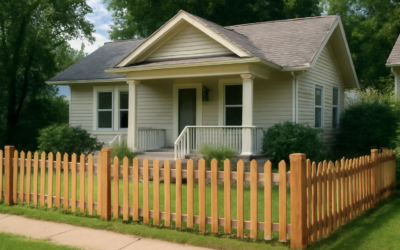
Fencing a yard can run $15 to $40 a linear foot when a contractor does it with premium materials — enough to blow a whole home-improvement budget on one project. But you don’t need to spend that much to get a fence that looks good and does its job. The best cheap wood fence ideas lean on affordable lumber, smart designs that use less material, and a little sweat equity to cut labor costs in half. This guide rounds up budget-friendly fence styles and the money-saving tactics that make them possible, so you can enclose your yard without emptying your wallet.
Part of our Decks & Outdoor guide — explore the full guide →
- Start With the Cheapest Lumber That Lasts
- Spaced Picket and Shadowbox Designs
- Horizontal Slat Fences on a Budget
- Reclaimed and Repurposed Materials
- Mix Wood With Cheaper Infill
- Save on Labor by Doing It Yourself
- Protect Your Investment Cheaply
- Picking the Right Cheap Fence for You
- Realistic Budget Breakdown
- Frequently Asked Questions
Start With the Cheapest Lumber That Lasts
Material is where most of the savings live, and the wood you choose sets the price. For a budget fence, pressure-treated pine is almost always the answer. It’s the least expensive rot-resistant option — often half the cost of cedar and a third the cost of redwood — and treated to survive ground contact and weather. Pickets run roughly $2 to $4 each, and pressure-treated posts and rails are widely stocked at any home center.
If you want a warmer look, standard dog-ear cedar pickets are a step up in price but still reasonable, and cedar’s natural rot resistance means you can even leave it unstained to silver over time. Skip exotic hardwoods and premium clear-grade lumber entirely for a budget build — knotty, standard-grade boards cost far less and look perfectly good in a fence, where a few knots read as character rather than flaws.
Spaced Picket and Shadowbox Designs
The single easiest way to cut fence cost is to use less wood, and spacing your pickets does exactly that. A traditional privacy fence packs pickets edge to edge; a spaced-picket design leaves a 2- to 3-inch gap between boards, using 20 to 30 percent fewer pickets while still defining the yard and looking intentional.
- Spaced picket: Boards with even gaps. Great for front yards, gardens, and dog runs where full privacy isn’t the goal. Uses noticeably less lumber.
- Shadowbox (board-on-board): Pickets alternate on opposite sides of the rail, overlapping slightly. Gives near-privacy and looks identical from both sides, so it’s neighbor-friendly, while using fewer boards than a solid overlapped fence.
- Picket-and-rail: Widely spaced pickets on a simple two- or three-rail frame for a classic, airy, low-cost look.
These designs prove that cheaper doesn’t mean flimsy or ugly — a well-spaced picket fence often looks more architectural than a solid wall of wood.
Horizontal Slat Fences on a Budget
Horizontal fences read as modern and expensive, but you can build one cheaply by using narrower, thinner boards. Instead of pricey wide planks, run 1×4 or 1×6 pressure-treated or cedar boards horizontally between posts with small, even gaps. The horizontal orientation feels contemporary and lets you use lower-cost dimensional lumber you’d find in any lumber-yard bin.
The key is keeping posts closer together — usually 6 feet on center rather than 8 — because horizontal boards sag over longer spans. That means a few more posts, but posts are cheap compared to the designer look you get. A coat of dark stain finishes the modern effect for a fraction of what a composite or metal modern fence would cost.
Reclaimed and Repurposed Materials
The cheapest wood is wood you don’t pay full price for. Several sources cut material cost dramatically:
- Pallet wood: Free or nearly free pallets, broken down, yield rustic boards for a charming, patchwork privacy fence. Labor-intensive to disassemble but almost zero material cost. Use heat-treated (HT stamped) pallets, never chemically treated ones.
- Reclaimed lumber: Barn wood, old fencing, or deck boards from demolition sites and salvage yards, often sold cheap or given away on classifieds.
- Mill seconds and cull lumber: Home centers sell discounted “cull” boards with minor cosmetic defects at a steep markdown — fine for a fence.
Reclaimed materials take more effort to prep and sort, but for anyone with time and patience, they can slash the cost of a fence to almost nothing while delivering a one-of-a-kind rustic look you can’t buy new.
Mix Wood With Cheaper Infill
You don’t have to build the whole fence from pickets. A hybrid approach uses wood posts and a wood frame — the part that gives structure and a finished look — filled with a cheaper infill panel:
- Hog panel / cattle panel fences: Galvanized welded-wire livestock panels framed in wood. Rustic-modern, extremely durable, and a full 16-foot panel costs around $30, covering ground that would take dozens of pickets.
- Welded wire or hardware cloth: Stapled inside a simple wood frame for a see-through garden or pet fence at minimal cost.
- Lattice panels: Prefab wood or vinyl lattice sheets drop into a post-and-rail frame quickly and cheaply for a decorative, semi-private screen.
These framed-panel fences cut both material and labor because a single panel covers a whole bay in one step instead of nailing up board after board.
Save on Labor by Doing It Yourself
Labor is roughly half the cost of a professionally installed fence, so DIY is the biggest single saving available. A basic wood fence is well within reach for a determined homeowner with a post-hole digger, a level, a drill, and a weekend or two. Rent a powered auger for around $75 a day to speed up the worst part of the job — digging post holes.
Set posts in concrete at least a third of their length deep (a 6-foot fence needs posts buried about 2 feet), space them evenly, and let the concrete cure before adding rails and pickets. Getting the posts plumb and evenly spaced is 80 percent of a good-looking fence; the pickets go up fast once the frame is true. Doing it yourself can bring a fence that would cost $4,000 installed down to $1,500 or less in materials.
Protect Your Investment Cheaply
A cheap fence stays cheap only if it lasts, and the difference between a fence that survives 5 years and one that survives 20 is finishing. Seal or stain the wood within a season of building. A gallon of quality exterior stain-sealer costs $30 to $50 and protects against the moisture, UV, and rot that destroy untreated lumber. Re-coat every few years.
Keep the bottom of the pickets an inch or two off the ground so they don’t wick moisture from the soil, keep grass and mulch from piling against the wood, and check for loose fasteners each spring. These small habits stretch the life of a budget fence far beyond its price.
Picking the Right Cheap Fence for You
Match the idea to your goal. Need privacy on a budget? Go shadowbox or horizontal slat with pressure-treated pine. Want a decorative front-yard boundary? Spaced pickets or lattice panels. Fencing a garden or dog run? Hog panels or wire infill in a wood frame. Have more time than money? Reclaimed pallet wood. Every one of these cheap wood fence ideas can look intentional and hold up for years — the secret is choosing a design that uses less material, doing the labor yourself, and sealing the wood so your savings don’t rot away. Build smart and your budget fence will look like it cost far more than it did.
Realistic Budget Breakdown
To plan a cheap fence, it helps to see where the dollars actually land. For a basic pressure-treated privacy or spaced-picket fence built yourself, expect roughly these per-linear-foot material costs: posts at $10 to $20 each set every 8 feet, rails at $3 to $6 per board, and pickets at $2 to $4 each. Add concrete at about $5 to $8 per post, plus fasteners and a gallon of stain per 150 to 200 square feet of fence. All in, a DIY pressure-treated fence typically runs $8 to $15 per linear foot in materials — versus $25 to $40 installed by a contractor.
The math makes the savings obvious. A 150-foot backyard fence might cost $1,500 to $2,000 in materials done yourself, against $4,000 to $6,000 hired out. Choosing a design that uses fewer pickets — spaced, shadowbox, or hog-panel infill — trims the material cost further, and reclaimed or cull lumber can cut it more still. The single biggest lever remains doing the labor yourself, so budget your weekends as part of the price.
Frequently Asked Questions
What’s the cheapest wood fence you can build?
A pressure-treated post-and-rail fence with widely spaced pickets, or a wood frame filled with hog panels, delivers the most enclosure for the least lumber. Reclaimed pallet wood is cheaper still on materials but costs more labor to prep.
Is pressure-treated or cedar cheaper?
Pressure-treated pine is almost always the budget winner, often half the cost of cedar, and it’s rated for ground contact. Cedar looks warmer and resists rot naturally but costs more; reserve it for where appearance matters most.
How can I make a cheap fence last longer?
Seal or stain the wood within a season of building and re-coat every few years, keep the pickets an inch or two off the ground to stop moisture wicking, and keep grass and mulch from piling against the boards. These habits stretch a budget fence from 5 years to 15 or 20.