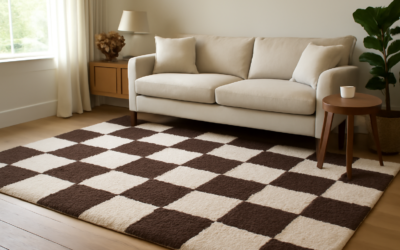
Black-and-white squares have anchored American kitchens and entry halls since the colonial era, and every decade since has produced a new version — marble in 1920s lobbies, peel-and-stick vinyl in 1950s diners, honed porcelain in today’s transitional remodels. Checkerboard flooring never really goes out of style because the pattern itself is architectural, not trend-driven; what changes is the material, the scale, and the rotation angle. Getting the look right today means choosing between vinyl, ceramic, porcelain, and real stone, deciding between 8-inch, 12-inch, and 18-inch tiles, and committing to either a square-to-wall or diagonal layout. This guide walks through every material option, pricing, installation nuances, and where the pattern does and does not belong.
A Quick History for Context
Checkerboard floors trace back to ancient Rome, appeared in European cathedrals through the Renaissance, and became standard in American Federal-style homes by the 1790s. The modern retro-diner version exploded in the 1940s with linoleum and vinyl composition tile (VCT). Today’s revival leans toward larger-format porcelain, honed marble, and occasionally reclaimed stone.
Material Options for Modern Checkerboard
Vinyl Composition Tile (VCT)
The classic diner floor. 12 by 12 inch tiles, $0.80 to $1.80 per sq ft, glue-down over concrete or underlayment. Requires waxing twice a year to maintain shine. Brands: Armstrong Excelon, Azrock.
Luxury Vinyl Tile (LVT)
Click-lock or glue-down waterproof vinyl in stone look. $2.50 to $5.50 per sq ft. No waxing, better wear layer, more realistic visuals than VCT.
Ceramic and Porcelain Tile
The most durable everyday option. $2 to $8 per sq ft for material, honed or matte finish for a period look. Porcelain resists moisture and stains better than ceramic.
Marble and Natural Stone
Carrara and Bianco Dolomite paired with Nero Marquina deliver the high-end Parisian look. $12 to $30 per sq ft for 12-inch tiles, honed finish recommended. Requires sealing.
Concrete and Cement
Pigmented concrete tiles or poured terrazzo sections in alternating colors. Labor-intensive but highly customizable. $14 to $35 per sq ft installed.
Classic Black and White or Something Else
While black and white is the definitive checkerboard, homeowners in 2026 are equally likely to specify:
- Charcoal and bone for a softer transitional look.
- Forest green and cream for English manor styling.
- Navy and white for coastal kitchens.
- Terracotta and off-white for Tuscan or Southwestern homes.
- Walnut and maple parquet for wood checkerboard effects.
Whatever the palette, maintain strong value contrast between the two colors — a checkerboard with similar tones reads as a fuzzy grid rather than a crisp pattern.
Pros of Checkerboard Flooring
- Instantly recognizable — adds character and period detail in one step.
- Hides dirt — the alternating dark squares disguise footprints and light grit.
- Pattern flexibility — works in kitchens, entries, bathrooms, butler’s pantries.
- Scales up or down — 8-inch squares feel cozy, 18-inch squares feel grand.
- Works across materials — vinyl at $2 per sq ft or marble at $25 per sq ft.
- Strong resale appeal — buyers connect it to quality and intentional design.
Cons to Consider
- Pattern reveals install errors — any crooked tile stands out immediately.
- Scale has to match the room — 12-inch squares can overwhelm a tiny powder room.
- White squares show stains — grout sealing matters more than on solid floors.
- Trendy interpretations date quickly — oversize supergraphics age faster than classic scales.
- Installer skill premium — precise layout costs more than a solid-color floor.
- Limited on open floor plans — can clash with adjoining hardwood if not bordered properly.
Layout Decisions That Matter
Square to Wall
Tiles align parallel with the walls. Clean, architectural, feels tailored. The safer choice for small rooms and transitional styles.
Diagonal (On Point)
Tiles rotate 45 degrees so squares become diamonds. Visually energetic, traditional in early-American and diner settings. Requires more cuts at the perimeter and more waste — expect 15 percent extra material.
Bordered
A single-color border of matching or contrasting tile frames the checkerboard. Ideal for grand entries, period homes, and rooms where the floor needs to feel like a rug.
Installation Notes
- Dry-lay the full pattern before applying any thinset or adhesive.
- Start from the center of the room, not a wall, so the pattern balances.
- Use leveling clips to minimize lippage on 12-inch and larger tiles.
- Match grout color to the lighter tile to keep the pattern reading clearly.
- Seal marble and stone tiles before grouting to prevent pigment migration.
- Plan transitions at doorways in advance to avoid awkward partial squares.
Best Rooms for the Look
- Kitchens — the classic placement, hides spills and crumbs.
- Entry halls and mudrooms — welcoming and forgiving of grit.
- Powder rooms — checkerboard on walls or floors adds instant character.
- Laundry rooms — durable and visually upgrading a utility space.
- Butler’s pantries — perfect scale for period-appropriate detail.
- Screened porches with porcelain that survives temperature swings.
Price Summary
- Vinyl VCT: $0.80 to $1.80 per sq ft material.
- Luxury vinyl tile: $2.50 to $5.50 per sq ft material.
- Porcelain tile: $2 to $8 per sq ft material.
- Honed marble: $12 to $30 per sq ft material.
- Installation: $5 to $12 per sq ft, more for diagonal and bordered layouts.
Bottom Line
Checkerboard flooring earns its enduring popularity because the pattern itself is timeless while the material and scale flex with the period and the budget. A budget-conscious homeowner can install vinyl squares in a weekend for $500. A design-focused remodel can spend $15,000 on honed Carrara and Nero Marquina and create a room that will be photographed by every buyer who tours it. Start by matching the scale to the room, pick the material that fits your maintenance tolerance, and hire an installer who has laid the pattern before. Whether you go diner nostalgia or French townhouse restraint, a well-executed checkerboard is one of the surest-footed design moves in residential flooring.
Prefer to explore on your own?
See how new flooring looks in your actual room in seconds — free, no signup.
Try the free Floor Studio →