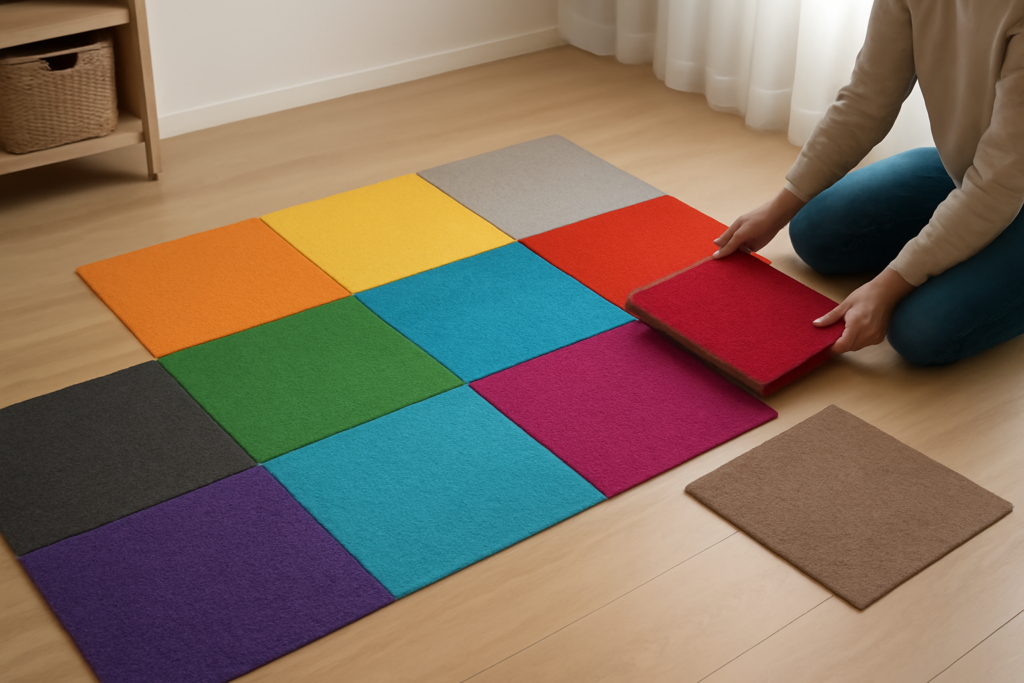
Carpet tiles broke out of beige corporate offices a decade ago and now anchor playrooms, basements, home offices, and creative studios in striking blues, oranges, greens, and reds. Coloured carpet tiles offer two practical advantages over traditional broadloom: individual replacement of stained sections and design flexibility through mixed colors, patterns, and laying orientations. The category has matured enough that residential homeowners can buy commercial-grade product through mainstream retail channels at prices competitive with stretched wall-to-wall carpet.
What Makes a Carpet Tile
Carpet tiles (also called modular carpet) come in 18-inch, 19.7-inch, and 24-inch squares. Construction stacks three layers: a low-pile loop or cut-pile carpet face, a stabilizing scrim, and a heavy bitumen or recycled rubber backing. The backing keeps the tile flat without glue in most residential applications.
Modern coloured tiles use solution-dyed nylon or recycled PET fibers that hold color even under harsh cleaning. Fade resistance ratings should hit minimum 4 on the AATCC color fastness scale for any tile installed in sun-exposed rooms.
Why Choose Coloured Over Neutral
Three benefits justify the color premium. First, design flexibility lets you create patterns — checkerboards, gradients, accent stripes, or color blocks defining functional zones in open floor plans. Second, the visual energy works for playrooms, creative studios, gym areas, and kids’ bedrooms where a neutral floor would feel sterile.
Third, hidden wear. Mid-tone and patterned tiles hide foot traffic and minor soiling better than light-colored alternatives. A teal or burnt orange tile in a basement playroom holds up visually for years longer than the same construction in beige.
Top Brands and Their Strengths
Five brands dominate the coloured carpet tile market in 2026:
- Interface — broadest color range, sustainability leader with Carbon Neutral Floors certification
- FLOR — direct-to-consumer pricing, easy 19.7-inch tiles, strong DIY support
- Shaw Contract — commercial-grade durability with vibrant residential colorways
- Milliken — high-design patterned options, modular WellBAC backing
- Tarkett — competitive pricing, decent residential color selection
Interface and Shaw Contract carry the deepest color libraries with 30 to 60 SKUs per collection. FLOR optimizes for residential ease — smaller boxes, simpler installation, and shipping direct to homes.
Pricing Breakdown
Coloured carpet tiles run a wider price range than broadloom because product specs vary more dramatically:
- Entry-level residential: $2.00 to $3.50 per square foot
- Mid-range commercial-grade: $3.50 to $6.00 per square foot
- Premium designer collections: $6.00 to $10.00 per square foot
- Specialty patterns and bespoke colors: $10.00 to $18.00 per square foot
Installation runs $1.00 to $2.50 per square foot for professional install. Most residential applications are loose-lay DIY because the backing weight holds tiles in place without adhesive.
Pros Over Wall-to-Wall
Individual tile replacement is the headline benefit. A stained tile in a playroom can be swapped for a clean one from a closet stash in five minutes. Compare that to broadloom where the only fix is bonnet cleaning or full replacement.
Installation speed favors tiles too. A single DIYer covers 200 to 300 square feet per day with loose-lay tiles versus 80 to 150 square feet of broadloom requiring stretching, seaming, and tackless strip prep. No seam-welding equipment needed.
Design flexibility extends to non-traditional layouts. Tiles can run quarter-turn (alternating direction) for visual texture, monolithic (all same direction) for clean modern look, or random mix of three to five colors for a bespoke designer aesthetic.
Cons to Plan For
Edge gaps appear over time on loose-lay installations as tiles shift under heavy furniture or aggressive vacuum sessions. Plan to pull and reset tiles every 12 to 18 months in high-traffic areas.
Some tile constructions feel firmer underfoot than padded broadloom. The bitumen backing absorbs less impact than a separate carpet pad. For playrooms where kids spend hours on the floor, look for tiles with attached cushion backing or add a thin underlayment.
Visible seams between tiles remain detectable up close, especially with light colors. Mid-tone and patterned products hide seams better than solid pale colors.
Color Combinations That Work
Five color schemes proven to work in residential spaces:
- Monochromatic blue family (navy, teal, sky) — calming for home office and bedroom
- Warm gradient (terracotta, mustard, rust) — energy for playrooms and craft studios
- High-contrast checkerboard (charcoal and white) — modern, graphic, easy to clean
- Tonal grays with one accent color (orange, yellow) — flexible for adult creative spaces
- Forest greens and ochre — biophilic design for studies and home gyms
Order sample tiles in five to seven colors before committing. Live with them on the floor for a week to see how they read in your room’s actual light.
Where Coloured Carpet Tiles Work Best
Six rooms suit coloured tiles especially well:
- Home offices — defines a creative or professional workspace
- Playrooms and kids’ bedrooms — energy and hide-the-mess in one product
- Finished basements — solves moisture risk with sealed-back tiles, adds visual warmth
- Home gyms — bold colors energize workouts and tiles handle moisture
- Walk-in closets and dressing rooms — accent the room’s purpose
- Craft and hobby studios — high-traffic, frequent spills, replaceable tiles
Skip coloured tiles in formal living rooms, primary suites used for resale, and dining rooms. The bold look can narrow buyer appeal at sale time.
Installation Tips
Four steps for clean residential installation:
- Start in the center of the room, not at a wall — corners will need cut tiles regardless
- Mark a center cross with chalk lines, snap perpendicular guides at the tile-edge intervals
- Lay full tiles outward from center until reaching walls
- Cut perimeter tiles with a sharp utility knife and steel straightedge — change blades often, the bitumen backing dulls quickly
Use double-sided carpet tape under tiles in doorways and high-traffic paths. Two-foot strips of 2-inch wide tape applied to the subfloor before tile placement prevents shifting.
Maintenance
Vacuum weekly with an upright that has adjustable height set high to avoid pulling fibers from low-pile loops. Spot-clean spills within 10 minutes using a 1:8 dish-soap-and-water solution and a microfiber cloth, blotting rather than rubbing. For deep cleaning, low-moisture encapsulation systems or DIY dry foam carpet cleaners outperform wet shampooers — moisture trapped between tiles can cause backing failure.
Where to Buy
FLOR ships direct nationally with the easiest residential ordering experience. Interface and Shaw Contract sell through commercial flooring dealers — show up with measurements and ask for residential project pricing. Big-box stores carry limited coloured tile offerings, mostly through Lowe’s and Home Depot online.
Order 10 to 15 percent overage for future replacements. Store extras in conditioned space — basement and garage humidity swings can fade or warp stored tiles over years. Coloured carpet tiles deliver design freedom and practical maintenance benefits that broadloom cannot match — for the right rooms and the right buyer, they are an upgrade rather than a compromise.