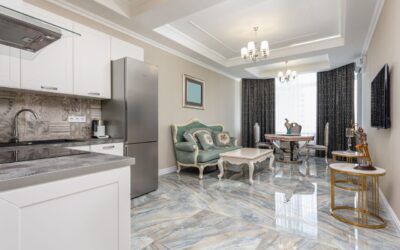
Every house has a small stretch of flooring that takes 80 percent of the daily abuse. The entry hall, the kitchen-to-laundry passageway, the upstairs landing where four bedrooms converge. Hall tile is the workhorse that decides whether your flooring renovation still looks fresh at year 10 or shows wear patterns at year 3. Picking it right means understanding tile ratings, the DCOF slip standard, grout choice, and how transition zones to other flooring change the install.
Part of our Tile & Grout guide — explore the full guide →
- Why Halls Demand Tile
- The PEI Rating Decoded
- DCOF: The Slip Conversation
- Porcelain vs Ceramic vs Stone for Halls
- Tile Size and Pattern in Halls
- Substrate and Setting Standards
- Grout Choice Saves Maintenance
- Real Cost for a 60 Sq Ft Hall
- Transitions to Other Flooring
- Brand Lines Worth Shortlisting
- The Bottom Line
Why Halls Demand Tile
The math is brutal. A 4-by-12-foot main hall in a household of four takes roughly 30,000 to 50,000 foot impacts per year. Carpet abrades. Wood scuffs and dents. Vinyl seams pump dirt. Tile, properly chosen, ignores all of it. Porcelain in particular handles abrasion at the molecular level; the surface glaze rates 4-5 on the PEI (Porcelain Enamel Institute) wear scale and survives spiked heels, dropped grocery bags, and dog-nail traffic without showing a pattern.
The PEI Rating Decoded
Every tile carries a PEI Class on the spec sheet. Buy the right class for the right room and you win:
- PEI 1: walls only. Never floor traffic.
- PEI 2: light residential. Powder rooms, master bath alone.
- PEI 3: normal residential. Kitchens, bathrooms, dining rooms.
- PEI 4: heavy residential or light commercial. Halls, entries, mudrooms, light retail.
- PEI 5: heavy commercial. Airports, restaurants, schools.
For any hall, demand PEI 4 minimum. The price premium over PEI 3 is negligible, often under $0.50 per sq ft.
DCOF: The Slip Conversation
ANSI A137.1 requires a dynamic coefficient of friction (DCOF) of 0.42 wet for any tile installed in level interior spaces. Entryways, where water tracks in from boots and umbrellas, deserve 0.50 or better. Look for the AcuTest or BOT-3000E rating on the tile box. Most reputable porcelain at the residential level hits 0.42 to 0.48. For entries in snow climates, push for 0.55 or specify a textured matte finish.
Porcelain vs Ceramic vs Stone for Halls
Three categories, three trade-offs:
- Porcelain: 0.5 percent or less water absorption (ASTM C373), color through the body in many lines. $2.50 to $7 per sq ft tile, $5.50 to $10 installed.
- Ceramic: 3 to 7 percent absorption, color is glaze-only so chips show the clay body underneath. $1.50 to $4 per sq ft tile, $4 to $7 installed.
- Natural stone (slate, travertine, marble): variable absorption, must be sealed every 12-24 months. $4 to $15 per sq ft tile, $8 to $20 installed.
Porcelain is the right answer for halls 90 percent of the time.
Tile Size and Pattern in Halls
Long narrow halls benefit from rectangular tile installed perpendicular to the long direction. The visual breaks up the bowling-alley feel. 12 by 24 or 18 by 36 sizes are popular. Avoid square tiles smaller than 12 by 12; they multiply grout lines and accentuate the tunnel. For entry halls, large-format tiles (24 by 24, 24 by 48) read upscale and reduce grout maintenance by 40 percent or more.
Patterns to consider: brick offset (50 percent or 33 percent), herringbone, and basket weave. Skip the running bond beyond 50 percent offset on rectangular tiles over 15 inches long; lippage becomes nearly impossible to control.
Substrate and Setting Standards
The ANSI A108 and TCNA Handbook spell out hall tile install. Subfloor deflection must be L/360 or better, which for typical 16-inch joist spacing means 3/4-inch tongue-and-groove plywood plus 1/4-inch cement board screwed 6 inches on center. Schluter Ditra at $1.70 per sq ft replaces cement board with a polyethylene uncoupling membrane that handles minor subfloor movement and adds a vapor break.
Use a polymer-modified thinset (ANSI A118.4 or A118.15) for porcelain. Standard unmodified thinset will not bond to dense porcelain in the long term.
Grout Choice Saves Maintenance
Cementitious grout is the cheap default, but in a high-traffic hall it stains, cracks, and needs annual sealing. Spend $1.50 to $2.50 per sq ft extra for epoxy grout (Laticrete SpectraLOCK Pro Premium, Mapei Kerapoxy). Epoxy resists stains, never needs sealing, and bridges minor cracks. The install is fussier, so most installers charge a premium. For high-end work, urethane grouts (TEC Power Grout) split the difference at $0.60 per sq ft.
Real Cost for a 60 Sq Ft Hall
- Mid-grade porcelain PEI 4 tile: $4 per sq ft = $240
- Schluter Ditra: $1.70 per sq ft = $102
- Polymer-modified thinset: $35 per bag, 2 bags = $70
- Epoxy grout: $80 per unit, 1 unit = $80
- Transition strip and shoe molding: $40
- Pro install at $6 per sq ft labor = $360
Total: about $890 to $1,100 for a professional hall tile install. DIY drops labor to zero but adds tool rental of $80 to $120 for a wet saw.
Transitions to Other Flooring
Halls connect to bedrooms (typically carpet or wood) and living rooms (often hardwood or vinyl). The transition strip is where amateur work shows. Use a Schluter Reno-T or T-Trim profile for height-matched transitions to hardwood. For carpet, a tack-strip-and-z-bar transition lets the carpet edge tuck cleanly. Plan transitions before the tile is set, because once thinset cures the height is fixed.
Brand Lines Worth Shortlisting
Daltile Veranda PEI 5 porcelain at $3.49 per sq ft is a value benchmark. MS International Carolina Timber wood-look porcelain hits PEI 4 with a 0.50 DCOF for $3.99 per sq ft, popular for entries. Florim Stone Project at $5.99 per sq ft delivers natural-stone visuals in a porcelain body. Marazzi Treverk gives realistic wood looks at PEI 4 for $4.49 per sq ft.
The Bottom Line
Hall tile is the single highest-impact flooring choice in any home. Spend the extra dollar per sq ft on PEI 4 porcelain and epoxy grout. The installation will outlast the cabinetry, the paint, and likely the appliances. Your hall floor will still look new long after the rest of the renovation has aged.
Prefer to explore on your own?
See how new flooring looks in your actual room in seconds — free, no signup.
Try the free Floor Studio →