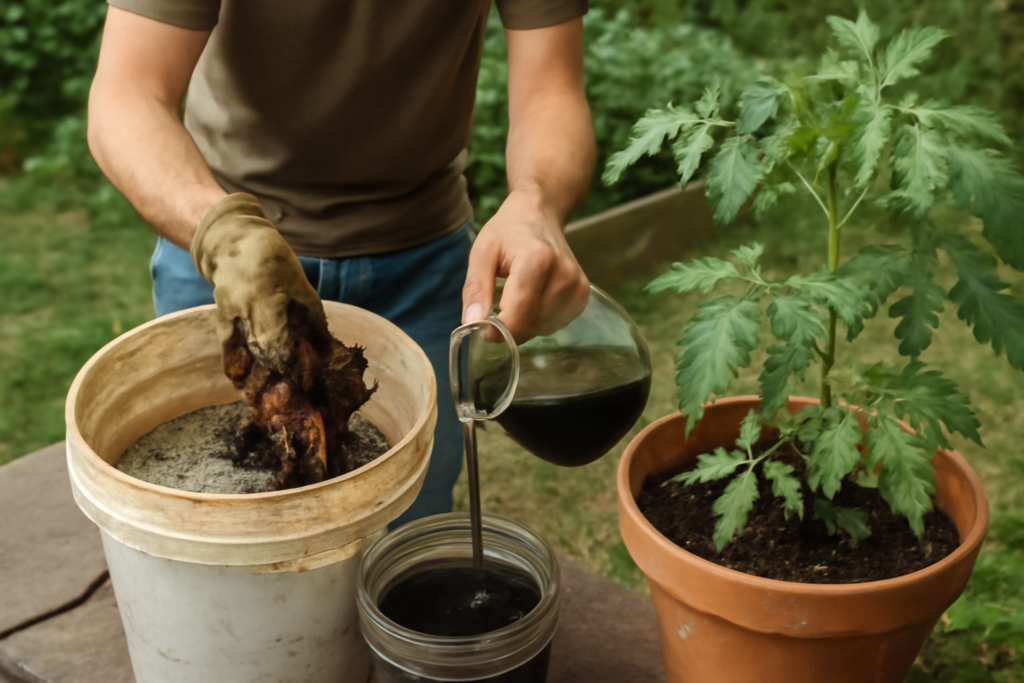
Compost tea is one of the oldest garden tricks: soak finished compost in water, strain it, and pour the brown liquid onto your beds. Gardeners use compost tea for plants as a gentle liquid feed that carries soluble nutrients and a dose of soil life straight to the root zone. It will not replace good soil or a balanced fertilizer program, but it is an easy way to get more value from a small compost pile.
There are two main ways to make it. Steeped (non-aerated) tea sits in a bucket for several days with occasional stirring. Aerated tea is bubbled with an aquarium-style air pump for about 24 to 36 hours. Both work. Aerated tea is faster and smells better, while steeped tea needs no equipment. Whichever you choose, use it promptly, dilute it, and follow a few hygiene rules so it stays safe around food crops.
What Compost Tea for Plants Does and Does Not Do
Compost tea is a watery extract of compost. It contains small amounts of soluble nitrogen, potassium and trace minerals, plus organic compounds and microbes washed out of the compost. When you apply it, those nutrients are immediately available to roots, and the organic matter feeds soil organisms.
Many gardeners report greener foliage and steadier growth, especially in containers and raised beds where nutrients wash out quickly. Still, keep expectations realistic. The nutrient content is low compared with a packaged fertilizer, results vary with the quality of your compost, and research on claims such as disease suppression is mixed. Think of it as a mild tonic and soil conditioner, not a cure-all.
Compost tea is also different from leachate, the dark liquid that drains from the bottom of a compost bin or worm bin. Leachate can carry partly decomposed material and should be diluted heavily and used only on ornamentals. True worm compost tea is brewed from finished worm castings, not from that runoff.
Steeped vs Aerated Compost Tea
Steeped (non-aerated) tea
This is the simplest method. You put compost in a bucket of water, stir it a few times a day, and strain it after 3 to 7 days. No equipment is needed beyond a bucket and a stick. The downside is that oxygen levels drop as microbes multiply, so the brew can turn sour and smelly, and it takes longer.
Aerated compost tea
Here, an air pump pushes bubbles through the water continuously. The oxygen keeps the brew fresh and favors aerobic microbes, and the tea is ready in about a day. Some gardeners add a small amount of a simple food source, such as unsulfured molasses, to boost microbial growth. Skip that additive if you plan to use the tea on edible crops near harvest, since extra sugar can encourage unwanted bacteria to multiply. A small compost tea brewer or a homemade compost tea aerator setup both work well.
Either way, the tea should smell earthy or sweet. A rotten-egg or sewage smell means the brew went anaerobic, and it should be poured onto a compost pile rather than onto plants.
Tools and Materials
- A clean 5 gallon bucket (food-grade if you have one)
- 2 to 4 cups of finished, mature compost or worm castings
- Dechlorinated water: rainwater, well water, or tap water left uncovered for 24 hours
- For aerated tea: an aquarium air pump, air line tubing and one or two air stones
- A mesh bag, old pillowcase, paint strainer bag or compost tea bags to hold the compost
- A watering can or pump sprayer used only for garden products
- Gloves
Use only fully finished compost that smells earthy and has no recognizable food scraps. Do not use compost made from pet waste, and avoid manure-based compost that has not been properly hot-composted and cured.
Step-by-Step: Making Compost Tea With a Bucket and Air Pump
- Prepare the water. Fill the bucket with about 4 gallons of rainwater or dechlorinated tap water. If using tap water, run the air pump in it for an hour or let it stand overnight.
- Bag the compost. Put 2 to 4 cups of compost into a mesh bag and tie it shut. Bagging it keeps solids out of your sprayer and makes cleanup easy.
- Set up aeration. Place the air stones on the bottom of the bucket, connect the tubing, and set the pump outside the bucket above the water line. Plug the pump into a GFCI-protected outdoor outlet, and keep the cord and pump away from splashes.
- Add the bag. Hang the compost bag in the water or let it sit near the air stones so bubbles move through it.
- Brew. Run the pump for 24 to 36 hours in a shaded spot between about 60 and 80°F. Stir once or twice and squeeze the bag.
- Check the smell. It should smell earthy. If it smells foul, discard it on the compost pile.
- Strain and use. Remove the bag, unplug the pump, and use the tea within a few hours. Aerated tea loses its oxygen quickly once bubbling stops.
For steeped tea, skip the pump, stir the bucket vigorously two or three times a day, cover it loosely to keep out debris and mosquitoes, and strain it after 3 to 7 days. Making compost tea this way takes patience, but it costs nothing.
Dilution and How Often to Apply
Strength varies from batch to batch, so dilution is a safe habit. A common starting point is 1 part tea to 3 to 10 parts water, until the liquid looks like weak iced tea. Stronger tea can be used as a soil drench on established plants; seedlings and containers do better with a weaker mix.
- Vegetables: apply as a soil drench around the base every 2 to 3 weeks during the growing season, about 1 to 2 cups per plant or a quart per square yard of bed.
- Containers and houseplants: use a well-diluted tea once a month in spring and summer.
- Lawns: apply with a watering can or hose-end sprayer at roughly 5 gallons of diluted tea per 1,000 square feet in spring and early fall, ideally after mowing or aerating.
- Flower beds and shrubs: every 3 to 4 weeks from spring through midsummer.
Apply in the early morning or evening so the liquid does not evaporate in the heat. Soil drenches are the most reliable use. Some gardeners spray tea on leaves of ornamentals, but straining must be very fine to avoid clogging the sprayer.
Hygiene and Food Safety
Compost tea is a brewed microbial product, so treat it with the same care you would give any garden amendment that touches food crops.
- Use it promptly. Apply within a few hours of brewing. Do not store it in a sealed container, where it can turn anaerobic and grow unwanted bacteria.
- Keep it off edible leaves near harvest. Apply to the soil around vegetables rather than spraying leafy greens, herbs or fruit. Avoid any contact with edible parts within about two weeks of picking.
- Wash produce thoroughly before eating, as you would anything grown in compost-amended soil.
- Wear gloves and wash your hands with soap and water after brewing and applying, and after cleaning the equipment.
- Clean equipment between batches. Scrub the bucket, air stones and tubing with hot soapy water, rinse well, and let everything dry. Biofilm in old tubing can seed the next batch with odors.
- Keep it away from children and pets, and label any container holding tea.
Troubleshooting
The tea smells bad. It went anaerobic, usually from too much compost, too little aeration, or too much molasses. Discard it, clean everything, and use less compost or more air next time.
Foam on top. Light foam is normal with aerated brewing, especially with added molasses. Heavy foam can spill over, so leave a few inches of headroom.
The sprayer clogs. Strain through a finer cloth, or use the tea only as a soil drench with a watering can.
No visible results. Compost tea is a mild feed. If plants are pale or stunted, test your soil and address major nutrient gaps with compost and a balanced fertilizer.
Costs
Steeped tea costs essentially nothing if you already make compost. An aerated setup with a basic aquarium pump, tubing and stones typically runs 15 to 40 dollars. Purpose-built compost tea brewers range from about 50 dollars for small units to several hundred for large garden or small-farm models. Pre-packed compost tea bags and worm casting tea kits are a convenient middle ground for gardeners without a compost pile.
If you are managing a large property or a commercial planting, a landscape or turf professional can recommend a soil testing and amendment program where compost tea fertilizer is one piece of a wider plan.
Frequently Asked Questions
How long does compost tea last after brewing?
Use aerated compost tea within a few hours of turning off the pump. Steeped tea should also be used the same day it is strained. Do not seal and store it, because it can turn sour and grow unwanted bacteria.
Can I use compost tea on vegetables?
Yes, as a soil drench around the base of plants every 2 to 3 weeks. Keep it off edible leaves and fruit, stop spraying foliage well before harvest, and wash produce before eating.
Do I need an air pump to make compost tea?
No. Steeped compost tea only needs a bucket, water and compost, stirred a few times a day for 3 to 7 days. An air pump simply makes the process faster and keeps the brew fresher.
How much compost tea for plants should I mix with water?
A common starting dilution is 1 part tea to 3 to 10 parts water, until it looks like weak tea. Use weaker mixes for seedlings and containers and stronger mixes for established beds.
Is worm compost tea different from regular compost tea?
It is brewed the same way, using finished worm castings instead of garden compost. Castings are fine and nutrient-rich, so a little goes a long way. Do not confuse it with liquid draining from a worm bin, which should be diluted heavily and kept off edibles.