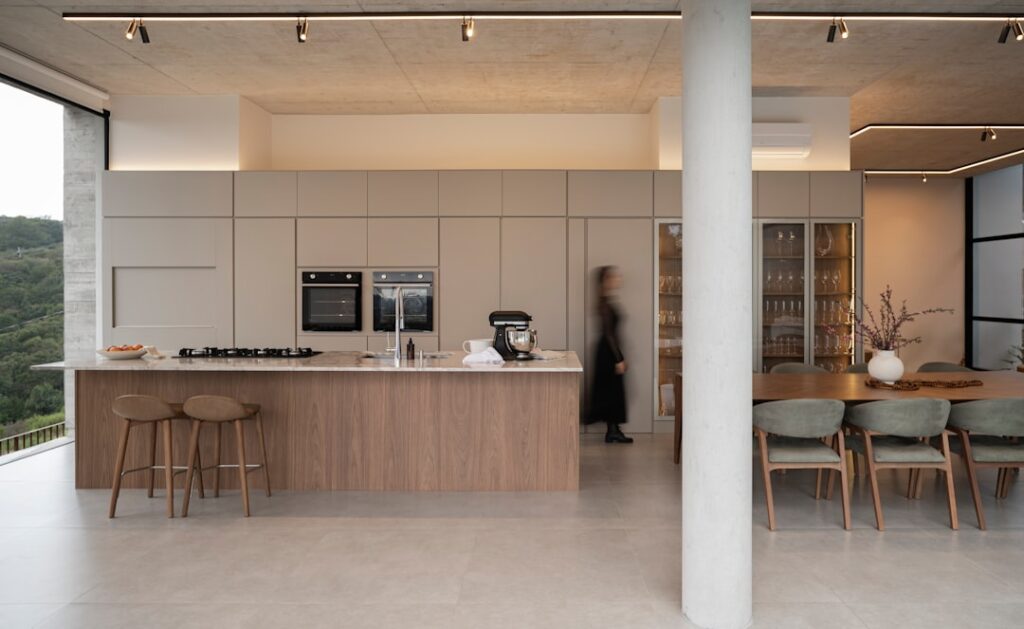
Few countertop materials offer the raw, sculptural versatility of concrete countertops. Once confined to industrial lofts and commercial kitchens, concrete has become a mainstream surface choice for homeowners who want something that feels handcrafted, utterly unique, and impossible to replicate with factory-produced slabs. Every concrete countertop is built to order, shaped by the hands of its maker, and finished to match a specific design vision—no two are alike.
That creative freedom comes with trade-offs. Concrete is heavy, porous without proper sealing, and susceptible to hairline cracks over time. It demands a sealing schedule, careful structural planning, and a realistic understanding of how it ages. But for homeowners who embrace its imperfect, living character, a well-made concrete countertop can anchor a kitchen or bathroom design for decades.
- What Are Concrete Countertops?
- Pros and Cons of Concrete Countertops
- Concrete Countertop Cost
- Concrete vs Granite vs Quartz vs Marble vs Butcher Block
- Customization Options
- Sealing Requirements
- Weight Considerations and Structural Support
- Installation Process
- DIY Concrete Countertops vs Professional Installation
- Maintenance: Staining, Heat, and Cracking
- Indoor vs Outdoor Use
- Kitchen vs Bathroom Use
- Modern Design Trends
- Frequently Asked Questions About Concrete Countertops
- Final Thoughts
This guide covers everything you need to know about concrete kitchen countertops—from fabrication methods and concrete countertop cost to sealing requirements, weight considerations, customization options, and honest comparisons against granite, quartz, marble, and butcher block. Whether you are considering a DIY concrete countertops project or hiring a professional fabricator, you will find the information you need to make a confident decision. If you are renovating an entire kitchen, our kitchen flooring guide is a valuable companion read for coordinating your surfaces.
What Are Concrete Countertops?
Concrete countertops are custom-built surfaces made from a mixture of Portland cement, fine aggregates (sand), water, and various additives that improve workability, strength, and appearance. Unlike the rough grey concrete used in sidewalks, countertop-grade concrete is a refined, engineered material that can be polished to a satin smoothness, tinted to virtually any color, and shaped into forms that no quarried stone can match.
There are two primary fabrication methods for poured concrete countertops:
Custom Pour-in-Place
With this method, forms are built directly on top of your existing cabinets, and the concrete is poured, leveled, and finished on-site. Pour-in-place eliminates seams entirely because the countertop is cast as a single monolithic piece that can wrap around corners, integrate backsplashes, and flow seamlessly along any layout. The downside is that the wet concrete process happens in your kitchen, which is messier and requires careful protection of surrounding surfaces, cabinets, and floors.
Precast (Shop-Fabricated)
Precast concrete countertops are formed and cured in a fabricator’s workshop, then transported to your home for installation. This method gives the fabricator more control over curing conditions, finishing techniques, and quality assurance. However, precast slabs must be sized to fit through doorways and around corners, which means seams are sometimes unavoidable on larger layouts. Precast slabs are typically 1.5 to 2 inches thick and are installed similarly to granite or quartz slabs.
Both methods produce a surface that typically reaches full structural strength after 28 days of curing, though countertops are usually functional within 5 to 7 days. The choice between pour-in-place and precast often comes down to the complexity of the layout, the fabricator’s preference, and whether seamless construction is a priority.
Pros and Cons of Concrete Countertops
Before committing to a concrete countertop, it is important to weigh the advantages against the limitations honestly. Concrete is not a set-it-and-forget-it surface like quartz, and its character evolves over time in ways that some homeowners love and others find frustrating.
Advantages
- Unlimited customization. Concrete can be tinted to any color, shaped to any dimension, and finished with textures ranging from glass-smooth to rugged and exposed-aggregate. No other countertop material offers this level of creative control.
- Seamless construction. Pour-in-place concrete can create countertops with zero visible seams, even around corners and integrated sinks—something impossible with slab materials like granite or quartz.
- Heat resistance. Concrete handles hot pots and pans well. While extreme thermal shock can cause cracking, everyday contact with hot cookware will not scorch or discolor a properly sealed surface.
- Unique character. Each countertop develops its own subtle variations, veining patterns, and patina over time. For homeowners who appreciate wabi-sabi aesthetics, this is a major draw.
- Eco-friendly potential. Concrete can incorporate recycled glass, fly ash, and other reclaimed materials, reducing its environmental footprint compared to quarried stone shipped from overseas.
- Pairs beautifully with natural materials. Concrete complements wood, steel, and stone surfaces. It is a natural match for terrazzo flooring, open shelving, and industrial or modern farmhouse design schemes.
Disadvantages
- Porous without sealing. Untreated concrete absorbs liquids like a sponge. Wine, coffee, lemon juice, and oil will stain quickly without a properly maintained seal.
- Hairline cracks. Concrete is a rigid material that can develop hairline cracks during curing or over time as a house settles. Most fabricators consider fine cracking a natural characteristic rather than a defect.
- Heavy. At approximately 18 to 25 pounds per square foot for a standard 1.5-inch slab, concrete countertops weigh roughly the same as granite—sometimes more. Cabinets and floor structures may need reinforcement.
- Maintenance commitment. Concrete requires periodic resealing (typically every 1 to 3 years) and daily care to prevent staining. It is not as low-maintenance as quartz or solid surface.
- Cost. Professional concrete countertops are not cheap. They often cost as much as or more than mid-range granite or quartz, especially for complex shapes and custom finishes.
- Long lead time. Between templating, casting, curing, and finishing, expect 3 to 6 weeks from order to installation for a custom fabrication.
Concrete Countertop Cost
The cost of concrete countertops varies significantly based on complexity, finish, fabrication method, and your geographic market. Here is what to expect in 2026:
| Cost Category | Price Range (per sq ft) | Notes |
|---|---|---|
| Basic professional install | $65 – $85 | Simple shapes, standard color, basic edge |
| Mid-range professional | $85 – $110 | Custom color, decorative edge, integrated drainboard |
| High-end / complex | $110 – $135+ | Embedded objects, integral sink, veining effects, waterfall edges |
| DIY materials only | $10 – $30 | Cement mix, forms, sealer, tools; labor is your own |
For a typical 40-square-foot kitchen countertop, professional installation runs between $2,600 and $5,400, with most homeowners landing in the $3,200 to $4,500 range. That puts concrete countertop cost on par with mid-tier granite and slightly below premium quartz. Keep in mind that highly custom features—integrated sinks, waterfall edges, embedded glass or stone, complex curves—can push costs toward the higher end.
Additional cost factors include demolition and removal of old countertops ($200–$500), cabinet reinforcement if needed ($300–$800), and plumbing reconnection ($150–$350). Always request an itemized quote so you understand exactly what is included.
Concrete vs Granite vs Quartz vs Marble vs Butcher Block
Choosing a countertop material means evaluating how each option balances aesthetics, durability, maintenance, and budget. The following comparison table puts concrete side by side with its four most common competitors.
| Feature | Concrete | Granite | Quartz | Marble | Butcher Block |
|---|---|---|---|---|---|
| Cost (installed/sqft) | $65 – $135 | $50 – $120 | $55 – $150 | $75 – $200 | $40 – $100 |
| Heat Resistance | Good | Excellent | Moderate | Good | Poor |
| Scratch Resistance | Moderate | Excellent | Excellent | Poor | Poor |
| Stain Resistance | Low (needs sealing) | Moderate (needs sealing) | Excellent | Low (needs sealing) | Low (needs oiling) |
| Maintenance | Reseal every 1–3 years | Reseal annually | Minimal | Reseal every 6–12 months | Oil monthly |
| Customization | Unlimited | Limited to natural patterns | Many manufactured patterns | Limited to natural patterns | Wood species and stain choice |
| Weight (per sqft) | 18 – 25 lbs | 18 – 20 lbs | 15 – 18 lbs | 16 – 19 lbs | 8 – 12 lbs |
| Seams | Can be seamless | Visible at joints | Visible at joints | Visible at joints | Visible at joints |
| Eco-Friendliness | Good (local, recyclable) | Moderate (quarried) | Moderate (manufactured) | Moderate (quarried, shipped) | Good (renewable) |
| Best For | Custom designs, modern kitchens | Traditional kitchens, high traffic | Low-maintenance kitchens | Luxury baths, baking stations | Warm, rustic kitchens |
Concrete vs Granite
Granite is quarried natural stone, so its patterns and colors are determined by nature. Concrete, by contrast, is a manufactured material whose appearance is entirely controlled by the fabricator. Granite is harder and more scratch-resistant than concrete, making it better suited for heavy-use kitchens where cutting boards are occasionally forgotten. However, granite cannot be poured into seamless, custom shapes, and its color options are limited to what nature provides. If you want a one-of-a-kind shape or a specific color that does not exist in natural stone, concrete wins. If you want proven toughness and minimal maintenance, granite has the edge.
Concrete vs Quartz
Engineered quartz is the low-maintenance champion of the countertop world. It is non-porous, never needs sealing, resists staining, and is available in a wide range of consistent patterns. Concrete cannot match quartz for ease of care. However, quartz lacks the handcrafted, artisanal character that draws homeowners to concrete. Quartz slabs are manufactured in factories and, despite their variety, have a uniformity that feels different from the organic imperfections of a hand-poured surface. Choose quartz if maintenance convenience is your top priority; choose concrete if bespoke character matters more.
Concrete vs Marble
Marble and concrete share a common vulnerability: both are porous and require sealing to resist stains. Marble, however, brings natural veining and a luminous depth that concrete can only approximate through artificial techniques. Marble is also more prone to etching from acidic foods. Concrete offers more shape flexibility and is typically less expensive than premium marble varieties. For homeowners who love the look of marble but want a more forgiving surface at a lower price point, concrete with a marble-inspired finish can be a compelling alternative.
[CTA: Get free quotes from concrete countertop fabricators in your area]
Customization Options
Customization is the single biggest reason homeowners choose concrete countertops over natural stone or engineered alternatives. The possibilities extend far beyond color selection.
Integral Color
Pigments are mixed directly into the concrete before it is poured, producing color that runs through the entire thickness of the slab. This means chips and scratches do not reveal a different color underneath. Integral coloring can produce anything from warm earth tones and cool greys to deep charcoal, bright white, and even vivid blues or greens. Most fabricators work with a palette of 30 to 50 standard colors and can custom-match to paint swatches or fabric samples.
Acid Staining and Topical Staining
Acid-based stains react chemically with the minerals in cured concrete, producing translucent, variegated color effects that mimic the movement of natural stone. Water-based topical stains sit on the surface and offer more predictable, uniform color. Both methods can be layered and combined for complex visual effects including faux-marble veining, ombre gradients, and patina finishes.
Embedded Objects
One of the most distinctive customization options is embedding decorative objects into the surface—recycled glass chips, seashells, river stones, fiber optics, metal fragments, fossils, or even personal mementos. The objects are placed in the form before or during the pour, then revealed when the surface is ground and polished. This technique creates truly one-of-a-kind surfaces that tell a story.
Edge Profiles
Concrete can be formed into virtually any edge profile: square, bullnose, ogee, beveled, chiseled, or waterfall (where the countertop material continues down the side of the cabinet to the floor). Custom edge profiles allow the countertop to match the architectural style of the space, from sleek and minimal to ornate and traditional.
Integrated Features
Because concrete is poured into forms, it can incorporate features that are impossible or prohibitively expensive with slab materials: integrated sinks, drainboards with sloped channels, trivets, soap dishes, cutting board slots, and built-in knife blocks. These integrated elements eliminate seams and joints where bacteria and grime can accumulate.
Sealing Requirements
Sealing is not optional for concrete countertops—it is essential. Unsealed concrete is highly porous and will absorb water, oils, and food-based acids within minutes, leading to permanent stains and potential bacterial growth. A quality concrete countertop sealer creates an invisible barrier that protects the surface while preserving its natural look and feel.
Types of Concrete Countertop Sealers
- Penetrating sealers. These soak into the concrete and form a chemical barrier within the pore structure. They do not change the surface sheen or texture and allow the concrete to breathe. Penetrating sealers are the most popular choice for kitchen countertops because they provide excellent stain protection without a plastic-like film.
- Topical sealers (film-forming). These sit on the surface and create a visible coating that ranges from matte to high gloss. Epoxy and polyurethane topical sealers provide excellent protection but can yellow over time, show scratches, and require stripping before reapplication.
- Food-safe sealers. Any sealer used on a kitchen countertop must be certified food-safe once cured. Look for products that comply with FDA and NSF/ANSI 51 standards. Most penetrating sealers formulated specifically for concrete countertops meet these requirements. Beeswax-based finishing coats can add an additional layer of food-safe protection.
Resealing Schedule
The frequency of resealing depends on the sealer type, the level of use the countertop receives, and how diligent you are about wiping up spills promptly. As a general guideline:
- Penetrating sealers: Reapply every 1 to 3 years.
- Topical sealers: Reapply every 1 to 5 years, depending on wear.
- Wax finishing coats: Reapply every 1 to 3 months for optimal protection.
A simple water-drop test can help you determine when resealing is needed. Sprinkle a few drops of water on the surface; if the water beads up, the seal is intact. If the water absorbs into the concrete and darkens the surface, it is time to reseal.
Weight Considerations and Structural Support
Weight is one of the most overlooked aspects of concrete countertop planning. A standard 1.5-inch-thick concrete slab weighs approximately 18 to 25 pounds per square foot. For a typical 40-square-foot kitchen countertop, that is 720 to 1,000 pounds of material sitting on your cabinets.
Standard kitchen cabinets are designed to support granite, which has a similar weight per square foot, so most quality cabinet systems will handle concrete without modification. However, there are situations where reinforcement is necessary:
- Older cabinets with particleboard boxes or weakened joints may need internal bracing or replacement.
- Extended overhangs (breakfast bars, waterfall edges) require steel corbels or a support structure to prevent cracking.
- Upper floors in older homes may need a structural assessment to confirm the floor joists can handle the concentrated load.
- Island installations with large spans should use steel reinforcement within the slab (rebar or fiber mesh) and may need an additional support leg.
Always discuss weight with your fabricator and, if there is any doubt, consult a structural engineer before installation. The cost of a quick structural assessment ($200–$500) is negligible compared to the cost of sagging cabinets or cracked countertops.
Installation Process
Whether you choose pour-in-place or precast, the installation of poured concrete countertops follows a general sequence:
- Templating. The fabricator takes precise measurements of your cabinet layout, including sink and cooktop cutout locations, faucet holes, and edge details. For precast, templates are made from cardboard or digital laser measurements.
- Form building. Melamine or acrylic forms are built to the exact template dimensions. Sink knockouts, edge profiles, and embedded features are incorporated into the form at this stage.
- Mixing and pouring. The concrete mix is prepared, pigmented, and poured into the forms. Vibration tables or hand-held vibrators remove air bubbles. Reinforcement (fiber mesh, wire mesh, or rebar) is embedded during the pour.
- Curing. The concrete cures for 3 to 7 days under controlled conditions. During this period, the surface is kept moist to prevent cracking from rapid drying.
- Finishing. The cured slab is removed from the form, then ground, honed, or polished to the desired texture. Pinholes (small surface voids) are filled with a matching slurry. Stains or decorative treatments are applied at this stage.
- Sealing. Multiple coats of sealer are applied, with curing time between coats.
- Installation. Precast slabs are transported and set onto the cabinets using silicone adhesive. Seams (if any) are filled with color-matched caulk or epoxy. Plumbing fixtures are reconnected.
From initial templating to a finished, usable countertop, expect a timeline of 3 to 6 weeks for professional fabrication.
DIY Concrete Countertops vs Professional Installation
The internet is full of DIY concrete countertops tutorials, and for good reason—the raw materials are affordable ($10–$30 per square foot) and the basic concept is straightforward. However, the gap between a YouTube tutorial and a professionally fabricated countertop is significant.
When DIY Makes Sense
- You have experience with concrete work or are comfortable learning hands-on.
- The project is small (a bathroom vanity, laundry room counter, or outdoor bar).
- You are comfortable with imperfections and a more rustic aesthetic.
- Budget is a primary constraint and you have the time to invest.
When to Hire a Professional
- The countertop is for a primary kitchen with complex layouts, sink cutouts, and cooktop integration.
- You want a refined, polished finish that rivals quartz or granite in smoothness.
- Structural considerations (weight, overhangs, upper-floor installation) require expert assessment.
- You need the project completed within a reliable timeline.
A common middle-ground approach is to DIY a small project first—such as a bathroom vanity top or an outdoor serving counter—before committing to a full kitchen. This lets you develop skills and understand the material’s behavior without risking a high-stakes project.
Maintenance: Staining, Heat, and Cracking
Living with concrete kitchen countertops requires an understanding of how the material behaves day to day and a willingness to maintain it proactively.
Staining Risk
Even with a quality sealer, concrete is more stain-prone than quartz or granite. Red wine, coffee, beet juice, turmeric, and citrus are the most common culprits. The best defense is simple: wipe up spills promptly. If a stain does develop, a paste of baking soda and water applied overnight often lifts it. For deeper stains, light sanding followed by spot-resealing may be necessary.
Heat Resistance
Concrete tolerates heat better than quartz (which can discolor at high temperatures) but is not impervious. Placing a screaming-hot pan directly from the oven onto a sealed concrete surface can damage the sealer and, in extreme cases, cause thermal cracking. Use trivets for pots and pans straight off the burner or out of the oven.
Cracking
Hairline cracks are an inherent possibility with any cementitious material. Skilled fabricators minimize cracking through proper mix design, reinforcement, controlled curing, and expansion joints in long runs. Many homeowners and designers accept hairline cracking as part of concrete’s organic character, similar to the natural variations in wood or leather. If a significant crack develops, it can usually be repaired with a color-matched epoxy fill and resealed.
Indoor vs Outdoor Use
Concrete is one of the few countertop materials that performs well both indoors and outdoors, making it a popular choice for outdoor kitchens, pool bars, and patio dining areas.
For outdoor concrete countertops, several additional considerations apply:
- UV exposure. Some pigments and sealers can fade or yellow under prolonged sun exposure. Choose UV-stable integral pigments and a UV-resistant sealer for outdoor applications.
- Freeze-thaw cycles. In cold climates, water that penetrates the concrete can freeze and expand, causing surface spalling. A high-quality penetrating sealer and proper mix design with air entrainment help prevent this.
- Drainage. Outdoor countertops should have a slight slope (1/8 inch per foot) to shed rainwater rather than letting it pool on the surface.
- Reinforcement. Outdoor installations often require heavier reinforcement (steel rebar rather than fiber mesh alone) to handle the stresses of temperature fluctuation.
For indoor use, concrete works in virtually any room. Kitchens are the most popular application, but bathroom vanity tops, laundry room counters, home bar surfaces, and fireplace hearths are all excellent candidates.
Kitchen vs Bathroom Use
The demands on a countertop differ significantly between a kitchen and a bathroom, and these differences affect how concrete performs in each setting.
In kitchens, concrete faces daily exposure to food acids, oils, heat, and heavy use. Sealing quality and frequency matter most here. Kitchens also demand more complex layouts with sink cutouts, cooktop openings, and extended overhangs for seating. The weight of a full kitchen run of concrete is substantial and requires solid cabinet infrastructure.
In bathrooms, the primary concern shifts to water and moisture. Concrete bathroom vanity tops are exposed to constant splashing, soap scum, and cosmetic products but face less heat and fewer staining agents than kitchen surfaces. Bathroom applications are typically smaller, simpler, and more affordable, making them an ideal entry point for homeowners new to concrete countertops. The material pairs particularly well with vessel sinks and wall-mounted faucets for a minimalist, spa-like aesthetic.
Modern Design Trends
Concrete countertops continue to evolve as fabrication techniques advance and design trends shift. Here are the leading trends shaping concrete kitchen countertops in 2026:
- Waterfall edges. The countertop material cascades down the side of an island to the floor, creating a dramatic, furniture-like statement piece. This technique showcases the material’s unique texture and color on a vertical plane.
- Ultra-thin profiles. Advances in glass fiber reinforced concrete (GFRC) allow fabricators to produce slabs as thin as 3/4 inch while maintaining structural integrity. Thin profiles give concrete a lighter, more contemporary look.
- White and light-toned concrete. The industrial grey stereotype is fading. White cement bases with subtle veining effects that mimic Carrara marble are increasingly popular, giving homeowners the organic feel of concrete with a bright, airy aesthetic.
- Integrated sinks. Seamlessly formed sinks that are part of the countertop eliminate the undermount or drop-in debate entirely. Integrated concrete sinks can be shaped into rectangles, troughs, or organic curves.
- Recycled aggregate finishes. Surfaces ground to reveal embedded recycled glass, mirror fragments, or crushed stone create a look reminiscent of terrazzo—combining sustainability with striking visual texture.
- Matte and honed finishes. High-gloss polished concrete is giving way to softer, matte-finished surfaces that feel more natural and tactile. Matte finishes also hide minor scratches and wear better than gloss.
- Mixed material kitchens. Designers are pairing concrete on islands or prep areas with butcher block, quartz, or stainless steel on perimeter counters. This layered approach lets each material shine in its ideal application zone.
[CTA: Schedule a free consultation with a concrete countertop specialist near you]
Frequently Asked Questions About Concrete Countertops
How long do concrete countertops last?
With proper sealing and maintenance, concrete countertops can last 20 years or more. The concrete itself is extremely durable and will not degrade under normal kitchen use. The sealer is the component that wears over time and must be refreshed periodically. Because concrete can be re-ground, re-stained, and re-sealed, it can be refinished rather than replaced if the surface becomes worn or damaged—giving it a functional lifespan that rivals granite and quartz.
Can you put hot pans directly on concrete countertops?
Concrete is more heat-resistant than quartz and butcher block, but you should still use trivets for very hot pots and pans. Direct contact with extreme heat can damage the sealer layer and, in rare cases, cause thermal stress cracks. Brief contact with moderately hot items is generally fine, but making a habit of using trivets protects both the sealer and the concrete itself over the long term.
Do concrete countertops always crack?
Not always, but hairline cracks are a known possibility with any cement-based material. A skilled fabricator minimizes cracking risk through proper mix design, steel or fiber reinforcement, controlled curing, and strategic placement of control joints on long runs. Many homeowners accept fine hairline cracking as part of the material’s artisanal character. If cracks do appear, they can be repaired with a color-matched filler and resealed without replacing the entire countertop.
Are DIY concrete countertops worth it?
DIY concrete countertops can save 50 to 70 percent on cost compared to professional fabrication, making them worth it for handy homeowners with realistic expectations. The key is starting small—a bathroom vanity or outdoor bar—before tackling a full kitchen. DIY results tend to have a more rustic, handmade quality with visible imperfections that some homeowners love. If you demand a factory-smooth finish or have a complex layout with integrated sinks and cooktop cutouts, professional fabrication is the better investment.
What is the best sealer for concrete countertops?
For kitchen use, a food-safe penetrating sealer is the best overall choice. Penetrating sealers protect against stains without forming a surface film that can scratch, peel, or yellow. Look for products specifically marketed as concrete countertop sealer that comply with FDA and NSF/ANSI 51 standards. Popular professional-grade options include solvent-based lithium silicate densifiers topped with a fluoropolymer stain repellent. For added protection, a food-safe wax finishing coat can be applied monthly over the penetrating sealer.
Final Thoughts
Concrete countertops are not for everyone—and that is precisely what makes them special. They demand more care than quartz, more planning than granite, and more patience than butcher block. But in return, they offer something no other countertop material can match: a surface that is entirely yours, shaped to your specifications, colored to your vision, and aged by your daily life.
If you value craftsmanship, customization, and a material that tells a story as it ages, concrete deserves serious consideration. Pair it with the right kitchen flooring, invest in quality fabrication and sealing, and you will have a countertop that anchors your kitchen design for decades to come.