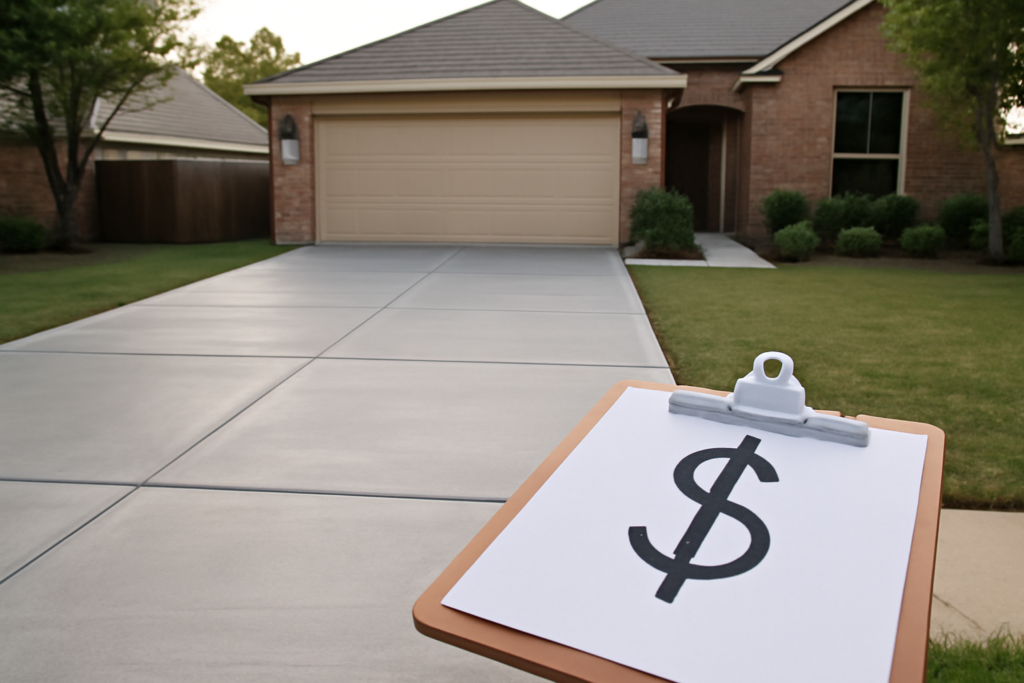
Most homeowners get blindsided by the gap between the headline number and the final invoice. The concrete driveway cost per sq ft sits at $6 to $12 installed for a basic gray slab in 2026, but stamped or colored concrete can push past $20. Site prep, demolition, and rebar are the line items that turn a $4,000 estimate into a $7,500 reality. Know what’s actually in the quote before you sign.
- What You Pay Per Square Foot
- Regional Price Swings Are Real
- What Drives the Price Up
- Standard Specs You Should Insist On
- Hidden Costs That Catch Homeowners Off Guard
- Concrete vs. Asphalt vs. Pavers
- Getting Accurate Bids
- Cement Driveway Cost per Square Foot and What Thickness Adds
- Bottom Line on What You'll Pay
- Timing the Pour for Best Results
What You Pay Per Square Foot
Standard 4-inch broom-finish concrete on flat, prepped ground runs $6 to $9 per sq ft in most US markets. Add wire mesh or rebar reinforcement and you’re at $8 to $11. Decorative options climb fast:
- Plain gray broom finish: $6-$9 per sq ft
- Integral colored concrete: $8-$12 per sq ft
- Stamped concrete (single pattern): $12-$18 per sq ft
- Stamped and stained, multi-color: $18-$28 per sq ft
- Exposed aggregate: $10-$15 per sq ft
For a typical 600 sq ft driveway (20 feet by 30 feet), that puts a basic install at $3,600-$5,400 and a stamped upgrade at $7,200-$10,800.
Regional Price Swings Are Real
Labor and material costs vary by 40 percent across the country. The Midwest and Southeast remain cheapest, with concrete running $115-$135 per cubic yard delivered. Coastal California, the Pacific Northwest, and the Northeast see $150-$185 per yard, plus higher labor rates that add $2-$3 per sq ft to the install.
If you’re in a high-cost metro like Seattle, San Francisco, or Boston, expect to pay 25-35 percent above the national average. Rural areas in Texas, Tennessee, or Ohio frequently come in below $6 per sq ft for straightforward jobs.
What Drives the Price Up
Three factors quietly inflate quotes more than anything else. First, demolition. Removing an old asphalt or concrete driveway adds $1.50-$3 per sq ft, plus $400-$800 in dump fees. Second, slope and grading. Anything beyond a gentle pitch requires extra forms, more labor, and sometimes retaining curbs. Third, access. If your driveway is more than 100 feet from the curb or a truck can’t get within 50 feet of the pour, the crew may need to wheelbarrow concrete or rent a pump truck for $700-$1,200.
Standard Specs You Should Insist On
Cheap quotes cut corners on thickness, base, and reinforcement. Don’t accept anything less than:
- 4 inches of concrete minimum (5 inches if heavy vehicles will park on it)
- 4-6 inches of compacted gravel base — class 5 or crushed limestone
- Wire mesh or #3 rebar on 18-inch grid for crack control
- Control joints every 8-10 feet in both directions
- 4,000 PSI concrete mix minimum, with air entrainment in freeze zones
A contractor who pours 3-inch concrete on dirt with no rebar will be back in five years patching cracks. Spend the extra $1.50 per sq ft now and the slab lasts 30 years.
Hidden Costs That Catch Homeowners Off Guard
Permit fees range from $50 to $500 depending on jurisdiction. Some cities require a survey ($300-$600) or engineered drainage plan ($500-$1,500). If your old driveway sits on a septic field or near a buried utility, marking and protection can add $200-$400. And in HOA neighborhoods, design approval often requires specific colors or finishes that nudge you out of the basic-gray price tier.
Sealing is another line item. A penetrating sealer at install runs $0.50-$1 per sq ft and should be reapplied every 3-5 years. Skip it and you’ll see staining, scaling, and salt damage by year four in northern climates.
Concrete vs. Asphalt vs. Pavers
Cost matters, but so does lifecycle. Here’s the realistic comparison for a 600 sq ft driveway:
- Asphalt: $4-$7 per sq ft installed, lasts 15-20 years, needs sealing every 3 years
- Concrete: $6-$12 per sq ft, lasts 25-30 years, low maintenance
- Pavers: $14-$25 per sq ft, lasts 50+ years, individual stones replaceable
- Gravel: $1-$3 per sq ft, lasts indefinitely with annual top-ups
Concrete wins for the middle ground — better longevity than asphalt at less than half the price of pavers.
Getting Accurate Bids
Get three written quotes minimum, and make sure each includes thickness, PSI, reinforcement type, base depth, and joint spacing. If a contractor refuses to put specs in writing, walk away. Ask for proof of liability insurance ($1 million minimum) and references from jobs poured at least three years ago — concrete failures usually show up by year two.
The lowest bid is rarely the best value. A contractor 15 percent above the cheap quote often delivers a slab that lasts 10 years longer.
Cement Driveway Cost per Square Foot and What Thickness Adds
A cement driveway costs the same as a concrete driveway, about $6 to $12 per square foot installed, because “cement” is simply the everyday name for it. Cement is the binding powder inside concrete, and every driveway contractor prices the finished slab as concrete. The bigger price lever most homeowners miss is slab thickness, since every extra inch adds material on every square foot.
How Thickness Changes Material Cost
One cubic yard of concrete covers about 81 square feet at 4 inches thick, 65 square feet at 5 inches and 54 square feet at 6 inches. At typical delivered prices of $115 to $185 per cubic yard, the ready-mix alone works out roughly as follows, before labor, base, reinforcement and finishing:
| Slab thickness | Coverage per cubic yard | Ready-mix cost per sq ft | Typical use |
|---|---|---|---|
| 4 inches | About 81 sq ft | About $1.40 to $2.30 | Cars and light SUVs |
| 5 inches | About 65 sq ft | About $1.80 to $2.90 | Pickups, vans, heavier vehicles |
| 6 inches | About 54 sq ft | About $2.10 to $3.40 | RVs, delivery trucks, aprons |
Most of the installed price is labor, forming, base and reinforcement, which is why going from 4 to 5 inches adds well under a dollar per square foot to the total while making the slab noticeably stronger.
Bagged Cement Mix vs Ready-Mix
Bagged mix only makes sense for small pads and repairs. An 80 pound bag yields about 0.6 cubic feet, enough for less than 2 square feet at 4 inches, so a 600 square foot driveway would need more than 300 bags mixed and placed before the first batch sets. Ready-mix delivered by truck is cheaper per square foot and gives a more uniform slab.
Safety on a Cement Driveway Job
- Wet concrete is caustic and can burn skin, so wear waterproof gloves, boots and eye protection.
- Cutting control joints or removing an old slab releases silica dust; use a wet saw and a properly fitted respirator.
- Call 811 a few business days before excavation so buried lines are marked.
Bottom Line on What You’ll Pay
For most US homeowners, the realistic concrete driveway cost per sq ft lands at $7-$10 for a properly built basic install. Budget $5,000-$7,000 for a standard 600 sq ft job, add $2,000-$5,000 for stamped or colored upgrades, and another $1,000-$2,500 if demolition is involved. Get the specs right up front and you won’t pay twice.
Timing the Pour for Best Results
Concrete cures best between 50°F and 85°F. In northern climates, that limits you to roughly April through October. Pours in cold weather require chemical accelerators or heated blankets, which add $150-$400 to the job. Hot summer pours need retarders and constant misting to prevent surface cracking.
Schedule the pour for early morning if possible. Crews work better in cool temperatures, and the slab benefits from a slow initial cure. Avoid pouring with rain in the 12-hour forecast — surface dimpling from raindrops ruins the broom finish. Most contractors are booked 4-8 weeks out during peak season, so call early in spring to lock in pricing before summer demand pushes quotes 8-12 percent higher.
If your project includes both a new driveway and a patio or sidewalk, bid them as a combined job. Mobilization fees (truck delivery, crew setup) get spread across more square footage and the per-sq-ft cost typically drops $0.50-$1.00. Most contractors offer this discount but only if asked.