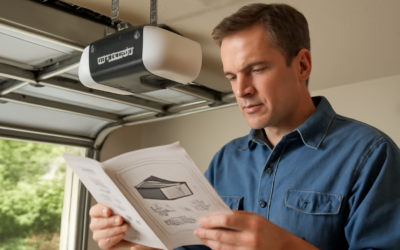
Half a horsepower does not sound like much until you realize it lifts a 150-pound sectional door thousands of times a year without complaint. The Craftsman 1/2 hp garage door opener has been the default choice in American garages for decades because it balances lifting muscle, price, and quiet operation for the doors most homes actually have. If you are buying, replacing, or troubleshooting one, understanding what that horsepower rating really means will save you money and frustration.
Part of our Garage Doors guide — explore the full guide →
What 1/2 HP Actually Handles
The 1/2 horsepower class is engineered for standard residential doors, and it covers the vast majority of homes. A single-car door up to 8 feet wide or a lightweight double door up to 16 feet wide falls comfortably within its range, provided the door itself is balanced and the springs do most of the lifting.
Here is the part homeowners miss: the opener does not lift the full weight of the door. Torsion or extension springs counterbalance the door so it feels nearly weightless. The motor only manages the small imbalance and the friction. That is why a modest 1/2 hp motor moves a heavy-looking door with ease when everything is tuned correctly.
- Best fit: Single doors and standard-weight double doors made of steel or lightweight composite.
- Step up to 3/4 hp: For heavy wood, insulated carriage-house, or oversized doors.
- Warning sign: If a 1/2 hp unit strains, the springs likely need adjustment, not a bigger motor.
Drive Types Craftsman Offers
Craftsman openers, many built on the same Chamberlain and LiftMaster platforms, come in three drive styles. Each moves the trolley along the rail differently, and the choice affects noise, maintenance, and cost.
Chain Drive
A metal chain pulls the trolley, much like a bicycle chain. It is the most affordable and the most durable under heavy use, but also the loudest. If your garage sits under a bedroom, the rattle can be a dealbreaker. Expect to pay $150 to $200 for a chain-drive 1/2 hp model.
Belt Drive
A reinforced rubber belt replaces the chain for dramatically quieter operation. It is the top pick for attached garages and rooms above the garage. The belt costs $50 to $80 more than chain but eliminates most of the vibration and clatter.
Screw Drive
A threaded steel rod turns to move the trolley. Screw drives have fewer moving parts and need less frequent adjustment, though they can be sensitive to temperature swings in unheated garages. They land in the middle for both noise and price.
Key Features to Look For
Modern Craftsman openers pack in convenience and safety features that older units lacked. When comparing models, weigh these against your budget and how you use the garage.
- Battery backup: Opens the door during a power outage, now required by law in some states like California.
- MyQ or smartphone control: Lets you open, close, and monitor the door from an app.
- LED lighting: Brighter, longer-lasting bulbs than old incandescent sockets.
- Motion-activated lights: Illuminate the garage automatically when you walk in.
- Rolling-code security: Changes the access code with every use to block code-grabbing thieves.
Battery backup deserves special attention. There is nothing worse than being trapped with a car inside during a storm-related outage. On heavier doors, the emergency release cord is the only manual option without it.
Installation Overview
Installing a 1/2 hp opener is a realistic weekend DIY project for a confident homeowner, though it helps to have a second set of hands. The rail assembles first, then mounts to a header bracket above the door and hangs from the ceiling with steel struts. Budget three to four hours for a first-time install.
Two safety steps are non-negotiable. First, test the door’s balance before you start: disconnect the opener, lift the door halfway by hand, and let go. A properly sprung door stays put. If it slams down or flies up, call a technician to adjust the springs, because a bigger motor cannot fix a spring problem safely. Second, mount the photo-eye sensors no higher than 6 inches off the floor so the door reverses if a child or pet crosses the path.
Programming the Remote and Keypad
Pairing accessories is straightforward once you find the Learn button on the motor head, usually near the antenna wire. The process is nearly identical across Craftsman models.
- Press and release the Learn button; an indicator light turns on for about 30 seconds.
- Within that window, press the remote button you want to program.
- The opener light flashes or clicks to confirm the code is learned.
- For a keypad, enter your chosen PIN and press Enter within the same window.
To program a built-in HomeLink button in your car, put the opener in Learn mode, then hold the car button until the door responds. Clearing all remotes is just as easy: hold the Learn button for about 6 seconds until the light goes out, which is the first thing to do if you lose a remote or buy a used home.
Common Problems and Fixes
Most opener complaints trace back to a handful of causes, and many cost nothing to fix. Before you assume the motor is dead, run through the basics.
- Door reverses before closing: Clean or realign the photo-eye sensors; a blinking sensor light means they are out of line.
- Remote works up close only: Replace the remote battery or check for interference from LED shop lights.
- Motor runs but door does not move: The trolley may be in manual-release mode; re-engage it by pulling the cord back toward the motor.
- Grinding or straining: Lubricate the chain or screw and inspect the springs for balance.
A twice-yearly maintenance habit prevents most failures. Wipe and lubricate the rail, tighten loose bolts, and test the auto-reverse by laying a 2×4 flat under the door. If the door does not reverse on contact, adjust the force settings immediately.
Maintenance That Extends Its Life
A garage door opener is one of the hardest-working motors in your home, cycling up and down several times a day for a decade or more. A little seasonal attention keeps it quiet and prevents the sudden failures that always seem to happen when your car is trapped inside.
- Lubricate twice a year: Use a garage-door-specific lithium or silicone spray on the chain or screw, rollers, hinges, and springs. Never use WD-40, which strips lubricant.
- Tighten hardware: Vibration loosens bolts on the rail, brackets, and roller carriers over time.
- Test the balance: Disconnect the opener and lift the door by hand; it should stay put at the halfway point.
- Check the auto-reverse: Lay a 2×4 flat under the door; a working opener reverses on contact.
Replace the remote and keypad batteries preemptively once a year rather than waiting for them to die. A weak remote battery is the single most common service call, and it costs pennies to prevent.
Understanding the Horsepower vs Newton Debate
You may notice newer Craftsman and Chamberlain openers advertised in Newtons of force rather than horsepower, and it confuses a lot of shoppers. The industry shifted to force ratings because horsepower alone never told the whole story; a well-geared motor can lift more than its raw horsepower suggests. A unit branded as “1/2 HP comparable” or rated around 500 Newtons delivers the same real-world lifting muscle homeowners expect from the traditional half-horse class.
When comparing models, focus on the door types the manufacturer says the unit supports rather than fixating on the horsepower number. A modern DC-motor opener rated as 1/2 HP equivalent often runs quieter and includes soft start and stop, which reduces wear on both the opener and the door hardware compared to older AC motors. If the spec sheet lists your door size and material as compatible, the motor has the muscle for the job.
Is It the Right Opener for You?
For the overwhelming majority of homes, a Craftsman 1/2 hp garage door opener delivers everything you need at a reasonable price. It lifts standard single and double doors reliably, offers belt-drive quiet if you want it, and now includes smartphone control and battery backup on mid-tier models. Only truly heavy wood or oversized doors justify stepping up to 3/4 or 1.25 horsepower. Match the drive type to your noise tolerance, keep the springs balanced, and this workhorse will open your garage tens of thousands of times before it ever asks for attention.