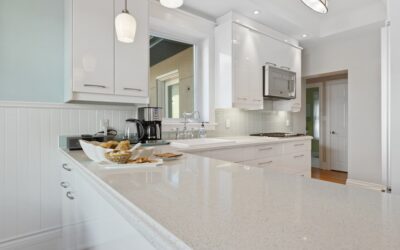
Delicatus granite is a Brazilian natural stone prized for its bright, creamy-white background scattered with dramatic gray, gold, burgundy, and black mineral clusters. If you love the look of high-end marble but want something far tougher for a working kitchen, delicatus granite deserves a spot on your short list. I have fabricated and installed a lot of it, and it consistently draws the same reaction from homeowners: it looks like a piece of art, and it wears like iron.
Part of our Countertops guide — explore the full guide →
Below is everything you should know before you pick a slab, including where it comes from, what it costs, how to care for it, and how it stacks up against the alternatives.
What Delicatus Granite Looks Like
The signature of this stone is contrast. A light, almost white to warm-cream base is crossed with bold splashes of dark mineral, along with flecks of gold and occasional deep red or maroon. Because it is a true natural granite, no two slabs are identical, and even within one slab the movement changes dramatically from one end to the other.
Common variations you will see at stone yards:
- Delicatus White – the brightest, whitest background with lighter gray veining.
- Delicatus Gold – more pronounced gold and amber tones running through the white.
- Delicatus Cream / Imperial – warmer beige base, often with heavier dark clusters.
Because the pattern is so busy and varied, you should always hand-select your actual slabs in person rather than ordering off a small sample. A 2×2 inch chip tells you almost nothing about how a 9-foot slab will read across your island.
Where It Comes From
Delicatus is quarried in Brazil, which supplies many of the exotic light granites on the U.S. market. Geologically it is a granite-family stone rich in quartz and feldspar, which is what gives it that hardness. It typically ships in slabs around 9 to 10 feet long by 5 to 6 feet wide, in 2 cm (3/4 inch) and 3 cm (1 1/4 inch) thicknesses. For kitchen countertops, insist on 3 cm; it is stronger and usually does not need a plywood substrate.
Delicatus Granite Cost
Delicatus falls into the mid-to-upper range for granite because it is an imported exotic. Expect:
- Material: $50 to $90 per sq ft depending on the specific variety and slab quality.
- Fabrication and installation: $40 to $70 per sq ft.
- Installed total: roughly $90 to $160 per sq ft.
For an average kitchen with 40 to 50 sq ft of counter, that puts most projects between $4,000 and $8,000 installed. Edge profiles like ogee or mitered waterfall edges, extra cutouts, and long single-slab runs push the number up. Getting three quotes from local fabricators is always worth the time, because labor rates vary widely.
Durability and Everyday Performance
This is where granite beats the marble it imitates. Granite ranks around 6 to 7 on the Mohs hardness scale, so it resists scratches from knives and cookware far better than marble, which sits near 3. Delicatus handles a hot pan straight off the burner without scorching, though I still recommend a trivet to protect the sealer, not the stone.
It is heat resistant, scratch resistant, and with proper sealing, highly stain resistant. The lighter background does show coffee, red wine, and oil more readily than a dark granite if a spill sits overnight, which is exactly why sealing matters.
Sealing and Maintenance
All natural granite is porous to some degree, and light-colored granites like Delicatus benefit from consistent sealing. The routine is simple:
- Seal on installation and then once or twice a year after.
- Test whether it needs sealing with the water-drop test: drop a little water on the surface and wait 15 minutes. If it darkens or soaks in, it is time to reseal.
- Use a quality impregnating sealer such as Tenax Hydrex or Miracle 511.
- Clean daily with warm water and a pH-neutral stone cleaner, not vinegar, lemon, or generic sprays that can dull the finish and break down the sealer.
- Wipe up acidic spills like citrus, wine, and tomato promptly.
Done right, sealing takes about 15 minutes per year and keeps the stone performing like new.
Delicatus Granite vs. Marble and Quartz
Homeowners chasing the white-with-veining look usually weigh three materials. Here is how Delicatus compares:
- vs. Marble (Carrara, Calacatta): Delicatus wins on durability by a mile. Marble etches from acids and scratches easily. Delicatus gives a similar bright, veined look without the babying. Marble still has a softer, more uniform elegance if that is your priority.
- vs. Quartz: Quartz is nonporous and never needs sealing, and it offers total pattern consistency. But quartz is manmade and can look uniform or artificial next to real stone, and it is not as heat resistant. Delicatus offers genuine natural variation and better heat tolerance.
- vs. other granites: Delicatus is brighter and more dramatic than everyday granites like Ubatuba or New Venetian Gold, which is why it costs more.
Design Ideas and Pairings
Because the stone is so busy, keep everything around it calm. A few combinations that work every time:
- White or light gray shaker cabinets let the counter be the star.
- Navy or deep green island cabinetry picks up the darker minerals in the stone.
- A simple white subway or solid backsplash keeps the eye on the granite instead of competing with it.
- Brushed nickel or matte black hardware complements the gray and black clusters.
Ask your fabricator to dry-lay the slabs and mark cuts so the best movement lands on the island and main runs, and the busier or plainer sections go where they will be less noticed.
Edge Profiles and Fabrication Details
The edge you choose changes both the look and the cost. On a busy stone like this, I usually steer people toward simpler edges so the profile does not fight the pattern:
- Eased or straight edge – clean and modern, the most affordable, and it lets the stone do the talking.
- Beveled edge – a small angled cut that catches light nicely without much added cost.
- Bullnose – a fully rounded edge, softer and family-friendly.
- Ogee – an S-curve for a traditional, ornate look; adds $10 to $20 per linear foot.
- Mitered waterfall – dramatic on an island, wrapping the stone down to the floor, but it burns through extra material.
Two fabrication details worth insisting on: seams placed in low-visibility spots and, ideally, over cabinet supports rather than spanning an unsupported gap; and a properly built-up edge that makes 3 cm stone look like a thicker slab if you want that substantial appearance. Ask to see the shop’s previous Delicatus work, because matching busy movement across a seam is a genuine skill and not every fabricator does it well.
Is Delicatus Granite Right for You?
If you want the luxury look of veined white stone but you cook real meals, have kids, and do not want to worry about every spill, delicatus granite is close to ideal. It delivers the bright, high-end aesthetic of marble with the toughness of true granite, at a price below most premium quartzites and designer marbles. The only real commitments are hand-selecting your slabs and sealing once or twice a year. Handle those two things and you will have a countertop that looks stunning and holds up to decades of daily use. Take a full afternoon at the stone yard, view your candidate slabs under both natural and artificial light, and bring a sample of your cabinet door so you can judge the pairing in person before you sign off.