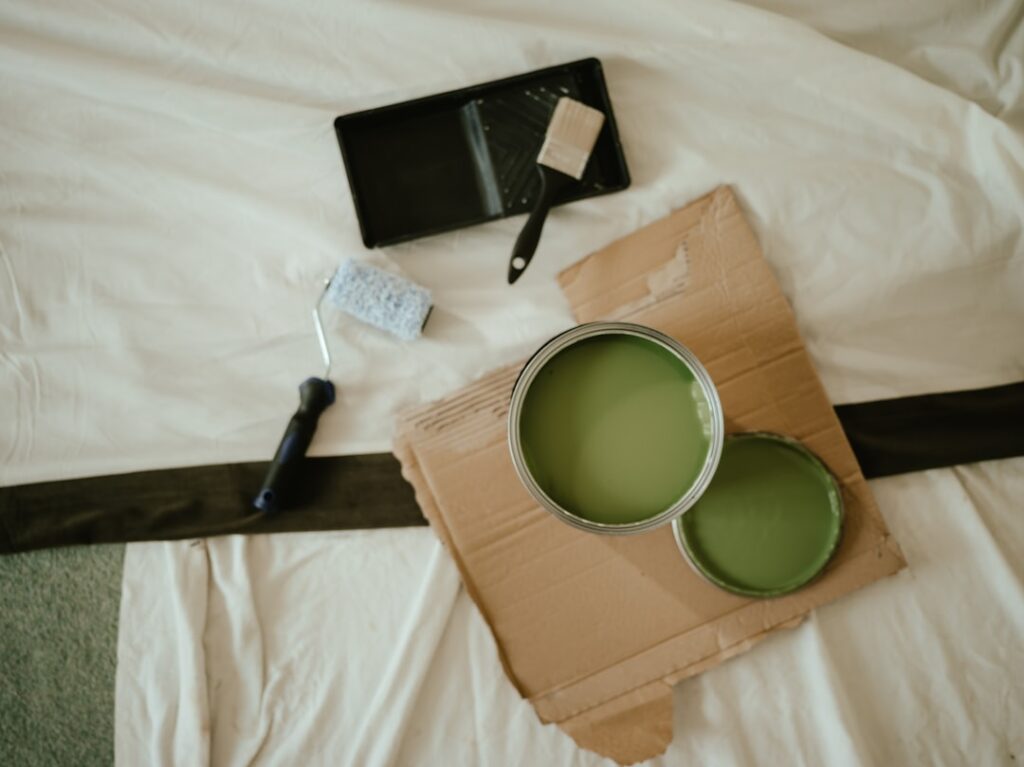
Two cans on the shelf can look nearly identical, carry the same brand, and even share a color name, yet cost different amounts and behave in completely different ways once they’re on a surface. The difference between interior and exterior paint isn’t marketing; it comes down to the resins, pigments, and additives engineered for two very different jobs. Understanding the difference between interior and exterior paint keeps you from making the two mistakes homeowners regret most: using leftover exterior paint on a bedroom wall, or stretching interior paint onto a fence or door.
Part of our Paint & Walls guide — explore the full guide →
Both are made from the same four basic ingredients: pigment, resin (binder), solvent, and additives. What changes is the recipe, and that recipe is tuned for either a stable indoor environment or a brutal outdoor one.
The Core Difference: Resin and Flexibility
The resin is the glue that binds pigment to the wall and gives the film its character. Interior paint uses rigid resins because indoor walls don’t move much; a firm film resists scuffs, scrubbing, and furniture marks. Exterior paint uses softer, more flexible resins because siding and trim expand and contract constantly as temperatures swing from freezing nights to baking afternoons.
That flexibility is the whole point outdoors. An exterior film has to stretch and shrink with the substrate without cracking or peeling. Put that soft resin indoors and it stays slightly tacky, scuffs easily, and won’t take repeated scrubbing. Put rigid interior resin outdoors and it cracks the first time the wood swells.
Additives Built for the Weather
Exterior paint carries a package of additives that interior paint simply doesn’t need, and some it legally can’t include indoors. These additives are what let a house survive years of sun and rain.
- UV stabilizers keep sunlight from breaking down the binder and fading the color
- Mildewcides and fungicides resist mold and algae in damp, shaded areas
- Water-repellent additives shed rain and moisture
- Freeze-thaw stabilizers let the film flex through temperature extremes
Many of these additives, particularly the stronger mildewcides and off-gassing agents, are the reason you should never use exterior paint indoors. In an enclosed room they release volatile compounds long after the paint feels dry, which is a genuine air-quality concern.
Pigment and Color Retention
Interior paints can use a wider range of pigments, including some organic colorants that produce vivid, saturated shades because they’ll never see direct sun. Exterior paints lean on more durable inorganic pigments that hold their color under UV exposure, which is partly why some ultra-bright exterior colors are harder to find or cost more.
This is why a deep red interior accent wall can look richer than the same nominal color on siding; the exterior version trades a bit of saturation for fade resistance. Over years outdoors, that trade keeps your house from looking chalky and washed out.
Durability and Cleanability
Each paint is tough in the way its environment demands. Interior paint is built to be washed and scrubbed, standing up to fingerprints, crayon, and kitchen splatter without wearing through. Its harder finish takes a magic eraser or a soapy sponge without burnishing.
Exterior paint is built to withstand weather rather than scrubbing. It resists rain, sun, and temperature cycling, but it’s softer, so it wouldn’t survive the daily abrasion an interior wall gets. Each is excellent at its own job and poor at the other’s.
Why You Can’t Just Swap Them
It’s tempting to use up a leftover can wherever, but the mismatch causes real problems. Here’s what actually goes wrong when you swap them:
- Exterior paint indoors: off-gasses harmful additives into your air, stays soft, scuffs easily, and can feel tacky for weeks.
- Interior paint outdoors: has no UV protection so it fades fast, no flexibility so it cracks and peels, and no mildewcide so it grows mold.
- Either in the wrong sheen: compounds the problem, since exterior formulas and interior formulas achieve gloss differently.
The one legitimate crossover is a category called interior/exterior paint, formulated to satisfy both sets of demands. It’s genuinely made for either use and is a good choice for spaces that blur the line, like a sunroom or a covered porch ceiling.
Sheen and VOC Differences
Beyond resins and additives, the two paints handle sheen and solvents differently. Interior paints come in a full ladder of sheens tuned for indoor use: flat and matte for ceilings and low-traffic walls, eggshell and satin for living spaces, and semigloss for trim, doors, and bathrooms. Each is engineered so the gloss stays uniform under indoor lighting.
Exterior paints skew toward flat and satin finishes that hide surface imperfections and expand and contract without cracking. A high-gloss exterior finish exists but is used sparingly on doors and trim. VOC content is another real difference. Interior paints are increasingly formulated as low-VOC or zero-VOC to protect indoor air quality, since you breathe the off-gassing in an enclosed space. Exterior paints can carry higher VOC levels and stronger solvents because they cure in open air, which is a further reason those exterior formulas don’t belong inside your home.
Cost and Coverage Compared
Price tracks the added technology in each can. Because exterior paint carries UV blockers, mildewcides, and flexible resins, a premium exterior gallon often costs a few dollars more than a comparable interior line, though budget grades of each exist.
Here’s how they generally compare:
- Interior paint: roughly $30 to $70 per gallon depending on grade, covering about 350 to 400 square feet per coat
- Exterior paint: roughly $35 to $80 per gallon, with coverage that drops on rough or porous siding
- Interior/exterior hybrid: priced with the exterior lines and formulated for either environment
Coverage is not just about the paint; it’s about the surface. Smooth interior drywall drinks less paint than rough cedar siding or stucco, which can cut exterior coverage by a third. When you estimate a project, always buy for the surface texture, not just the square footage, and factor a second coat, which nearly every job needs for a uniform, durable finish. Spending a little more on the correct, higher-grade paint almost always saves money over the life of the job by lasting longer and covering in fewer coats.
What About Primer?
Primer follows the same interior-versus-exterior logic as topcoat, and using the wrong one undermines an otherwise good paint job. Interior primer seals drywall, blocks stains, and gives topcoat something to grip indoors. Exterior primer is formulated to bond to weathered wood and to flex and resist moisture outdoors.
A few situations make priming non-negotiable regardless of location:
- Bare wood, new drywall, or raw masonry that would otherwise drink up topcoat unevenly
- A dramatic color change, especially painting light over dark or covering bold hues
- Stained or water-damaged surfaces that need a stain-blocking primer to seal them
- Glossy surfaces that need a bonding primer so the new paint adheres
Skipping primer on a raw or problem surface leads to blotchy coverage, poor adhesion, and premature peeling, which erases any time you thought you saved.
Reading the Label Before You Buy
Manufacturers spell out a paint’s intended use right on the can, and taking ten seconds to read it prevents the wrong-can mistake. Look for the explicit words “interior,” “exterior,” or “interior/exterior,” which tell you where the paint belongs.
Also scan for these details that signal the right product for your job:
- The intended surfaces listed, such as walls, trim, siding, or masonry.
- The sheen, from flat through high gloss, matched to the room or exterior element.
- The VOC level, important for interior air quality in bedrooms and enclosed spaces.
- Coverage per gallon and recommended number of coats for accurate estimating.
- Any mildew-resistance or UV-protection claims, which point to a true exterior formula.
When a project blurs the indoor-outdoor line, the label’s “interior/exterior” designation is your green light to use it in either place. Reading these few lines before checkout is the simplest safeguard against buying a can that will fail in the environment you need it for.
Where Each One Belongs
Matching paint to location is simple once you know the rules. Reserve interior paint for walls, ceilings, trim, and cabinets inside the conditioned envelope of your home. Use exterior paint for siding, fascia, soffits, exterior doors, fences, decks, and anything exposed to weather.
For transitional spaces, reach for a true interior/exterior product:
- Enclosed porches and three-season rooms
- Garage interiors that see moisture and temperature swings
- Basement walls prone to dampness
- Trim on a covered but unconditioned entryway
The difference between interior and exterior paint comes down to engineering for two different worlds: a stable indoor room that gets scrubbed, and a harsh outdoor surface that gets weathered. Buy the paint made for the job, respect the crossover product for in-between spaces, and your finish will last as long as it should while keeping your indoor air clean.