Cucumber vines sprawl up to 8 feet horizontally if left on the ground, and that sprawl is the single biggest reason home gardens produce small, curved, or rotting fruit. DIY trellis for cucumbers turns a 12 sq ft footprint into a vertical 36 sq ft canopy that gets twice the airflow, drops powdery mildew pressure by an estimated 40% to 60%, and yields straight fruit that hangs free of soil contact. The right build depends on whether you grow in raised beds, in-ground rows, or containers.
- Vine Behavior That Drives the Design
- Four Build Options Ranked by Cost
- Cattle Panel Arch: The Most Popular Build
- Raised Bed PVC A-Frame Plan
- Spacing and Plant Density
- Training and Pruning Through the Season
- Anchoring Against Wind
- Materials That Hold Up Past One Season
- Growing Cucumbers Vertically From Seedling to Harvest
Vine Behavior That Drives the Design
Standard slicing varieties like Marketmore 76, Straight Eight, and Diva grow vines 5 to 7 feet long and produce tendrils every 4 to 6 inches. The tendrils grab anything 1/4 inch in diameter or smaller, which is why string, twine, and welded wire all work. Pickling types like Boston Pickling, Calypso, and Pick a Bushel stay shorter at 3 to 5 feet but produce twice as many lateral shoots, so they prefer dense panel-style supports.
Bush types like Spacemaster and Bush Champion technically do not need a trellis but yield 25% to 40% more fruit on a 30 inch ring or short A-frame because the leaves stay drier.
Four Build Options Ranked by Cost
- Bamboo tepee, 6 stakes — $8 to $14 for six 6 foot bamboo poles plus jute twine, builds in 15 minutes, fits a 36 inch circle
- PVC A-frame with netting — $22 to $34 in 3/4 inch PVC, elbows, and a 5-by-6 foot nylon trellis net
- Cattle panel arch — $28 to $42 for one 16-foot 4-by-4 inch galvanized cattle panel and four rebar stakes, 4 to 5 foot wide arch
- Cedar lean-to with hog wire — $55 to $90 for two 8-foot cedar 2x2s, two cross braces, and 4-by-6 foot welded wire
Cattle Panel Arch: The Most Popular Build
The cattle panel arch has dominated garden Instagram for five seasons running for a reason — it lasts 15 to 25 years, supports any vining crop, and bends without permanent kinks. Buy a single 50-by-16 inch panel from Tractor Supply at $32, a four-pack of 24 inch rebar stakes at $18, and zip ties at $4. Total under $55.
Position the arch over two parallel rows or two raised beds spaced 4 to 5 feet apart. Push two rebar stakes 12 inches into the soil on each side, bend the panel into an arch, and secure each corner to the rebar with three zip ties. The arch tops out at 6-1/2 to 7 feet, leaving comfortable walking height underneath.
Raised Bed PVC A-Frame Plan
For a 4-by-8 foot raised bed, build an A-frame that fits inside the perimeter. Cut 3/4 inch PVC into four 6 foot uprights, two 4 foot crossbars, and two 4 foot top rails. Use four 3-way corners and two T-fittings.
- Cut all PVC with a miter saw or PVC cutter for clean ends
- Dry-fit the frame before any glue to confirm dimensions
- Glue only the bottom and top joints with PVC primer and cement
- Stretch a 5-by-6 foot nylon trellis net across one face, secure with zip ties at 8 inch intervals
- Anchor the bottom of each leg to the bed frame with a 1-1/2 inch deck screw through a pre-drilled hole
Total materials run $24 to $32 at any big-box home center. The A-frame stores flat after the season if you skip glue on the top joints.
Spacing and Plant Density
For a vertical trellis, space transplants 8 to 12 inches apart along the base. That density doubles the in-ground recommendation because the vines climb instead of competing horizontally. Pickling varieties tolerate the tighter 8 inch spacing better than slicers.
A 6 foot wide arch easily supports 12 to 16 plants — 6 to 8 on each side — and produces 80 to 140 cucumbers across an 8 to 10 week harvest window from a single planting in zones 5 through 9.
Training and Pruning Through the Season
Cucumber vines need a hand for the first 2 to 3 feet of growth. Once the main stem reaches 12 inches, loosely tie it to the support with garden twine, soft plant ties, or even strips of old t-shirt every 6 to 8 inches. After the vine reaches 30 inches, the tendrils take over and active tying stops being necessary.
Pinch off the bottom 4 to 6 lateral shoots to keep the lower stem clear of soil splash. After the main vine hits the top of the trellis, pinch the growing tip to redirect energy into fruit production rather than more vine length.
Anchoring Against Wind
Mature cucumber vines plus fruit add 8 to 14 pounds of weight to a trellis, and a 30 mph gust will topple any free-standing structure not anchored properly. For PVC and bamboo builds, drive 18 to 24 inch rebar or T-posts at least 12 inches into the soil at each base point. For cattle panel arches, the rebar stakes plus the panel weight itself create enough mass that additional anchoring is rarely needed.
In areas that see frequent thunderstorms or microbursts, add diagonal guy lines from the top of an A-frame to ground stakes 4 feet away. A pair of 3/16 inch nylon paracord lines per side handles loads up to roughly 80 pounds without stretch.
Materials That Hold Up Past One Season
Bamboo lasts 2 to 3 seasons before splitting; PVC lasts 5 to 8 seasons but yellows in UV; galvanized cattle panel lasts 15 to 25 seasons; cedar 2x2s last 5 to 10 seasons before rot starts at the soil line. If you plan to leave the structure in place year-round, cattle panel is the only material that breaks even on cost across 10 years. For seasonal builds that get stored under cover, PVC or bamboo wins on convenience and storage footprint.
Growing Cucumbers Vertically From Seedling to Harvest
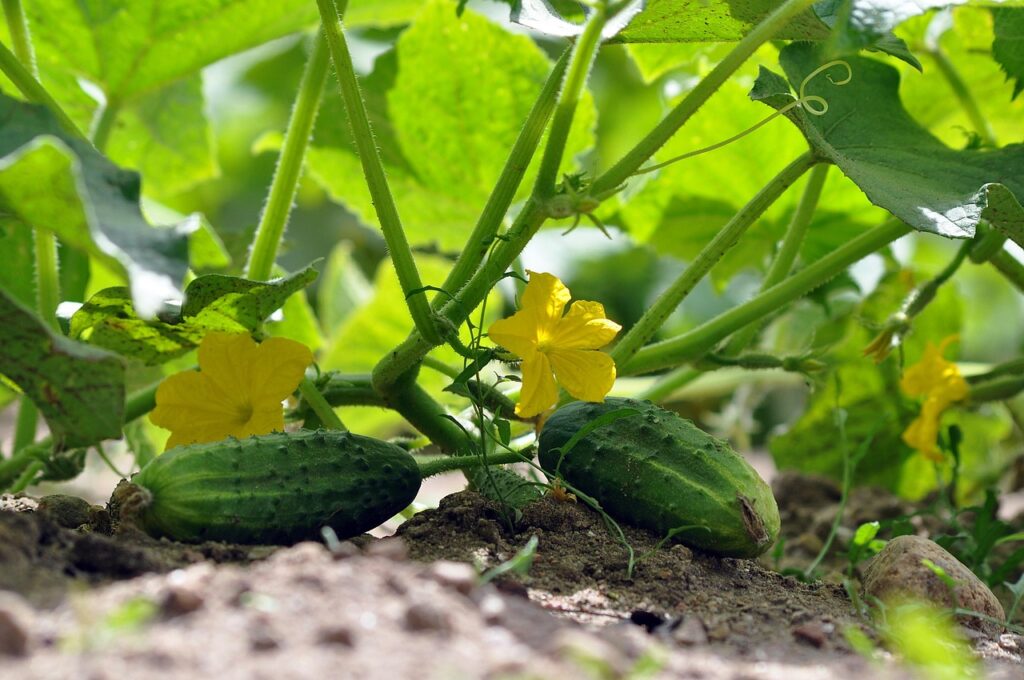
Growing cucumbers vertically keeps leaves dry, fruit clean and straight, and paths open for picking. Building the support is only half the job. How you choose the trellis style, train the vines, space the plants and carry the weight of the crop decides whether the vines climb neatly or slump into a tangle by midsummer.
Matching Trellis Types to Your Space
Vertical netting with a 4 to 6 inch grid suits long rows and the back edge of raised beds, since tendrils grab the mesh with little help. String trellises, where single lines run from a top rail down to each plant, work well in tunnels and narrow beds and make pruning to one main stem easy. Rigid welded wire panels handle heavy crops and stay put in wind. A leaning frame set at an angle lets fruit hang down on the underside, which keeps it shaded and easy to see.
Training Vines Onto the Support
Young vines often wander before they find the trellis. Once a seedling has a few true leaves, guide the main stem toward the support and clip or tie it loosely with soft ties. Check every few days for the first couple of weeks and tuck wandering tips back into the grid or wrap them gently around the string. For single-stem training on string, remove side shoots from the lowest few leaf joints so energy goes upward. On netting, leave more side shoots and let the vine spread across the panel.
Spacing for Airflow and Yield
Vertical plants can sit closer together than sprawling ones, but crowding still invites mildew. Leave enough room between plants that the leaves of neighbors overlap only lightly once mature. Keep rows far enough apart that you can walk both sides and that sun reaches the lower leaves. Mulch the base of the planting to hold moisture and reduce soil splash onto the lowest leaves.
Supporting Fruit as It Develops
Most slicing and pickling fruit hangs fine on its own, but large varieties pull on the vine as they swell. Harvest often, since overgrown fruit adds weight and slows new flowers. For heavier types, a small sling made from mesh fabric or old stretchy cloth, tied to the trellis, cradles the fruit and keeps the stem from snapping. Check the top rail and ties as the canopy fills in, because a fully loaded trellis catches more wind than it did in spring.
Common Problems on Vertical Vines
Leaves yellowing at the bottom often point to uneven watering, so water at the base on a regular schedule. Curled or bitter fruit tends to follow heat stress and dry soil. Powdery spots on leaves call for removing affected foliage and improving airflow by thinning crowded growth.