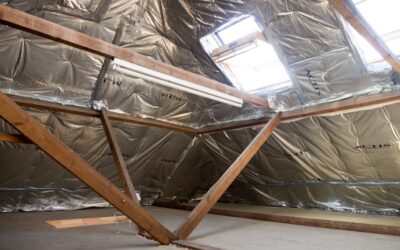
Few products in the insulation aisle generate more confusion — or more inflated claims — than the shiny rolls of double bubble insulation: two layers of polyethylene bubble film laminated between reflective foil facings, sold under names like Reflectix, US Energy Products, and SmartShield. Depending on who’s selling it, you’ll hear it called “equivalent to R-15” or dismissed as “a $150 pool float.” The truth is specific: the material itself is roughly R-1, but the foil surfaces can block a large share of radiant heat transfer — a real effect that only exists under particular conditions. This guide explains the physics honestly, names the applications where bubble wrap genuinely earns its cost, and flags the ones where it’s a waste of staples.
What Double Bubble Insulation Is
The construction is simple: two plies of air-bubble film (like heavy-duty packing wrap) bonded between layers of aluminum foil or metalized film, usually 5/16 inch thick in total, sold in rolls 16 to 48 inches wide at roughly $0.50-$0.90 per square foot. “Double” refers to the two bubble layers; single-bubble versions run thinner and cheaper. Variants come foil-both-sides, or white-poly one side for a finished interior look. The material is lightweight, staples and tapes easily, doubles as a vapor barrier (foil is Class I, near-zero perms), and doesn’t itch, shed fibers, or feed mold — the handling advantages are genuine.
The Physics: R-Value vs. Radiant Rejection
Heat moves three ways — conduction, convection, radiation — and R-value measures resistance to the first. Tested as a material, double bubble delivers about R-1 to R-1.3: two thin air films trapped in bubbles simply can’t match 3.5 inches of fiberglass at R-13. Anyone quoting R-8 or R-15 for the product alone is quoting an assembly number or fiction.
The foil is a different mechanism entirely. Polished aluminum has an emissivity around 0.03-0.05, meaning it emits and absorbs only about 3-5 percent of the radiant energy a normal building surface would (wood, drywall, and shingles sit near 0.90). Facing a radiant source across an air gap, foil rejects up to ~95 percent of that radiant transfer. The two iron rules that follow:
- The foil must face an air space — at least 3/4 inch. Sandwich foil tightly between two solids and radiation is out of the picture; heat just conducts through, and you’re back to R-1.
- It helps most where radiation dominates — under sun-baked metal roofs and doors, around hot ducts, in hot climates. In a cold, cloudy climate where conduction rules, foil contributes little.
Dust matters too: a foil surface facing up in an attic collects dust and can lose half its reflectivity within years. Face reflective surfaces down or vertically where possible. For the broader heat-transfer framework, see our thermal insulation reference.
Where Double Bubble Genuinely Works
Metal buildings and pole barns
The classic legitimate use. Rolled across the purlins before the steel roof panels go down, double bubble does three jobs at once: blocks summer radiant blast from the sun-heated steel (panel surfaces hit 140-160°F), stops condensation from dripping by keeping interior humidity off the cold metal, and adds its modest R-1. In an uninsulated shop that isn’t heavily heated or cooled, that combination transforms comfort for about $0.60 per square foot. For a conditioned shop, treat it as the radiant/condensation layer and add real R (fiberglass blanket or spray foam) for the conductive load.
HVAC ducts in hot attics
Wrapped around supply ducts with spacers preserving an air gap, foil bubble rejects radiant gain from a 130°F attic. Codes typically demand R-6 to R-8 duct insulation in unconditioned space, so bubble wrap alone doesn’t satisfy code — but as a radiant jacket over fiberglass duct wrap, or on ducts in milder spaces, it pulls real weight.
Garage doors
A west-facing steel garage door is a radiant panel aimed at your garage. Bubble-foil kits ($50-$100 per door) cut the radiant load sharply and measurably drop summer garage temperatures 8-15°F, with the foil facing the door skin across the stamped air gap. Rigid foam kits add more R for winter; bubble kits win on summer radiation, weight, and ease.
Water heater blankets, ducts, crawlspace odds and ends
Wrapping a water heater, insulating a well-house, lining a doghouse, backing radiators toward exterior walls — small jobs where a flexible, moisture-proof, modestly insulating sheet is exactly enough.
Where It’s the Wrong Product
- Wall cavities: Stapling bubble foil inside a stud bay and closing drywall over it buys about R-1 plus one dubious air gap where R-13-R-21 belongs. Batts cost the same or less per square foot and deliver ten times the R. This is the misuse that gives the product its scam reputation.
- Attic floors: Laying it over joists instead of real depth is a comfort placebo — you need R-38-R-60 of bulk insulation there; see our attic insulation guide. (A stapled-to-rafters radiant barrier in a hot-climate attic is a different, legitimate product and placement.)
- As sole insulation in heated spaces anywhere cold: Winter heat loss is conduction-driven; R-1 is R-1 no matter how shiny.
- Under slabs: Buried foil faces no air gap, so only the R-1 counts; codes want R-5-R-10 rigid foam, and rigid insulation is the correct material.
Reading the Marketing Critically
The FTC’s “R-value Rule” requires sellers to disclose tested R-values, and it has repeatedly acted against reflective-insulation sellers claiming R-6 to R-15 for foil products. The trick behind big numbers is assembly testing: measure a wall with two 3/4-inch air gaps and the bubble layer, in a downward-heat-flow condition (where trapped air films perform best), and the system might test near R-8 — then the ad quietly attributes the whole number to the wrap. Legitimate manufacturers publish tables listing R by application and heat-flow direction; the honest ones show R-1.1 for the material and assembly values only with the air spaces spelled out. If a listing says “equivalent to R-15 batts,” close the tab.
Installation Tips
- Maintain the air gap: furring strips, spacers, or the natural cavity — 3/4 inch minimum on at least one foil face.
- Seal seams with foil tape, since the product often serves as the vapor/condensation layer; unsealed laps leak humid air to cold metal.
- Keep clearance from chimneys, flues, and recessed lights — polyethylene bubbles melt around 200°F and the product is combustible despite the metallic look.
- On roof purlins, stretch modestly and let panels compress it; oversagging traps water paths at the eaves.
Cost Comparison at a Glance
To put the value question in numbers: double bubble at $0.60 per square foot delivering R-1 costs about $0.60 per unit of R. R-13 fiberglass batts at $0.65 per square foot cost five cents per R. Even closed-cell spray foam at $1.20 per square foot per inch (R-6.5) comes in under $0.20 per R. Bought as R-value, bubble foil is the most expensive insulation in the store by a factor of ten — which is precisely why it should only ever be bought as a radiant barrier and condensation layer, jobs the fiberglass can’t do and where the foil’s $0.60 buys performance no R-number captures.
FAQ
What is the actual R-value of double bubble insulation?
About R-1 to R-1.3 for the material. Assembly values with proper air gaps can reach R-3 to R-8 depending on orientation, but those belong to the air spaces as much as the product.
Is double bubble insulation worth it?
Yes for metal roofs, pole barns, garage doors, and duct jackets — anywhere a hot surface radiates across an air gap and condensation control matters. No as a substitute for bulk insulation in walls, attics, or any heavily heated space.
Which side should the foil face?
Toward the radiant source across an air gap — toward the roof deck or door skin in summer-dominated uses. With foil on both sides, orientation matters less; the air gap is what you must protect.
Bottom line: double bubble is an honest R-1 radiant barrier and vapor layer masquerading, in some listings, as a miracle. Use it where radiation and condensation are the enemies, pair it with real bulk insulation where conduction is, and it’s a cheap, durable tool instead of a shiny regret.