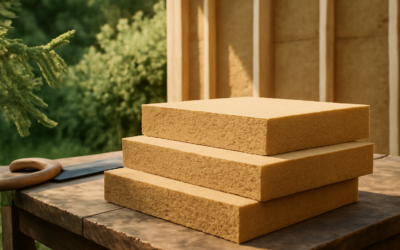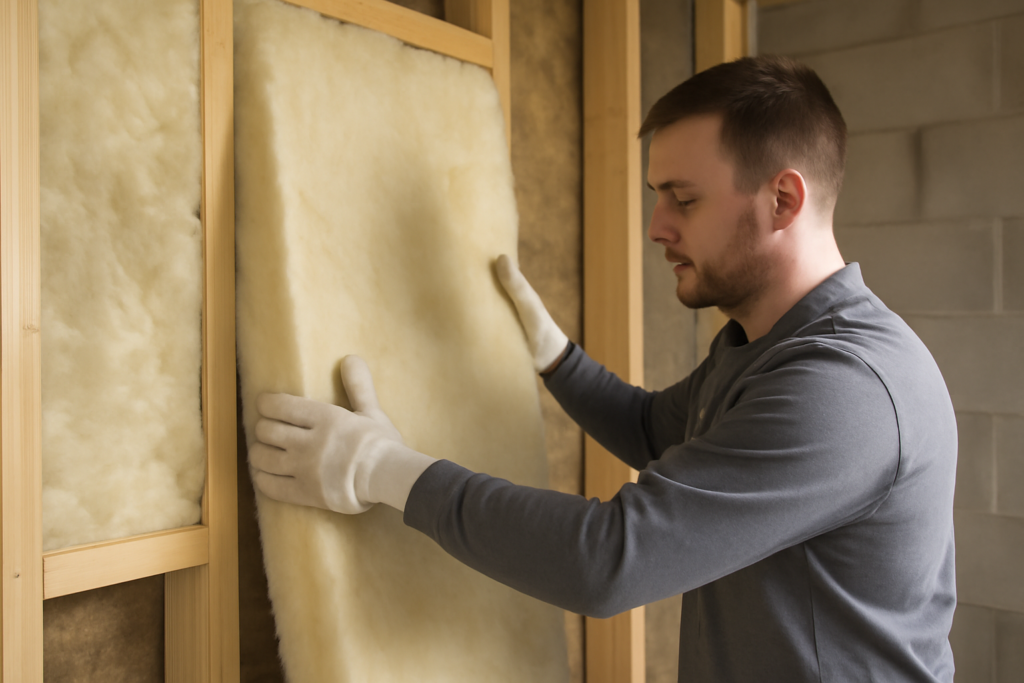
Every product in the insulation aisle — pink batts, foam boards, silver bubble wrap, shredded newspaper — is solving the same physics problem in a different way. Thermal insulation works by slowing the three mechanisms that move heat: conduction, convection, and radiation. Once you understand which mechanism each material targets, the whole confusing marketplace snaps into focus, R-value claims become easy to evaluate, and choosing the right product for a wall versus an attic versus a duct becomes almost automatic. This is the reference piece: the physics in plain English, the metrics that matter, and a map of where each insulation type belongs.
The Three Ways Heat Moves
Conduction
Conduction is heat passing through solid material by direct molecular contact — the reason a metal spoon in hot coffee burns your hand. Materials conduct at wildly different rates: aluminum conducts about 8,000 times better than still air. That’s the central trick of almost all bulk insulation: fiberglass, cellulose, mineral wool, and foam are mostly trapped air (or gas) held in millions of tiny pockets, using a small amount of solid material to immobilize a large amount of poorly conducting gas.
Convection
Convection is heat carried by moving air or liquid. Inside an empty wall cavity, air warms against the inner face, rises, cools against the outer face, and sinks — a conveyor belt for heat. Bulk insulation kills this loop by breaking the cavity into pockets too small for meaningful circulation. Convection is also why air sealing matters as much as insulation: a 1/8-inch gap around a can light lets warm air bypass an R-49 attic entirely.
Radiation
Radiation is heat traveling as infrared energy through space — how the sun warms your face and how a 150°F roof deck cooks the attic below it without touching it. Radiant heat doesn’t care about trapped air; it’s blocked by reflective, low-emissivity surfaces. This is the niche of foil-faced products and radiant barriers, covered honestly in our double bubble insulation review — reflectives are real physics often wrapped in inflated marketing.
R-Value and U-Value, Decoded
R-value measures resistance to conductive heat flow: higher is better, and values add — two R-15 layers make R-30. U-value (or U-factor) is the inverse (U = 1/R) and measures how much heat passes through; lower is better, and it’s the standard metric for windows because glass assemblies are rated as whole units. Rules of thumb worth memorizing:
- R-value is per product, not per material class — check the label, not the aisle sign.
- Doubling R-value halves conductive loss, but with diminishing absolute returns: going from R-2 to R-10 saves far more energy than R-30 to R-38.
- Installed R rarely equals labeled R. Compression, gaps, and thermal bridging through studs (a 2×4 is only about R-4.4) drag a nominal R-13 wall down to roughly R-10 whole-wall performance.
- Radiant barriers have no meaningful R-value themselves; they reduce radiant gain, a different quantity that only matters facing an air gap.
The Main Types of Thermal Insulation
| Type | R per inch | Cost | Best at |
|---|---|---|---|
| Fiberglass batts | 3.1-4.3 | $ | Open walls, floors, DIY attics |
| Blown fiberglass | 2.2-2.7 | $ | Attic floors, topping up |
| Blown cellulose | 3.2-3.8 | $ | Attics, dense-pack retrofit walls |
| Mineral wool | 3.8-4.3 | $$ | Fire/sound walls, exterior boards |
| EPS/XPS/polyiso rigid foam | 3.8-6.5 | $$-$$$ | Basements, sheathing, rim joists |
| Open-cell spray foam | 3.5-3.7 | $$$ | Air-sealing complex framing |
| Closed-cell spray foam | 6.0-7.0 | $$$$ | Rim joists, crawlspaces, thin cavities |
| Radiant barrier/reflective | ~0 (blocks radiation) | $ | Hot-climate attics, ducts, garage doors |
Fiberglass and cellulose are the volume players — cheap trapped air for big cavities. Mineral wool adds fire resistance (it withstands 2,000°F) and meaningful acoustic mass; it also stars in sound insulation assemblies. Rigid foam boards bring high R in thin profiles plus moisture tolerance, which is why rigid insulation owns basements and exterior continuous-insulation layers. Spray foams are the premium option because they insulate and air-seal in one pass — closed-cell even doubles as a vapor retarder and adds structural stiffness.
Matching Insulation to the Assembly
- Attic floor: Blown cellulose or fiberglass to R-38-R-60 depending on climate zone. Cheapest R in the house and usually the best payback. Air-seal the ceiling plane first.
- 2×4 / 2×6 walls: R-13/R-15 and R-19/R-21 batts, or dense-pack cellulose in closed retrofit walls. Colder zones add exterior rigid foam to break stud bridging.
- Basement walls: Rigid foam or closed-cell foam against concrete — never bare fiberglass, which wicks moisture and molds.
- Rim joists: Closed-cell spray foam or cut-and-sealed rigid foam blocks; this leaky band is a top-five heat loss site.
- Crawlspaces: Either insulate the floor above with batts or, better in most climates, insulate the walls and seal the ground with a vapor barrier.
- Ducts in unconditioned space: Wrapped fiberglass duct insulation, R-6 to R-8, seams sealed with mastic before wrapping.
- Windows: The weakest links at U-0.25-0.50 (R-2 to R-4 at best); see window insulation for the film, cellular-shade, and sealing options that help.
How Much Insulation Do You Need?
The IECC climate-zone map sets the floor. Broad strokes for existing homes: attics want R-38 in the Deep South, R-49 in the middle of the country, and R-49 to R-60 in the north; walls want R-13 to R-21 in-cavity; floors over unconditioned space R-19 to R-30. New construction codes push higher. The economic answer differs from the code answer: if your attic currently has R-11, almost any topping-up pays back in a handful of years; if it already has R-38, chasing R-60 pays back slowly and your money works harder on air sealing and duct sealing.
The Mistakes That Waste Insulation
- Insulating without air sealing. Fibrous insulation filters moving air; it doesn’t stop it. Caulk and foam the ceiling penetrations before burying them.
- Compressing batts. Cramming an R-19 into a 3.5-inch cavity yields about R-13. Fluff to full loft, cut around wires, don’t stuff.
- Leaving gaps. A 5 percent void in a wall can cut effective R-value by 20 percent or more because heat funnels through the bypass.
- Blocking ventilation. Attic insulation jammed into the eaves suffocates soffit vents; baffles preserve the airflow path.
- Ignoring vapor rules. Where the vapor retarder goes depends on climate — get it wrong and insulation traps condensation. The placement rules live in our vapor barrier insulation guide.
Prioritizing Upgrades: Where the Money Works Hardest
If you’re improving an existing house rather than building, sequence matters more than material. The standard priority ladder, ranked by dollars saved per dollar spent: air sealing the attic plane and rim joist first ($200-$600 in materials, often 10-15 percent off the energy bill by itself); attic insulation to zone target second (the machine-blown afternoon that pays back in 3-8 years); duct sealing third if ducts run through unconditioned space (leaky ducts waste 20-30 percent of system output in typical homes); then basement/crawlspace walls; and dense-packing closed walls last, because it’s the most invasive per R gained. Windows sit at the bottom of the payback list despite being the most-marketed upgrade — replacing a whole house of windows to gain R-2 costs more than every item above it combined. An energy audit with a blower door ($150-$500, often rebated) turns this generic ladder into a house-specific one.
FAQ
What is the best thermal insulation?
There’s no single best — closed-cell spray foam has the highest common R per inch (R-6 to R-7) and air-seals, but blown cellulose at a third of the price is “best” for an open attic floor. Match the material to the assembly and moisture conditions.
Does thermal insulation work in summer?
Yes — heat flow is direction-agnostic. The same R-49 attic that holds furnace heat in January resists 130°F attic heat in July. Radiant barriers add summer-specific value in hot climates by rejecting roof radiation.
How long does insulation last?
Fiberglass and mineral wool effectively last the life of the house if kept dry; cellulose settles about 15-20 percent (accounted for in coverage charts); foams are stable for decades though polyiso loses a little R as blowing agents diffuse out. Moisture and rodents, not time, are what kill insulation.
Slow conduction with trapped air, stop convection with air sealing, reflect radiation where the sun hammers — every good insulation decision is one of those three moves, sized to your climate zone.