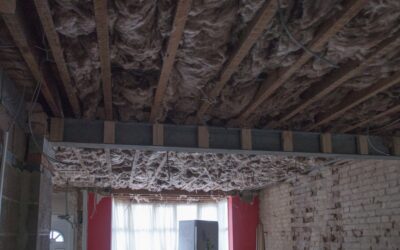
A standard interior wall does almost nothing to stop your neighbor’s TV, a teenager’s bass, or footsteps overhead. Effective sound insulation is not one product — it is a system built from four principles: mass, absorption, decoupling, and damping. Get all four working together and you can take a wall from “hear every word” to “faint murmur.” Skip one and you’ll wonder where your money went. This guide covers how sound ratings actually work, which materials earn their cost, and the proven assemblies for walls, floors, and ceilings.
- Understand STC Ratings Before You Buy Anything
- The Four Elements of Sound Control
- Mineral Wool vs Fiberglass for Sound
- Mass-Loaded Vinyl (MLV)
- Resilient Channel and Isolation Clips
- Proven Wall Assemblies, Ranked
- Floors and Ceilings: Fighting Impact Noise
- Mistakes That Waste Money
- Sound Insulation FAQ
Understand STC Ratings Before You Buy Anything
Sound Transmission Class (STC) measures how well an assembly blocks airborne sound — voices, music, TV. Higher is better, and the scale is roughly logarithmic, so small numbers mean big differences:
- STC 30-34: A basic 2×4 wall with 1/2″ drywall on each side. Normal speech is clearly understood through it.
- STC 38-42: Loud speech audible but muffled. Adding insulation in the cavity gets a standard wall here.
- STC 45-50: Loud speech barely audible. Code minimum for multifamily party walls is STC 50.
- STC 55-60+: Most sounds inaudible; only heavy bass gets through. Achievable with double drywall, decoupling, and damping compound.
For floors and ceilings there is a second number: IIC (Impact Insulation Class), which measures footfall and impact noise. A ceiling can have excellent STC and terrible IIC — that thumping from upstairs is structure-borne, and no amount of fluffy insulation alone will fix it.
The Four Elements of Sound Control
1. Mass
Heavy things block sound. Doubling drywall from one layer of 1/2″ to two layers of 5/8″ Type X adds roughly 3-5 STC points by itself. Drywall is the cheapest mass you can buy — about $12-18 per 5/8″ sheet — so a second layer is almost always the first upgrade worth making.
2. Absorption
Insulation inside the cavity soaks up the sound energy bouncing between the two faces of the wall. This is where mineral wool and fiberglass come in — more on the matchup below. Absorption alone adds about 3-6 STC points to an empty wall.
3. Decoupling
Sound travels through solid connections. If the drywall on both sides screws into the same studs, vibration passes straight through the framing. Breaking that path — with resilient channel, sound isolation clips, or double-stud framing — is the single biggest STC gain available, often 8-12 points.
4. Damping
Viscoelastic compounds like Green Glue (about $17-20 per tube, two tubes per 4×8 sheet) go between two layers of drywall and convert vibration into trace amounts of heat. Independent lab tests show damped double-layer assemblies picking up 5-9 STC points over undamped ones, with the biggest gains at bass frequencies where walls are weakest.
Mineral Wool vs Fiberglass for Sound
Both work, and neither is the magic bullet marketing suggests. The honest comparison:
| Factor | Mineral Wool (Rockwool Safe’n’Sound) | Fiberglass Batts |
|---|---|---|
| Density | ~2.5 lb/cu ft | ~0.5-1.0 lb/cu ft |
| STC contribution in a wall | +5-6 points | +4-5 points |
| Cost per sq ft (2×4 cavity) | $1.00-1.40 | $0.40-0.70 |
| Fire resistance | Excellent (non-combustible to ~2,150°F) | Good (melts at lower temps) |
| Handling | Rigid, friction-fits, cuts with bread knife | Floppier, itchier to work with |
In lab tests the difference between the two in an otherwise identical wall is usually 1-2 STC points. Mineral wool is denser, easier to fit tightly, and better in fire — but if budget is tight, spend the difference on a second drywall layer or Green Glue instead. An over-stuffed cavity actually hurts performance; the insulation should fill the cavity without compression. If you’re insulating anyway for thermal reasons, see our mineral wool insulation guide for R-values and sizing.
Mass-Loaded Vinyl (MLV)
MLV is a limp, heavy vinyl sheet — typically 1 lb per square foot at 1/8″ thick — that adds mass without adding stiffness. Stapled over studs before drywall, a 1-lb layer adds roughly 5-6 STC points. It costs $1.50-2.50 per square foot, which makes it one of the pricier options per point of improvement. Where MLV genuinely shines is in tight spots where you can’t add thickness: wrapping ducts and pipes, lining a media closet, or upgrading a door. For a full wall, two layers of drywall with Green Glue usually beats MLV on cost per decibel. Never sandwich MLV directly between two drywall layers — it needs to hang limp to work.
Resilient Channel and Isolation Clips
Resilient channel (RC-1) is a springy metal strip screwed perpendicular to studs or joists; drywall then screws to the channel, never touching the framing. Done correctly it adds 8-10 STC points for about $0.50-0.75 per square foot. The catch: it is easy to ruin. One drywall screw that reaches through into a stud “short-circuits” the channel, and hanging a heavy shelf later does the same. Use 25-gauge channel from a reputable manufacturer — thin big-box knockoffs perform noticeably worse.
Sound isolation clips with hat channel (Whisper Clips, IsoMax, RSIC-1) are the more foolproof, better-performing upgrade. Clips run $4-8 each, spaced roughly 48″ apart on studs 24″ on center, and typically deliver 12-15 STC points of improvement plus meaningful low-frequency gains. Budget $1.50-2.50 per square foot for a clip system. For a serious home theater or a bedroom against a noisy party wall, clips are worth every dollar.
Proven Wall Assemblies, Ranked
- Budget (~STC 44-46): Existing wall + mineral wool in cavity + second layer of 5/8″ drywall with Green Glue. About $2.50-3.50/sq ft in materials.
- Better (~STC 52-56): Single stud wall, insulation, clips and hat channel one side, double 5/8″ drywall with Green Glue. About $4-6/sq ft.
- Best (~STC 60+): Double-stud or staggered-stud wall with a 1″ gap, insulation in both cavities, double damped drywall both sides. Eats 3-4″ of floor space but bass barely gets through.
Floors and Ceilings: Fighting Impact Noise
Airborne fixes help ceilings, but footfall needs different medicine. Attack it from above if you can: carpet with a heavy pad is the single most effective impact treatment, raising IIC by 20+ points. From below, the winning ceiling assembly is insulation in the joist bays, isolation clips and hat channel, then two layers of 5/8″ drywall with damping compound. Skip recessed can lights if possible — every ceiling penetration leaks sound; if you must have them, use shallow surface-mount LEDs and seal around the boxes with acoustical caulk.
Squeaks and flanking through gaps undo good work fast. Seal the drywall perimeter, outlet boxes, and any penetrations with acoustical sealant (about $8-12 per tube) — a 1% gap in a wall’s area can cut its effective performance by 10 STC points or more. The same airtightness logic that drives window insulation applies here: air paths are sound paths. Doors matter too; a hollow-core door in an otherwise good wall caps the whole room around STC 25. Swap to a solid-core slab and gasket it like an exterior door, sweep included.
Mistakes That Waste Money
- Foam mattress-style panels for blocking sound. Acoustic foam treats echo inside a room; it does almost nothing to stop sound passing through a wall.
- “Soundproof paint.” A few mils of coating cannot add meaningful mass. Ignore it.
- Insulation alone. Filling a cavity in a bare stud wall gets you 3-6 points — real, but it will not silence a home theater. Pair it with mass and decoupling.
- Rigid connections after decoupling. Crown molding screwed through to framing, long screws, or a ceiling fan brace can bridge a decoupled assembly.
- Ignoring flanking paths. Sound routes around a great wall through shared subfloors, HVAC ducts, and back-to-back outlets.
Sound Insulation FAQ
How much does it cost to soundproof a room?
A 12×12 bedroom treated with cavity insulation, damped double drywall, and sealed penetrations runs roughly $800-1,500 in materials DIY. Add clips and channel on the worst wall or ceiling and you’re at $1,500-2,500. Contractor pricing typically lands between $3,000 and $8,000 depending on assembly.
Does sound insulation help with bass?
Bass is the hardest frequency range to stop because long wavelengths shrug off light assemblies. Damping compound and decoupling help most; absorption and MLV help least. For a subwoofer-heavy theater, plan on a clip-and-channel ceiling and double damped drywall at minimum.
Can I soundproof without removing drywall?
Yes — the damped second layer is designed for exactly that. Screw 5/8″ drywall with Green Glue directly over the existing wall, seal the perimeter, and expect a 5-8 point improvement. Blown-in dense-pack insulation can be added to empty cavities through small holes for a few extra points.
Sound insulation rewards system thinking. Decide on your target — conversation privacy is cheap, theater-grade isolation is not — then build mass, absorption, decoupling, and damping into the same assembly, and seal every last gap.