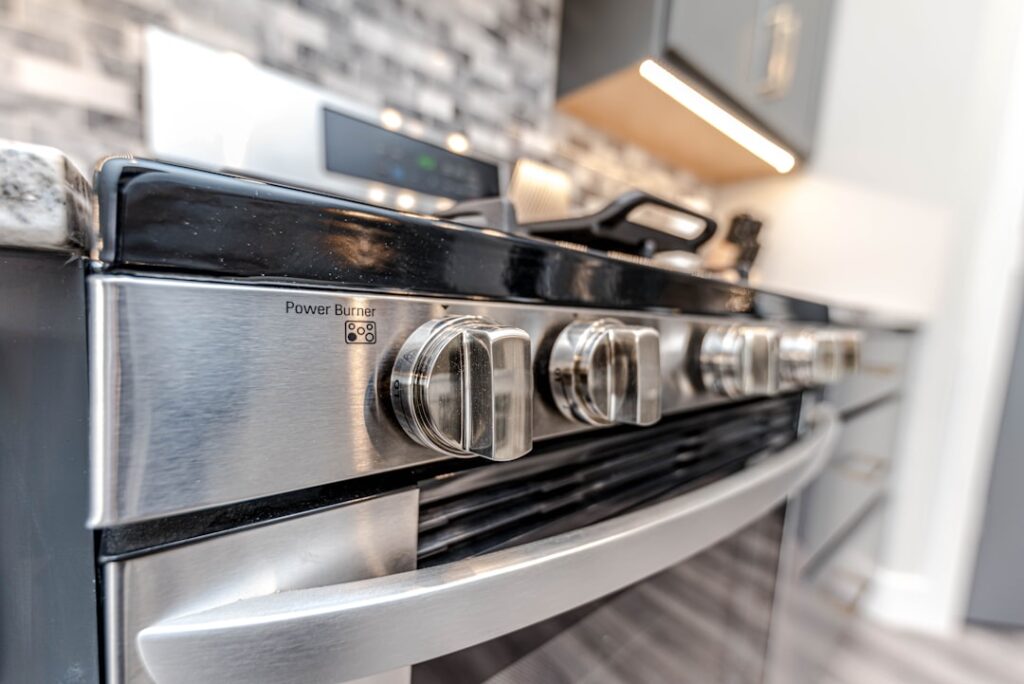
A double oven gas range gives you two separate baking cavities in the same 30-inch footprint as a standard stove, which is why it has become the go-to upgrade for anyone who cooks big meals. Picking the right double oven gas range comes down to a handful of specs — burner BTU output, cavity sizes, convection, and how it hooks up to your gas line — and this guide walks through all of it, including the safety steps that keep a gas install from going wrong.
- How a Double Oven Gas Range Works
- BTU Output: What the Burners Should Deliver
- Single Oven vs. Double Oven: Trade-offs
- Convection and Other Features Worth Paying For
- Top Brands and What They Cost
- Gas-Line and Installation Safety
- Don’t Forget the Anti-Tip Bracket
- Clearances and Ventilation
- Measuring Before You Buy
- Maintenance That Extends Its Life
- Is It the Right Choice for You?
I’ve installed and serviced these ranges for years. They’re fantastic when matched to the right kitchen, and a headache when someone buys on looks alone and ignores the gas and clearance requirements. Let’s get you the former.
How a Double Oven Gas Range Works
Instead of one large cavity, you get two: typically a smaller upper oven around 2.5 cubic feet and a larger lower oven near 4 cubic feet, for a combined capacity of roughly 6.5 to 6.9 cubic feet. The point is flexibility — roast a turkey in the big oven at 325°F while the small one holds a pie at 375°F. The smaller cavity also preheats faster and uses less gas for everyday tasks like reheating or baking a single sheet of cookies.
Most freestanding models are 30 inches wide to drop into a standard cutout. Slide-in versions sit flush with your counters for a built-in look, usually at a higher price.
BTU Output: What the Burners Should Deliver
Burner power is measured in BTU per hour, and it’s the number that separates a range that sears from one that simmers weakly. A well-rounded cooktop gives you a mix:
- Power/output burner: 15,000 to 18,000 BTU for fast boiling and hard searing. Premium ranges push 20,000 BTU.
- Standard burners: 9,000 to 12,000 BTU for everyday cooking.
- Simmer burner: 5,000 BTU or lower for melting chocolate or holding a delicate sauce without scorching.
Don’t just chase the biggest number. A cooktop that’s all 18,000-BTU burners and no true low simmer is frustrating for sauces. Look for range — a strong high burner and a genuine low one.
Single Oven vs. Double Oven: Trade-offs
The upside is obvious: two temperatures at once, less energy wasted heating a giant cavity for a small dish, and faster preheats up top. The trade-off is that neither cavity is as tall as a single large oven. A tall roasting pan or a commercial sheet pan may not fit the upper oven, and very large items can be tight even in the lower one. Measure your biggest roasting pan and holiday cookware before you commit. If you routinely cook one enormous turkey rather than several medium dishes, a single large oven might serve you better.
Convection and Other Features Worth Paying For
True convection with a third heating element and a rear fan gives you even browning and lets you bake on multiple racks at once — worth the upgrade if you bake often. Other features I’d actually pay for:
- Continuous cast-iron grates that let you slide heavy pots across the cooktop without lifting.
- Sealed burners that trap spills on the surface for easy wiping instead of dripping into the burner box.
- A reliable self-clean cycle (pyrolytic), though run it only when you can ventilate — it hits 800°F to 900°F and gets smoky.
- A cast-iron griddle or center oval burner if you cook pancakes and bacon in volume.
Top Brands and What They Cost
Expect to spend $900 to $1,400 for a solid mainstream double oven gas range, and $1,800 to $3,000-plus for premium. The common players:
- Whirlpool and Maytag: dependable mid-range workhorses, easy to get parts for, often $1,000 to $1,300.
- GE and GE Profile: wide feature range, good convection options, $1,000 to $1,900.
- Samsung and LG: feature-rich with smart connectivity and strong cooktops, $1,100 to $1,900.
- KitchenAid: a step up in fit and finish, $1,700 to $2,500.
- Café and premium lines: $2,500 and up for design-forward kitchens.
Gas-Line and Installation Safety
This is the part people skip, and it’s the part that matters most. A gas range connects to your home’s gas supply, and mistakes here cause leaks, fires, and carbon monoxide. Read this before you buy:
- Gas hookups often require a licensed professional and a permit. Many jurisdictions legally require a licensed plumber or gas fitter to connect the line and pull a permit. Check your local code before assuming it’s a DIY job.
- Use a new flexible connector. Never reuse an old gas connector. Install a new, correctly rated stainless steel flex line and a shutoff valve you can reach.
- Leak-test every joint. After connecting, brush a soap-and-water solution over each fitting and watch for bubbles with the gas on. Bubbles mean a leak — shut the gas off immediately and reseal.
- Know the smell. If you ever smell gas (a rotten-egg odor), do not flip any switch or light anything. Shut off the supply, leave, and call the gas company from outside.
- Install a carbon monoxide detector near the kitchen. Gas ranges produce CO, and a working detector is non-negotiable.
- Confirm the gas type. Ranges ship configured for natural gas; converting to liquid propane requires the included LP conversion kit and re-jetting the burners. Do not run a range on the wrong gas.
Don’t Forget the Anti-Tip Bracket
Every freestanding range ships with an anti-tip bracket, and it must be installed. This L-shaped metal bracket screws into the floor or rear wall and catches a leg of the range so it can’t tip forward when weight is applied to an open oven door. A child climbing on the door, or even a heavy pan on the door edge, can flip an unsecured range — it’s a documented cause of serious injuries. Installation takes ten minutes and a couple of screws. If you inherit a range, check that the bracket is there and engaged; slide the range out and confirm a rear leg sits inside the bracket.
Clearances and Ventilation
Leave the manufacturer-specified clearance to combustibles — usually the cabinet cutout is 30 inches wide with specific gaps to side walls. You’ll want a range hood rated for gas cooking; figure at least 100 CFM per 10,000 BTU of total cooktop output, so a range topping 40,000 BTU wants a hood moving 400 CFM or more, vented outside rather than recirculating. Good ventilation clears combustion byproducts, grease, and moisture, and it’s part of a safe gas kitchen.
Measuring Before You Buy
Nothing kills a delivery day faster than a range that won’t fit. Standard freestanding models are 30 inches wide, about 36 inches tall to the cooktop, and 25 to 28 inches deep before the handles. Measure the cabinet opening at its narrowest point, and don’t forget to check that the range will clear the doorway and any tight kitchen turns on the way in. Confirm where your gas shutoff and 120V outlet sit behind the cutout — gas ranges still need a standard electrical outlet for the igniters, clock, lights, and convection fan, so a total power outage means no oven even though the fuel is gas. Leave yourself a few inches of slack in the supply line so the range can slide out for cleaning and service.
Maintenance That Extends Its Life
A gas range is simple to keep running. Wipe sealed burners after spills so food doesn’t bake onto the caps, and pull the grates and burner caps for a soapy soak every couple of weeks. If a burner won’t light or clicks repeatedly, the igniter port is usually clogged — clear it with a straightened paperclip or a needle once the burner is cool and dry, never while lit. A yellow, lazy flame instead of a crisp blue cone means the air-to-gas mix is off or the port is dirty; a proper flame burns blue and steady. Keep the oven’s igniter in mind too: a weak oven igniter that glows but takes too long to light the burner is the most common oven failure on these ranges, a $40-to-$90 part that a handy owner can replace.
Is It the Right Choice for You?
A double oven gas range earns its keep for anyone who entertains, bakes and roasts at the same time, or wants faster preheats for small dishes. If you only ever cook one big item at a time, a single-cavity range gives you more usable height for the money. Match the burner BTUs to how you cook, budget for a licensed gas hookup if your code requires it, install the anti-tip bracket, and vent it properly — do that, and you’ll have a versatile workhorse at the center of your kitchen for the next 15 years.